
A decision by Syria’s Ministry of Information, affiliated with the transitional government, to ban three media platforms from operating inside the country has triggered a wave of criticism and sharp reactions, amid accusations that the ministry is using administrative pretexts to restrict media activity.
While the government insists the measure is legal and related to licensing, the targeted platforms believe the decision has political dimensions and targets critical voices. As the dispute escalates, journalistic bodies have offered to mediate to resolve the ongoing issue.
Details of the official decision and the ministry’s statements
The Ministry of Information decided to ban the platforms “Hashtag,” “Jusoor News,” and “Al-Dalil” from operating inside Syria for failing to obtain the required licenses from the General Directorate of Press and Media Affairs, based on Circulars No. 18 and 57 of 2025.
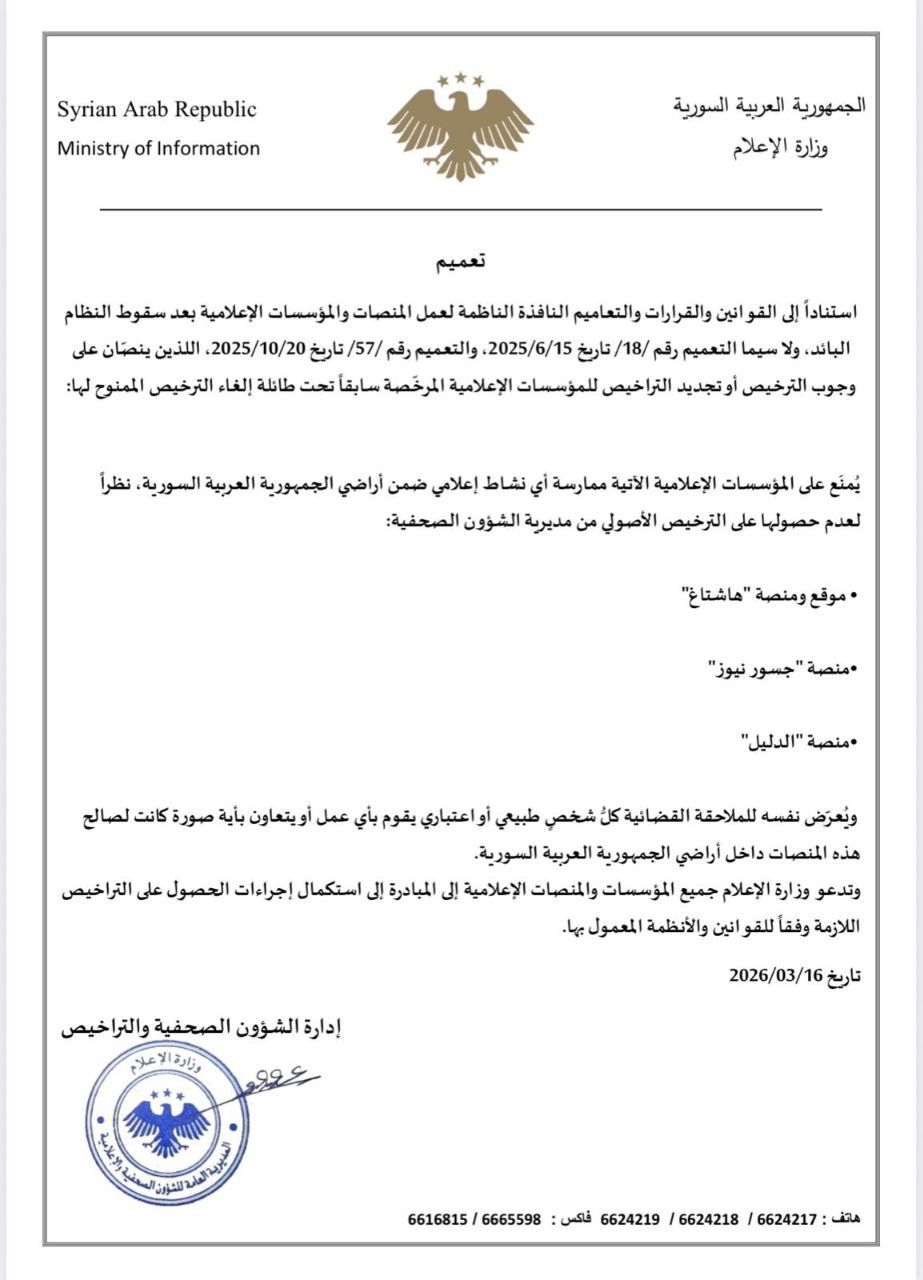
The ministry explained that the decision falls within the laws and regulations in force after the fall of the former regime, which require media institutions to obtain new licenses or renew their existing ones, or risk having their licenses revoked.
It also warned that any person or entity cooperating with these platforms inside Syria could face legal action.
In an official comment, Assistant Minister of Information Obada Koujan said that the “Hashtag” platform refused to obtain the new license, even though it had previously been licensed only during Bashar al-Assad’s rule. He added that “Jusoor News” submitted an application “without completing the required documents,” while the “Al-Dalil” platform did not submit any application at all.
Koujan added, justifying the decision, that the matter is “purely administrative,” asking: “Is there media in France without a license?” He said the ministry has not yet addressed the “misleading content” that warrants accountability.
https://t.co/AdCK7wjfeZFor his part, Assistant Minister of Information for Content Affairs Abdullah al-Mousa said that the ministry is monitoring platforms that “engage in media disinformation and frequently publish fake news,” noting that some institutions responded to the ministry’s observations, while others refused “even to submit a licensing application.”
Rejection of the decision and accusations of arbitrariness and defamation
The decision was met with rejection and condemnation from the targeted platforms, which considered it an arbitrary measure with a political rather than legal character.
The “Hashtag” platform issued a lengthy statement rejecting the decision “in its entirety,” describing the move as a “security-political measure aimed at closing down the public sphere again.” It said it has been an established institution since 2014 and holds an official license that is still valid, in addition to legal licenses in London and Dubai.
The platform accused the ministry of presenting a “misleading” picture of its legal status, noting that it had submitted its files since the new authorities took power, but that the ministry “lost the file,” despite continued communication to complete the procedures. It also denied accusations of incitement and spreading hatred, stressing that no evidence had been provided.
It revealed that the decision came as part of a gradual tightening, preceded by an incident in which its team was prevented from covering the “Bab Touma” sit-in two days before the circular was issued. It announced the temporary suspension of its operations inside Syria while continuing to work from abroad, while maintaining its right to oppose the authorities.
“Jusoor News,” meanwhile, also denied the accuracy of what was stated in the ministry’s statement, confirming that it had obtained a valid temporary permit renewed monthly and that it had completed all the documents required to obtain the license.
Its editor-in-chief, Hdeel Oueis, said the platform’s inclusion in the decision amounted to “defamation,” exposing its team to legal and on-the-ground risks, especially after receiving threats, including death threats, following the issuance of the circular.
She indicated that the ministry had been granting it permits continuously and that it had previously received verbal assurances that it was “licensed,” expecting the issue to be resolved soon.
For its part, the “Al-Dalil” platform announced the temporary suspension of its work inside Syria until its legal status is settled, while continuing to operate from abroad. It noted that most of its activity had been carried out with the ministry’s knowledge and with temporary approvals, and that completing the licensing process requires difficult financial and logistical steps, such as paying $1,000 and renting an office in Syria.
The Journalists Association offers mediation
Amid the dispute, the Syrian Journalists Association called for the formation of an independent professional committee including representatives of journalistic bodies and media institutions to separate the administrative aspects related to licensing from editorial disputes.
The association stressed the need to distinguish between an individual journalist’s eligibility to practice the profession and the legal status of the institution, warning that conflating the two leads to confusion in the media environment. It also emphasized the importance of adopting a “flexible approach” that grants institutions additional time to regularize their status, while guaranteeing their right to legal objection, warning that any measures should not negatively affect journalists’ safety or rights.
It expressed its readiness to play the role of a professional mediator to bring viewpoints closer together, calling for solutions based on dialogue instead of escalatory measures.
Accusations of restricting the public sphere
In parallel with the official dispute, activists and media figures argued that the decision cannot be separated from a broader context of tension between the authorities and critical media outlets, considering that it contributes to deepening division within Syrian society.
They cited previous criticism published by the “Hashtag” platform on sensitive issues, such as the controversy surrounding the “Bab Touma” sit-in and decisions related to public freedoms, arguing that such coverage may be behind its targeting.
According to these views, the problem is not limited to the existing division, but extends to what is seen as an increasing role by the authorities in fueling it, through controversial decisions or by narrowing the space for media pluralism, at a time when Syrians are facing complex economic and political crises.
- How the Houthis Are Choking Yemen’s Peace Efforts with a Broad Escalation on the Ground
- Economy in the Wind: How Yemenis Are Paying the Price of Disrupted Shipping Routes
- Houthi Summer Centers: Factories for Indoctrination and Raising a “Scream” Generation
- The “Coalition of Necessity”: What Costa Rica’s Terrorism Designation of the Houthis Signifies
- Mojtaba Khamenei Runs Iran from His Bed as Photos Vanish and the Supreme Leader Makes a “Voice-Only” Appearance