In a text message sent via WhatsApp, Ahmad asks whether anyone can confirm that the road to his home is free of any “basta.” It is just past midnight, and the 25-year-old Syrian has just finished work. He wants to go home and sleep before returning to work the next morning, but no one replies to:
- What’s it like in front of the bakery by the big roundabout, guys?
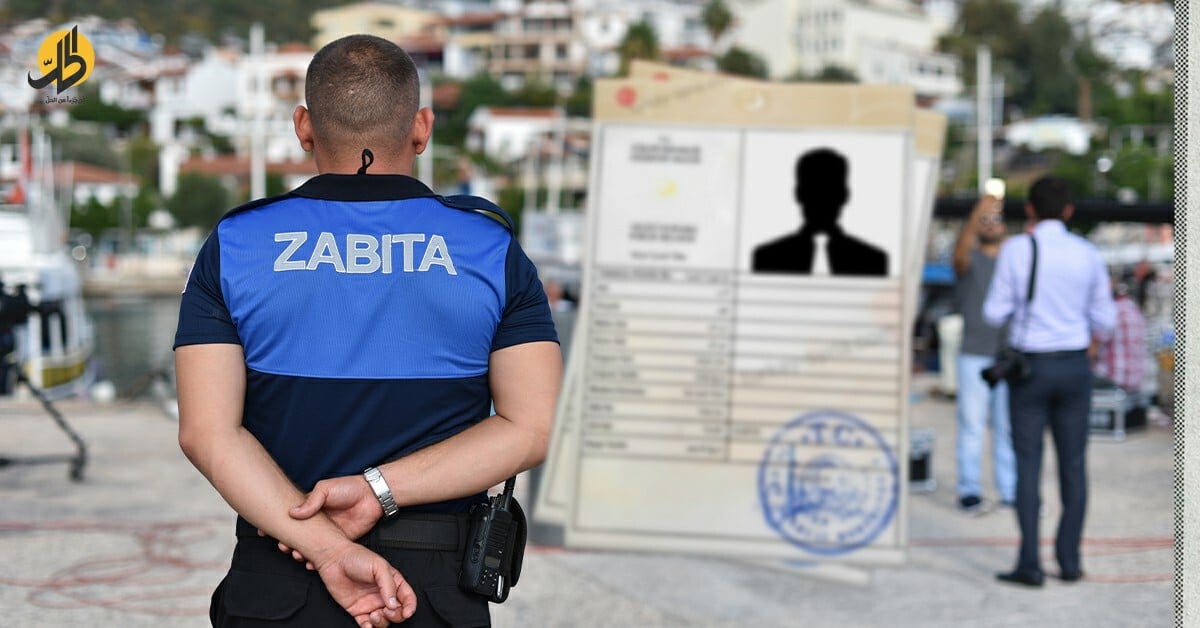
“Basta” is a term Syrian refugees have agreed to use as a substitute for saying police patrol or checkpoint targeting irregular migrants in Istanbul—an expression they believe protects them from legal repercussions while exchanging information via instant messaging apps or social media.
No one in the WhatsApp group answers Ahmad’s message, so he sends another:
- For God’s sake, guys, what’s the road like?
Another young man replies:
- Brother, everyone’s already home. Just go home and trust in God.
The message gives Ahmad no real reassurance. He now has to head home without any prior information.
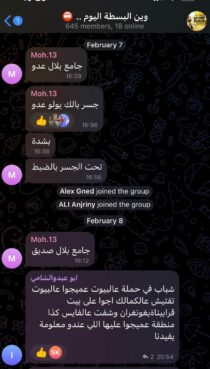
Since July 2023, after the Turkish government launched a security campaign targeting irregular migrants, Syrian refugees have created groups called “Where’s the basta today?” These groups are active on Telegram, WhatsApp, and Facebook, at a minimum. Hundreds have joined them in Istanbul alone, while other groups with the same name and purpose have been launched in provinces such as Izmir, Gaziantep, and Ankara: to avoid inspection patrols searching for refugees in violation and taking them to deportation centers, or sending them back to the provinces where they obtained their temporary protection cards.
Ahmad holds a temporary protection card from Sakarya province in northwestern Turkey. Under the law, he is not allowed to reside, work, or even visit Istanbul or any other province without prior approval known as a travel permit. Obtaining that permit requires additional official documents. As a result, any police patrol that stops him could immediately transfer him to a migration center, and he could even be deported to northern Syria. Although the law on moving between provinces without permission stipulates only a fine, what frightens Ahmad most is the growing number of forced deportations of Syrian refugees.
The current security campaign targeting irregular migrants is not the first. Similar campaigns date back to 2019. The current one was announced last July, when Turkish Interior Minister Ali Yerlikaya referred to a series of measures to be taken against irregular migrants, including deportation. But the minister’s remarks to the Turkish newspaper Hurriyet did not mention Syrian refugees in any way, limiting the issue to “foreigners who enter the country illegally, or whose visas or residence permits have expired.”
Last September, Yerlikaya announced that 42,875 irregular migrants had been deported between June 1 and September 22, 2023, without any indication of their nationalities.
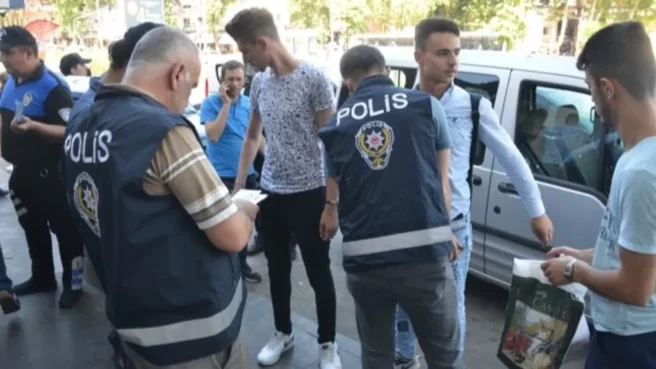
Reasons for the security campaign
Prominent Syrian-Turkish rights activist Taha al-Ghazi, speaking to Al-Hal Net, explains the reasons behind the current security campaign. He says it stems from the same causes as previous security campaigns involving refugees in Turkey—namely, the exploitation of the refugee, migrant, and foreigner issue by all Turkish political forces. Al-Ghazi adds that Turkish opposition parties and currents have used hate speech and racial discrimination to mobilize against refugees and foreigners in the event they come to power, in every previous election, from presidential to municipal.
As for the ruling alliance, al-Ghazi says it also bears responsibility for the pressure placed on refugees. Through arbitrary and unlawful decisions issued by migration centers affiliated with the Interior Ministry, many Syrian refugees have been deported to their country. He says the authorities are trying to signal to Turkish society that they will deport Syrian refugees, in line with what the Turkish president said clearly in his victory speech after the last presidential election, when he promised to deport one million Syrian refugees.
Al-Ghazi does not expect security campaigns against irregular migrants—or discriminatory rhetoric against them by political parties and currents in the country—to stop anytime soon. In his view, elections are not the only reason; rather, the decision to return refugees and tighten restrictions on them has effectively been adopted by both ruling and opposition forces alike.
Turkish opposition parties and currents have used hate speech and racial discrimination to mobilize against refugees and foreigners in the event they come to power, in every previous election, from presidential to municipal.
Rights activist Taha al-Ghazi
The country is awaiting municipal elections considered decisive, especially in Istanbul and Ankara, where the ruling Justice and Development Party wants to regain the two municipalities after losing them to the Republican People’s Party in 2019. Taha al-Ghazi believes the current campaign is directly tied to these elections and to influencing voters who have been repeatedly told that refugees and foreigners are the cause of their economic problems.
At eight in the morning in Istanbul, audio notifications keep coming from the group “Where’s the basta today?” Members ask about conditions at public transport stations and on main roads in Esenyurt, west of Istanbul. One message asks about one of the roads near Abu Ahmad’s workplace. Abu Ahmad, the group’s founder and administrator, writes:
- I’ll be there shortly and I’ll tell you what it’s like.
Abu Ahmad gets on his motorcycle and heads to the area he monitors. He quickly takes a photo showing there is no security presence and sends it to reassure anyone planning to take that road. Abu Ahmad uses a non-Turkish phone number and has enabled automatic deletion of messages after 24 hours as a security measure. Speaking to Al-Hal Net about why he created the group, he says he was in the same legal situation a few years ago, but now holds a temporary protection card issued in Istanbul after buying a work permit for as much as 30,000 Turkish liras (about $1,000). The law allows a transfer if there is a work permit from a company or factory in Istanbul, but Abu Ahmad, who works as a freelance painter, obtained a fictitious contract from a Turkish company in exchange for money.
Abu Ahmad founded the group and shared its link in WhatsApp groups for Syrians, as well as in Facebook groups. It is one of many groups created for the same purpose.
Yazan, 27, did not need the group’s information until last October, when he left the house he had been renting because of a rent increase and moved to a new home. But the new neighborhood he moved to is one closed to new foreign registrations. The Turkish Interior Ministry had announced the closure of nearly 1,200 neighborhoods across the country, with no foreigner living there after the decision being granted residency registration, in order to keep the proportion of foreigners below 20 percent in each neighborhood.
For Syrian refugees, not having valid address registration can mean losing the right to temporary protection—the kimlik—if the migration authority discovers that the refugee is not living at the registered address. To verify this, patrols are sent to Syrian refugees’ addresses every few months. A message from the Turkish migration authority informed Yazan that he must obtain new residency registration; until then, his file has been suspended, and any migration patrol that stops him could take him to deportation centers.
Codes for refugees
Every violation of Turkey’s temporary protection law has its own code, visible only in the police system. Some codes require a visit to the migration offices, notorious among refugees; others mean immediate deportation if the refugee is arrested or detained. There is a code for failing to register one’s residence, a code for traveling without permission, a code for an unpaid bill, a code for an administrative case, and other codes whose meaning, cause, and method of assignment can only be understood by a legal specialist or lawyer. All of them appear on patrol devices as soon as the refugee’s ID number is entered—if such codes exist, of course.
The number of messages in the group drops between midnight and 6 p.m. Everyone is at work or at home, and there is little movement requiring questions about road conditions, except for those who absolutely have to go out. Then a notification appears:
“Hello, what’s it like around the school?”
The message was sent by a woman preparing to go to an elementary school to bring her two sons home. She is Rama, a mother of two whose husband suffers from a chronic illness. All of them hold temporary protection cards from another province. She is the family’s breadwinner and caregiver. Some replies come in:
- Clear
- Clear, no one there
- Completely clear
Rama leaves home reassured and walks for ten minutes toward the school before spotting a police patrol. How had they said in the group that there was no basta there? She opens the app and sends a long message rebuking the members:
- How did you say the road to the school was clear? There’s a patrol here—I barely escaped.
She receives several replies with the same message:
- That’s traffic police, sister. They have nothing to do with us.
In the group, the police referred to as “basta” are coded by colors and names according to their uniform or type: red in some cases, green in others, “traffic” quite often, plainclothes officers in rarer cases, and sometimes black or blue. The red ones are considered the most dangerous, forceful, and terrifying—the ones that place a Syrian refugee caught in their trap in real danger, according to a pinned message in the group. The green ones offer greater chances of getting away, while encounters with plainclothes officers depend on one’s legal status and how serious the security code attached to one’s name is. All of them can take a refugee with a code to police stations and then to migration authority deportation centers.
The “red” police are the most dangerous, forceful, and terrifying; they are the ones that place a Syrian refugee caught in their trap in real danger.
We return to Taha al-Ghazi to ask about ways to solve all these legal problems facing refugees in Turkey. He says there is no clear policy regarding refugees; all decisions concerning them are temporary in nature and may at times be obstructed by the whims of a minor employee in any migration office. Many refugees find themselves facing a large set of legal complications for which there is practically no solution.
Al-Ghazi explains that in many cases in which he provided advocacy, a judge might issue a ruling acquitting the accused and ordering his immediate release, yet the migration administration would fail to implement the court ruling and would continue detaining refugees or deporting them to Syrian territory. He adds that another decision has complicated the lives of thousands of newly arrived refugees: in 2019, after the Justice and Development Party lost the Istanbul municipality, the Turkish government stopped granting temporary protection, or kimlik, to them. Syrian territory is still considered a war zone under Turkish law, yet the country no longer wants to receive refugees. This is a clear legal violation that continues to this day. As a result, thousands of Syrian refugees are living in Turkey without legal papers because there is simply no way for them to obtain them.
White buses
The most dangerous patrols, regardless of color, are those accompanied by a medium-sized white bus. That almost certainly means they are searching for refugees and for people with codes. Usually, such patrols do not leave until the bus is full of “migrant” passengers. Hossam, 37, witnessed this firsthand. Although he holds a tourist residence permit in Turkey rather than a temporary protection kimlik, he found himself on a bus in Esenyurt Square in Istanbul, and all his attempts to make the officer understand that he was making a mistake failed.
When the bus headed directly toward the deportation center in Tuzla, east of Istanbul—a trip that can last three hours during rush hour—Hossam struck up a conversation with the policeman, who admitted that Hossam had nothing to do with the rest of the detainees on the bus: Syrians, other Arabs, and Africans who either had no residence permit, had expired permits, or had some kind of security code against them. He reassured him, saying:
- They’ll release you in Tuzla.
Hossam says the policeman told him with a smile that the bus had to fill up before it could depart, and that this sometimes takes more than ten hours. Refugees and migrants have been avoiding Esenyurt Square for months, and the patrols have instructions to bring in the largest possible number of “violators” every day.
When Hossam arrived at the center, the reception official looked at his papers and residence card and immediately said, “What are you doing here?” He ordered him to leave at once. Hossam is not the only one who ended up at the center for this reason; dozens of foreigners, especially Arabs and Africans with legal residence in the country, have been taken to deportation centers and then released from them.
Since last July, it has become possible to notice a decline in the number of Syrians in Istanbul—in public transport, some workplaces, shopping centers, and large markets. The Syrian presence is no longer as visible as it was years ago. An unknown number have headed by irregular routes to European Union countries, others have managed to travel to Arab countries, and another group has decided to return voluntarily to northern Syria.
Lawyer Ammar Ezz al-Din of the Free Syrian Lawyers Association says that the implementing regulation of the temporary protection law, issued in 2014, allows the authorities to revoke protection and deport those who had previously been granted it. He notes that Syria, according to the 2023 report of the UN International Commission of Inquiry, remains unsafe for the return of refugees.
Ezz al-Din adds that the deportation process carried out by the Turkish authorities under the banner of the security campaign—through the forced return of Syrian refugees to northwestern Syria—constitutes a violation of the principle of non-refoulement, as enshrined in international law and reflected in the 1951 Refugee Convention and its 1967 Protocol. This principle is the cornerstone of protecting the rights of asylum seekers and refugees, and it is a binding customary norm on all states, including those that have not ratified the 1951 Refugee Convention.
As for those who enter Turkey irregularly from northern Syria and have not obtained a temporary protection card, they may legally be deported because they do not enjoy the legal status of those covered by the temporary protection law.
As for what is called voluntary return—meaning that those covered by the temporary protection law choose of their own will to return to the liberated areas—this does not in itself constitute a violation under international human rights law. But if legal abuses occur that force refugees to return to those “liberated” areas, then the return is forced, not voluntary.
Future fighters
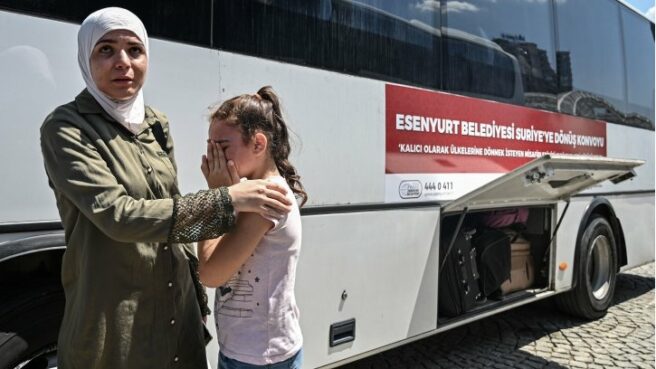
In the city of al-Bab in the northern Aleppo countryside, under the control of military factions backed by Ankara, lives Hassan, 46, who was deported from Turkey three months ago for no fault of his own, as he says. Throughout those three months, he has still been unable to secure housing in the Syrian city, where landlords demand high rents and insist on payment in US dollars. Job opportunities are virtually nonexistent, and the security situation, which he describes as deteriorating and unsafe, is likewise dire—consistent with reports by Syrian rights organizations documenting ongoing violations against civilians, in addition to periodic armed clashes between different factions.
The new legal dilemma Hassan faces concerns his wife and children, who remained in Turkey. He cannot return to Turkey, even by irregular means that cost hundreds of dollars and expose him to renewed security pursuit. Nor can his wife return to Syria with their children, because she must present a legal power of attorney from the father at the border crossing. The situation becomes even more complicated because the Turkish authorities require that the power of attorney be issued by the Syrian government in Damascus, not by any Syrian authority outside its control, as is the case in northern and northwestern Syria. Even obtaining such a document through Damascus is impossible without legal procedures that include registering the marriage and the children in official Syrian government records—something that is logistically out of reach and, if pursued through a lawyer in Damascus, costs thousands of dollars.
When we asked Hassan what work he would do after losing hope of re-entering Turkey, he said plainly that he would volunteer with an armed faction. The name or affiliation does not matter to him; what matters is the monthly salary paid in Turkish liras. Hassan is not the only deportee in northern Syria taking this path. Hundreds have preceded him, while hundreds of others are trying to return to Turkey by irregular means.
- How the Houthis Are Choking Yemen’s Peace Efforts with a Broad Escalation on the Ground
- Economy in the Wind: How Yemenis Are Paying the Price of Disrupted Shipping Routes
- Houthi Summer Centers: Factories for Indoctrination and Raising a “Scream” Generation
- The “Coalition of Necessity”: What Costa Rica’s Terrorism Designation of the Houthis Signifies
- Mojtaba Khamenei Runs Iran from His Bed as Photos Vanish and the Supreme Leader Makes a “Voice-Only” Appearance