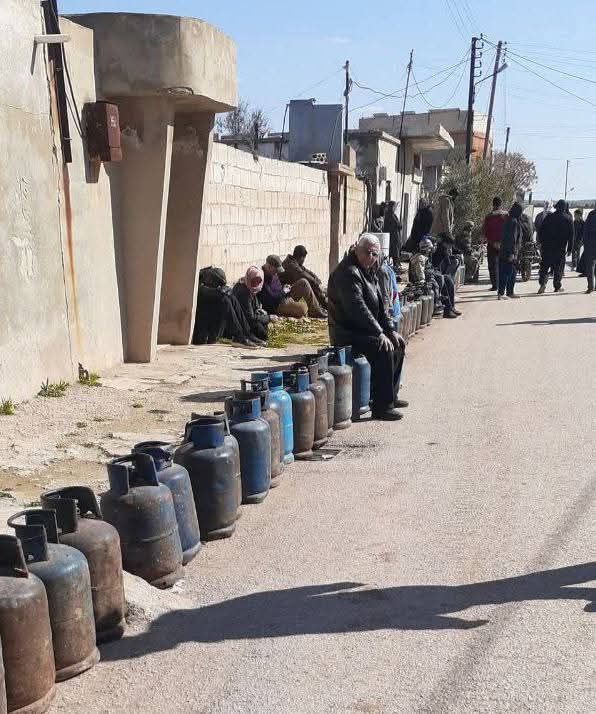
Since late February, Syria has been experiencing a crisis in the availability of household gas. Although it has been partially resolved in some areas by using the family booklet to distribute cylinders, waiting lines remain the most prominent sight outside distribution centers.
Earlier, the Syrian Petroleum Company denied any intention to return to using the “smart card” or the family booklet in gas distribution, yet the reality on the ground indicates that the family booklet has been adopted as a mechanism to regulate distribution in a number of governorates.
A new mechanism under crisis pressure
The household gas shortage has pushed a number of governorates to adopt the “family booklet” as a way to regulate the distribution of gas cylinders, instead of the “smart card” system that was in use under the former Syrian regime.
Under the new mechanism, presenting the family booklet is required to receive a gas cylinder, with each family allocated one cylinder every two months under the current regulatory measures. The price of a cylinder has also been set at about 123,000 Syrian pounds.
Despite these measures, waiting lines are still seen in a number of areas, reflecting continued pressure on this essential commodity, especially with increased demand during the winter season.
Mohammad al-Kilani told Al-Hal Net: “Thank God, after the fall, gas became much more available and people felt relieved. We said we were done with the whole card, text message, and queues story. Even if we paid more, we said that was okay—the important thing was not having to stand in line. But now there are queues, we’re paying, and it still isn’t available.”
Meanwhile, some Syrians believe that distributing gas cylinders based on the family booklet is unfair compared with the smart card system.
Ahmad al-Yousef told Al-Hal Net: “At first, the smart card was better. We would get a message telling us to go and collect it. Later there was hoarding—one day it was available and one day it wasn’t—but it was much cheaper than it is today.”
Official denial of the smart card’s return
Earlier, the Syrian Petroleum Company attributed the gas crisis to rising demand, in addition to what it described as cases of hoarding, stressing that distribution is taking place according to specific mechanisms aimed at achieving a degree of fairness among citizens.
At the beginning of this month, Safwan al-Sheikh Ahmad, director of institutional communication at the Syrian Petroleum Company, denied the accuracy of circulating information about reinstating the “smart card” system.
He also denied any intention by the institution to distribute one gas cylinder per month to each family booklet, or to record the date of cylinder replacement on the pages of the family booklet.
In a statement carried by the Syrian “Al-Ikhbariya” channel, he said that the mechanism currently in place is the only reference for regulating the distribution of gas cylinders, and that any changes will be announced only through official channels.
The director of institutional communication at the Syrian Petroleum Company warned against circulating inaccurate news or reports not attributed to official sources, saying they have a negative impact on public opinion.
Meanwhile, observers believe there is confusion in the statements of Syrian officials regarding the reinstatement of the “smart card” system or the adoption of the “family booklet,” as they returned to using it after previously denying it.
- How the Houthis Are Choking Yemen’s Peace Efforts with a Broad Escalation on the Ground
- Economy in the Wind: How Yemenis Are Paying the Price of Disrupted Shipping Routes
- Houthi Summer Centers: Factories for Indoctrination and Raising a “Scream” Generation
- The “Coalition of Necessity”: What Costa Rica’s Terrorism Designation of the Houthis Signifies
- Mojtaba Khamenei Runs Iran from His Bed as Photos Vanish and the Supreme Leader Makes a “Voice-Only” Appearance