
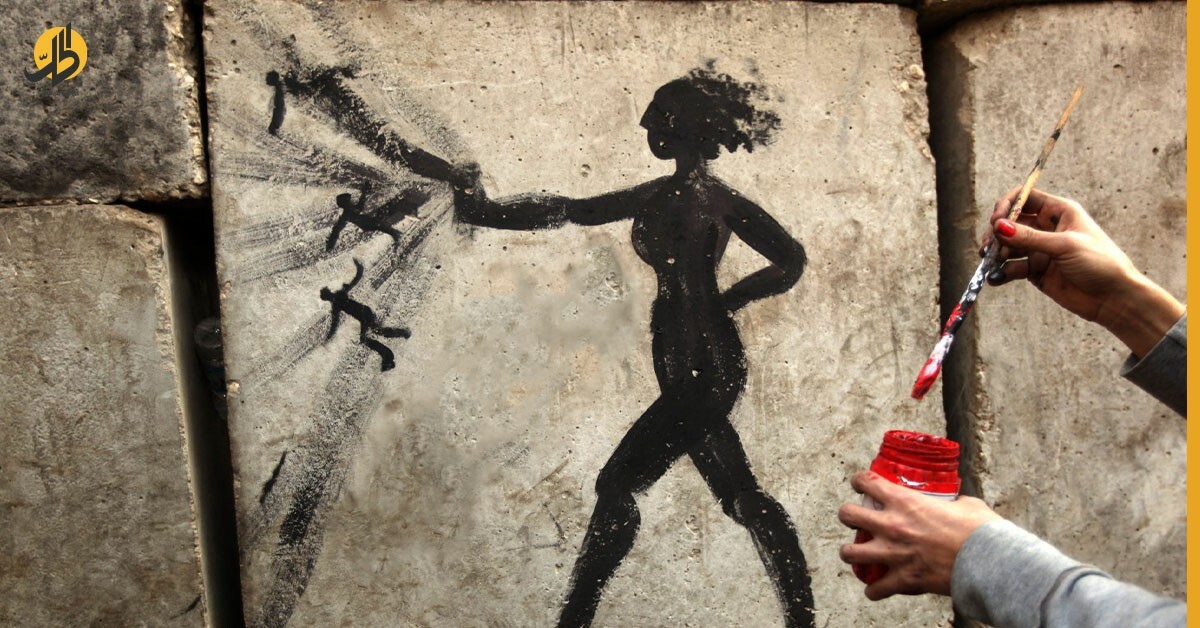
Throughout history, women have been defined in terms of their bodies. Poets have long celebrated the features of the female body, which societies in the past used for men’s sexual pleasure, not to mention linking it to religion, custom, and tradition. Thus, the collective consciousness passed down from one generation to the next has symbolized the female body and invested it with a number of values such as “family honor,” “honor,” and “purity and chastity,” all of which are embodied in a girl’s virginity—something that remains deeply rooted in the male imagination to this day. A girl’s virginity is seen as the honor of the family and, by extension, of the tribe or clan.
Some societies, including Arab ones, have embodied the idea that a woman’s only value lies in her virginity. Once she passes from being a virgin girl to a married woman, her body becomes a means of pleasing her husband, and she also loses ownership over it, which is transferred to her husband. Thus, by the logic of these societies, she becomes “sacrosanct,” and sexual rights are considered permissible for men but not for women. This is what Michel Foucault pointed to in his book on the history of sexuality, The Use of Pleasures, when he said: “The confiscation of sex is not a product of the present moment; rather, its roots go back to ancient patriarchal civilizations and to the patriarchal tendency that formed a moral system conferring legitimacy on male authority after it succeeded in controlling the movement of the woman’s body and regulating her sexual activity, thereby determining her mobility and confiscating her freedom. Thus arose a system of social and moral values and norms that reflects what is permitted and forbidden in the patriarchal institution.”
Among the restrictions on movement to which Foucault referred, we find female circumcision in Egypt, Sudan, and some other countries, the aim of which is to suppress girls’ desire in light of the cultural and social shift that enabled women to enter public space, which had previously been reserved for males. In the Maghreb countries, including Tunisia, we find the phenomenon of “tasfih,” a practice considered morally permissible despite contradicting the religious order, because it is one of the magical practices intended to protect girls’ honor and virginity, especially those who study or work far from their families.
What is “tasfih”?
“Tasfih” is a verbal and physical magical practice aimed at fortifying the female body. It takes place in two stages. The first is the “closing” stage, carried out before the girl reaches puberty, by making a wound in her thigh, then bringing seven dates or seven raisins, smearing them with that blood, and forcing the girl to eat them while repeating the following sentence each time, with each raisin: “I am a wall and other people’s sons are a thread.” The second is the “opening” stage, carried out on the wedding night, in which the same practice is performed but with the sentence reversed: “I am a thread and other people’s sons are a wall.” “This sentence becomes entrenched in the little girl’s mind and seeps into her unconscious.” As for the effectiveness of this practice, some scholars of the phenomenon explain it as a combination of the psychological and the biological, to the point of convergence, resulting in difficulty—or even impossibility—of sexual intercourse.
The magical dimension of this practice lies in the significance of the number seven, which in the popular imagination and collective memory is linked to a religious and mythological heritage laden with symbols: the seven heavens in Islam, the seven upper and lower worlds, reincarnation and seven lives in Hinduism, Buddha’s seven steps, and the seven tribes of the jinn.
In the belief of those who practice it, tasfih consists of appointing a jinn to guard a girl’s virginity and prevent any sexual relationship, in protection of her “honor” and thus the honor of the family. To this day, many families in Tunisia still rely on and pass down these rituals in the belief that they are effective. This phenomenon is not tied to any particular social milieu; rather, it is practiced across all social classes and educational levels, though more widely in rural communities.
The Female Body in Public Space
Fatema Mernissi believes that “our identity in its traditional structure is fundamentally sexual, in that the concept of (honor) ties the reputation of men and women to the fate of their reproductive organs. A man who does not father children is not considered virile, nor is one who does not control his (harem). Fear of women entering public space is fear of the defilement of male (virility), because they will become the object of pursuit by the eyes of unrelated men. Thus, the respectable man is not merely one who manages economic wealth, but also one who controls the sexual behavior of his wife, daughters, and sisters. He can only achieve that if he is able to regulate their movements and limit their mobility, thereby reducing the chances of their meeting unrelated men with whom they might defile the family’s honor.”
This belief still prevails in many societies to this day. But the truth that must be acknowledged is that the primary fear of women entering public space is fear of their liberation and their breaking away from the patriarchal frame of reference, thereby undermining its dominance. Therefore, women’s presence within public space is seen as competition with male authority, which is thought to create a kind of disorder, especially since this presence is based on parity and equality—and of course this is considered unacceptable. Moreover, women’s entry into public space means changing that space’s rules and norms, which is regarded as a breaking of the social values that define the roles of both sexes.
The forms of violence practiced against women in the public sphere have multiplied. Women are subjected to physical and verbal violence, and several horrific practices linked to their personal freedom in dress have emerged, such as the phenomenon of slashing.
Education is one of the most important mechanisms that enabled women to be present in this space. At the same time, women have become economic actors and are no longer prisoners of the private sphere that regulates their presence and role within the family framework. This change has even included rural women, albeit to a lesser degree than in urban areas.
But these outwardly positive developments carry negative aspects rooted in the patriarchal system, in that the phase of women’s transition from the private sphere to the public sphere generated and intensified several conflicts based on differing identities. This is what the anthropological researcher Anne M. Lovell pointed to when she said: “The modernization that has affected social sectors has added another dimension to what is at stake in public spaces, as the spatial dimension of these places reveals to us the nature of the ties existing within them. These places also make it possible to understand the nature of mixed and differing gender relations. Thus, the public spaces of ‘modern’ cities appear as though they emerge from a focal point of conflict and clash of interests, from negotiation and struggle between different groups, between women and men…, where this conflict is manifested in every attempt at gendered appropriation of the city or domination over it.”
Although the dynamics of change require women’s presence as active and influential agents, patriarchal thought still seeks to exclude and push them away in an effort to restore its presence and prestige, which have begun to fade. This has led men to practice all forms of exclusion and violence, one of the mechanisms of patriarchal domination over public space. We find this justified—and even supported—by society, and painfully, by women themselves, which explains the culture and values prevailing within society, because to this day common sense still views women as beings whose presence threatens the social order.

Accordingly, the forms of violence practiced against women in the public sphere have multiplied. Women are subjected to physical and verbal violence, and several horrific practices linked to their personal freedom in dress have emerged, such as the phenomenon of “tashlit.” This phenomenon appeared during different periods in Tunisia and consists of young men assaulting women with razor blades or other sharp instruments because their clothing does not conform to the standards of the prevailing cultural and social order. Sexual harassment is also highly rampant in public space, and there is no real social deterrent. Although it has been criminalized in many countries, the social order supports this practice and protects its perpetrators because they are seen as defenders of society’s moral order. Women are among the strongest supporters of such practices, on the grounds that women are the source of temptation and moral decay.
Despite the cultural and social development of most Arab societies, the question of gender, modernity, and women’s presence in public space poses a real dilemma in how to manage this social transformation without departing from the standards of the traditional order. For this reason, the magical practices mentioned above—alongside female circumcision, of course—were introduced as a means of achieving balance in women’s presence in public space. The aim is, first, to protect males from moral decline by curbing women’s sexual desires, and second, to preserve the presence and continuity of patriarchal authority through tighter control over the female body. Naturally, this takes place with social and cultural approval, instrumentalizing religious sentiment to sanctify these practices. This is why, to this day, we still see crimes against women under what are called “honor crimes,” though they are not fundamentally related to honor at all, but usually to inheritance. These crimes are covered up because, unfortunately, in many Arab countries today, the perpetrators of an honor crime are not executed but instead receive only symbolic punishment. This points to the contradiction of social thought, which classifies the woman’s body as socially defiling while at the same time considering it sacred for male sexual pleasure.
- How the Houthis Are Choking Yemen’s Peace Efforts with a Broad Escalation on the Ground
- Economy in the Wind: How Yemenis Are Paying the Price of Disrupted Shipping Routes
- Houthi Summer Centers: Factories for Indoctrination and Raising a “Scream” Generation
- The “Coalition of Necessity”: What Costa Rica’s Terrorism Designation of the Houthis Signifies
- Mojtaba Khamenei Runs Iran from His Bed as Photos Vanish and the Supreme Leader Makes a “Voice-Only” Appearance