Much has been said about women—in books, novels, poems, and religions; in the media, in life, and in dreams. Yet most of what has been said and continues to be said remains on paper, because despite everything, women are still placed in a position beneath men, even by those who have written the most lavish words and verses about them. If that condescending view did not exist, this day would not exist either. International Women’s Day reminds us of one truth: we celebrate and glorify women in volumes of writing instead of changing how we view them in real life and ending the discrimination between men and women in favor of equality.
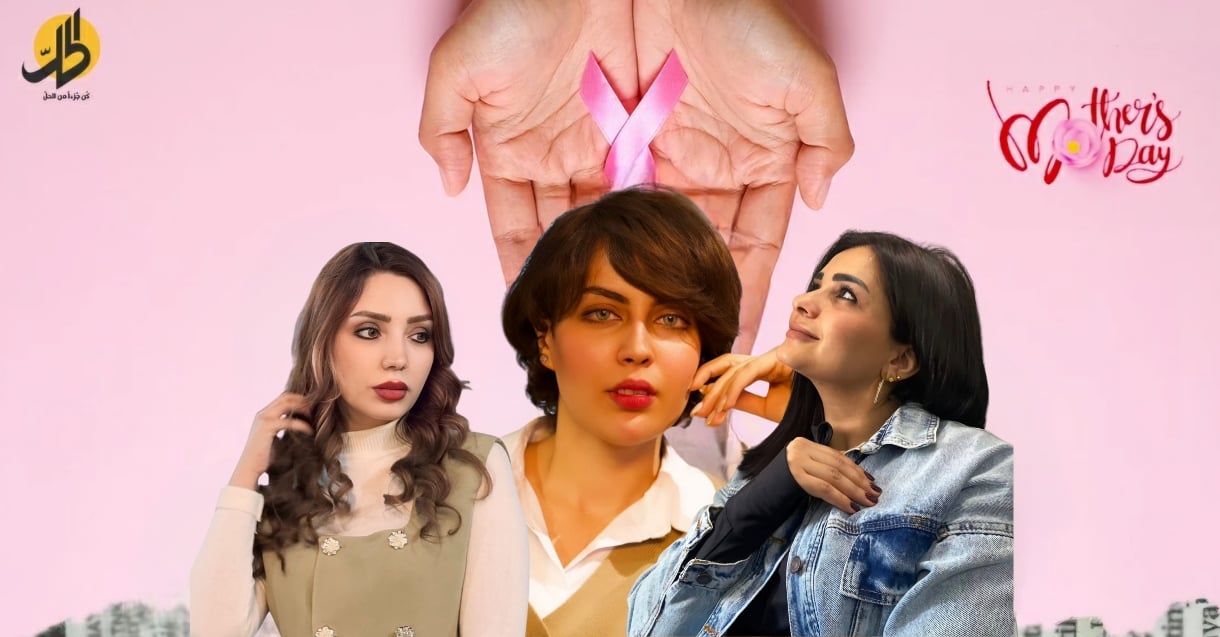
This day comes to remind us that women are like mountains: they endure every kind of weather and remain proud and steadfast in the face of challenges, struggling to claim their rights. There are many women who have shown persistence and defiance, especially in our region, which has yet to move beyond reactionary ideas about women. Iraqi society is no exception. So, on the occasion of International Women’s Day, we have carefully chosen three Iraqi women from different fields to spotlight their achievements, as part of celebrating successful women on their day.
Helen Hussein.. Carving Through Stone
A rebel who carves through stone to reach her goal—that is Helen Hussein, daughter of Basra. Helen is a human rights activist, an Iraqi lawyer, and a defender of women’s rights. Above all, she is the head of the “Basra Feminists Team.” She barely pauses to recover from one shock before returning stronger than before.
Helen Hussein was born in Basra, in the far south of Iraq, not knowing that when she came of age she would stand as tall as the palm trees of her city, defending the rights taken from Iraqi women, and Basrawi women in particular.
Helen did not spend the springtime of her life in peace, especially in Basra. The city was at the forefront of Iraq’s 2018 uprising, and from it she drew the strength to face the future. Later, during the October Uprising in 2019, she helped lead a number of demonstrations. She stood at the forefront of young people and women, chanting for the most basic right of all: “We want a homeland.”
She did not keep leadership to herself. Instead, she helped bring her peers to the forefront of the popular movement in her city. Because she was a woman, first and foremost, and because her activism surprised patriarchal authorities unaccustomed to women participating boldly in protests, she faced serious threats. But she did not surrender, and she continued her struggle.
After the setback of October, which was brutally suppressed, Helen did not remain confined to her home or trapped in her private life. Her concern became freeing the voices of abused and oppressed women in Basra. She founded the first feminist group focused on women’s rights in the governorate—likely the first in southern Iraq—the “Basra Feminists Team,” which she still leads today despite all obstacles and setbacks.
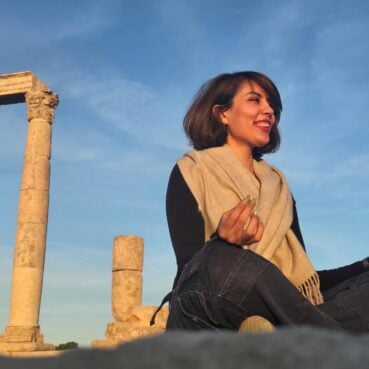
Helen is made of Sumerian clay. Her roots are in her birthplace; her face carries the salt of the Shatt al-Arab, and her eyes the charm of old Basra’s shanashil balconies. She was born on 22 August 1996, studied law at Shatt al-Arab College, and earned a bachelor’s degree there. Her legal training strengthened her commitment to defending the rights of the vulnerable.
In 2021, on the occasion of the International Day for the Elimination of Violence against Women—specifically on 25 November—the “Basra Feminists Team,” led by Helen, organized the first protest vigil in the Middle East on that day calling for an end to violence against women. Even that vigil faced obstacles.
“The women and girls in the team had difficulty leaving their homes to reach the site of the vigil and organize it, because a woman’s leaving the house still requires permission in a conservative tribal society. This is one of the simplest forms of violence against Iraqi women, and Basrawi women in particular, even though leaving the house is among the most basic rights a woman should have,” Helen says.
Baghdad, a relatively more open and urban city, is still saturated with injustice and violence against women—so what about a conservative tribal city? To live in a city like Basra, breathing customs and traditions, means carving through stone in order to confront injustice and fight for rights. Helen has neither surrendered nor despaired. She continues her struggle and now focuses her activism on monitoring and documenting violations against women and children in her community.
Inas Phlip.. Dissecting the Forbidden
Bold to the core, Inas Phlip is a writer unafraid to delve into what society considers forbidden, dissecting taboos through her texts. Inas is a young Iraqi poet and writer, born on 22 December 1993, when sanctions on Iraq were at their height and children were dying for lack of milk. But she survived those days, only to become a poet writing the tragedies of today.
Her early years were steeped in pain. Baghdad, where Phlip was born, had become a place of blood and bullets, with sectarian war raging across the capital. Inas experienced the bitterness of forced displacement within the country, moving with her family to Basra until conditions stabilized in her home city, then returning to it once again.
Inas Phlip’s life was far from ideal. Circumstances were harsh and prevented her from continuing her education, yet those same circumstances shaped her into the poet and writer she became, and later into a journalist writing for major Iraqi institutions. Still, she never gave up on her dream of studying, and kept pursuing it until she achieved it.
Basra, which sheltered her from the violence of the war years, is also the city that later made her a poet. She entered it in 2018 writing short stories and left it writing poetry. From there, her poems carried her to Berlin, where she read to German audiences at the invitation of the German Foreign Ministry after winning third place in the poetry category of the “Inanna” project.
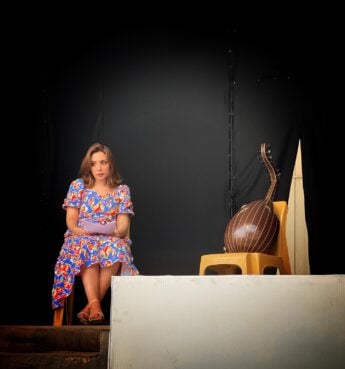
“I saw an announcement for a writing workshop for young women under the age of 25. The workshop was held in Basra governorate and was part of the ‘Inanna’ project. ‘Inanna’ was a project run by the German journalist Birgit. She traveled to Basra, where the workshop included training in short stories, novels, and poetry, and concluded with a competition for participants. I won third place in the poetry category,” Phlip says.
Inas Phlip has read poetry in the German countryside, at the House of Poetry in Berlin, and at the German Foreign Ministry. Copies of her joint book, “The Eyes of Inanna,” were sold, as Germans found it striking to attend a signing by an Iraqi writer given the conditions they usually hear about. “It is wonderful to board a plane and cross cities to read poetry in Europe. It is a good window onto other cultures,” Phlip says.
Inas Phlip, who has received many local invitations and honors, especially from the General Union of Writers and Authors in Iraq, never misses an opportunity to take part in discussions about the role of women in Iraq and how they are affected by surrounding circumstances. She does not hesitate to speak about October and the challenges it brought, nor about writing as something that “constitutes a scandal in a society ruled by weapons.”
Writers often end up becoming journalists, and Phlip followed that path too, becoming a journalist of note. She began during the October protest movement with Ultra Iraq, then Al-Mada, then became head of the media department at Al-Bayan Center for Studies and Planning, and finally the media face of the Iraq International Book Fair. Yesterday, she was honored by the National Bank of Iraq for her journalistic career on the occasion of International Women’s Day. At 32, Inas Phlip believes she is still only at the beginning of the road—and that is one of the traits of successful people.
Zainab Al-Mashat.. Soaring to Reach Her Dreams
“Slowly, slowly” — we searched for the best words and found none more fitting than the lyrics of a Seta Hagopian song to describe the journey of Iraqi journalist and media presenter Zainab Al-Mashat, from local journalism to some of the Arab world’s most prominent television stations.
In journalism, her pen is among the finest: fluid, graceful, and capable of touching the soul while capturing reality in both its sweetness and bitterness with remarkable professionalism. This is evident in her work for Al-Mada, Daraj, and KirkukNow, not to mention Tatu and Iraqiyat, and most recently Jummar.
In television, she began her career with notable success at NRT Arabic, then moved between Asia, Al-Taghyeer, and MBC Iraq, before finally reaching stardom through her work with Al Arabiya. She worked hard and mastered her craft.
Zainab’s childhood was not especially remarkable; she did not come from a family that raised its children in exceptional circumstances. “A student in a public school, playing with her peers at school and in the street.” In adolescence, her hobbies and interests differed from those of other girls her age. “I used to have political discussions with adults in their gatherings. Even emotionally, during adolescence, I always told myself not to be swept away by my feelings because I was still a teenager. I tried to write my feelings in a small notebook that I kept to myself. I practiced quiet hobbies: drawing, knitting, sewing, and making cold-ceramic ornaments.”
Chemistry was Al-Mashat’s first passion. She dreamed of becoming Iraq’s Marie Curie. But she soon discovered that chemistry was not for her, and that her heart leaned toward something that touched people’s lives more directly. She found that in journalism. After graduating, a media professional read some of her writing and asked her to contribute social articles to their website, which she did. Then she began publishing in newspapers without pay, and from there her journey in journalism and media began.
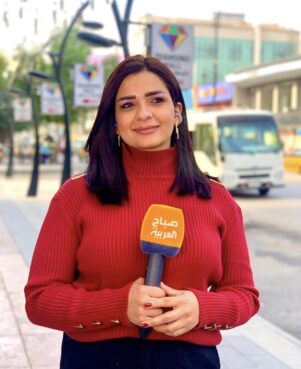
Zainab says: “After that, I went to Al-Mada Foundation, and people told me it was not an institution that accepted beginner writers. That was a challenge for me, so I decided to present myself to them, and I was accepted based on the very first journalistic piece I produced for them. I developed my journalistic work in this institution, where I worked for more than five years.”
Al-Mashat had a column titled “Femininities” in Tatu magazine, the monthly supplement of Al-Mada newspaper. She would make a point of going out on the day the magazine issue was released dressed in full elegance, as if she were meeting a lover. The column dealt with taboos and unspoken women’s issues, discussing them in a literary style.
In 2014, Zainab entered the world of journalism at Al-Mada Foundation and made a promise to herself: to produce work that would be recognized by everyone and to become a professional in Arab media. At the time, she dreamed of doing field reporting for either Al Arabiya or Al Jazeera, and today she has achieved part of that dream by working at Al Arabiya.
Television will never be closest to Al-Mashat’s heart. The pen remains her sanctuary, and words are the finest thing she weaves to express herself. Zainab stopped writing for a while after going through a period of writer’s block, but she later returned stronger than before. She came back as part of the editorial leadership of Jummar, a platform offering serious Iraqi journalism that competes with major Arab journalistic schools with notable professionalism.
“Whenever I walked in the street, I always felt that my feet barely touched the ground. Even now, that feeling stays with me, because I do not walk—I soar. I soar to pluck my dreams and turn them into reality. And I will never stop pursuing my dreams. Today, I no longer dream; I am achieving what I once dreamed of, and I am still moving forward,” Zainab says.