

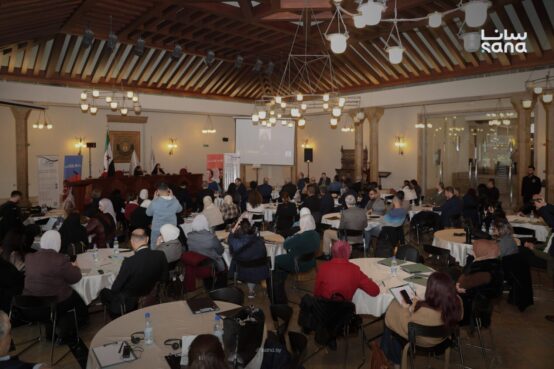
The conference “Gaps in the Syrian Nationality Law: Achieving Gender Equality,” organized by the National Commission for Transitional Justice today, Monday, at Reda Saeed Hall at Damascus University, addressed the main legal issues related to the nationality law.
The conference focused on the repercussions of discrimination for mothers and their children, the risks of statelessness, and the legal legacy of discriminatory provisions, with official and UN participation, alongside legal experts, international organizations, and representatives of civil society.
Legal reforms and comparative experiences
During the conference, participants discussed paths for constitutional and legislative reform in light of international law, while reviewing comparative regional experiences from Morocco, Tunisia, and Lebanon, with the aim of drawing on them to address existing legal gaps, according to the official SANA news agency. The conference also highlighted the challenges facing Syrian mothers and their children as a result of discriminatory provisions, in the context of pushing for legal reforms based on human rights principles and advancing justice.
Abd al-Basit Abd al-Latif, head of the National Commission for Transitional Justice, explained that the Syrian nationality law contains legal loopholes that have contributed to entrenching discrimination against women, particularly by depriving them of the right to pass their nationality to their children if they marry a non-Syrian. This negatively affects the children’s legal and social status and impacts their access to basic rights, including education, healthcare, work, and freedom of movement.
Calls for substantial amendments and UN support
Abd al-Latif stated that achieving equality in this area requires introducing substantial legislative amendments within the framework of the transitional justice process, alongside strengthening public awareness and community advocacy, in a way that helps entrench the principles of justice and equality and protect children’s rights. For his part, UN Women representative Ajay Madiwale affirmed that Syrian women have struggled for decades to obtain their rights, considering that Syria today stands at a pivotal moment to address these injustices.
He pointed out that the issue of nationality is not limited to its legal dimension, but is also linked to belonging, dignity, and basic rights. He also expressed UN Women’s readiness to provide the necessary technical support to strengthen the path of legal reform and build a more just and equitable society. The conference comes as part of national efforts aimed at promoting the principles of gender equality and ensuring the protection of the legal rights of all citizens, in line with international human rights standards and in support of the transitional justice process in Syria.
The 1969 Nationality Law
The Syrian nationality law issued under Legislative Decree No. 276 of 1969 remains the legal framework governing the granting of nationality. At its core, the law is based on the principle of paternal lineage, restricting the transmission of nationality to the Syrian father rather than the mother in most cases. Over the decades, this approach has produced complex legal and social problems, especially in cases where Syrian women marry non-Syrians, as their children face restrictions related to residency and obtaining official documents, in addition to difficulties accessing education, healthcare, and the labor market. This reality also contributes to increasing the risks of statelessness, particularly under conditions of conflict, displacement, and loss of documents.
Despite growing local calls and international human rights pressure to introduce substantial amendments to the law in a way that achieves gender equality and is aligned with international standards, particularly the Convention on the Elimination of All Forms of Discrimination against Women, no actual legislative reforms have yet been approved. Accordingly, the ongoing discussions, including those raised at the conference, remain part of a gradual process seeking to reconsider the existing legal structure and open the way for possible reform that addresses the current imbalances and limits their human rights and social repercussions.
- How the Houthis Are Choking Yemen’s Peace Efforts with a Broad Escalation on the Ground
- Economy in the Wind: How Yemenis Are Paying the Price of Disrupted Shipping Routes
- Houthi Summer Centers: Factories for Indoctrination and Raising a “Scream” Generation
- The “Coalition of Necessity”: What Costa Rica’s Terrorism Designation of the Houthis Signifies
- Mojtaba Khamenei Runs Iran from His Bed as Photos Vanish and the Supreme Leader Makes a “Voice-Only” Appearance