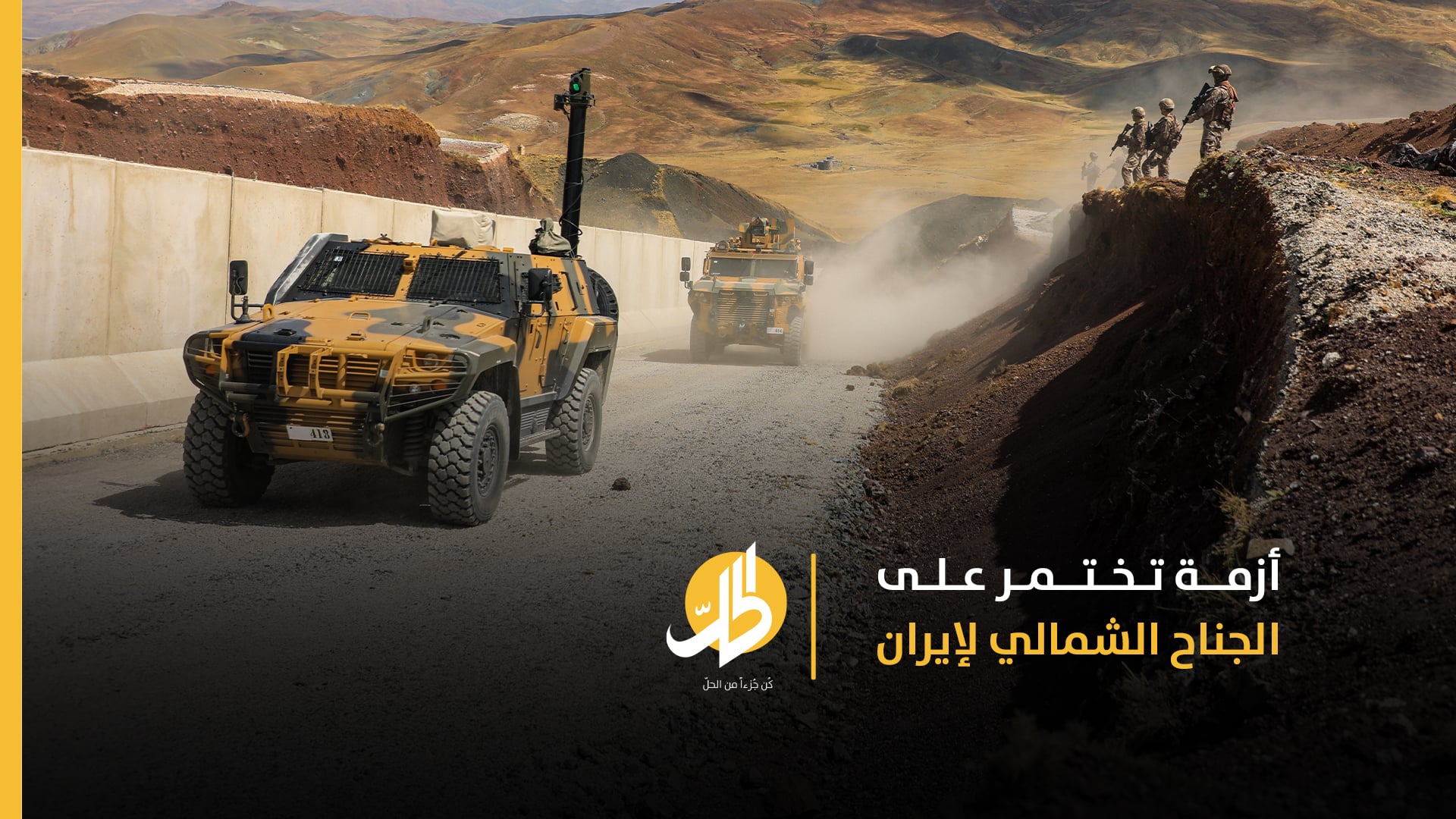
The Iranian religious regime is increasingly worried that Azerbaijan may exploit ethnic nationalism to weaken Tehran. As a result, a crisis is brewing along the South Caucasus frontier, involving ethnic Azerbaijanis living on both sides of the border—who form the majority in Azerbaijan, but also constitute the largest minority in Iran.
Baku’s victory in the 2020 Nagorno-Karabakh conflict with Armenia left Azerbaijan with a much longer border with Iran. At the same time, the accelerating transformation of the regime in Tehran could create a crisis on Iran’s northern flank, where Tehran faces a major challenge from its Azerbaijani ethnic citizens, against whom it has practiced discrimination for decades. Al-Hal Net reviewed and translated a report by The National Interest on this issue.
Relations between Baku and Tehran hit rock bottom after an armed attacker killed the head of security at Azerbaijan’s embassy in Tehran last January. This was followed by Iran’s expulsion of four Azerbaijani diplomats on May 5, in response to Baku’s April 6 expulsion of four Iranian diplomats, in retaliation for the attempted assassination of Fazil Mustafa, one of its prominent lawmakers, on March 29.
Tensions between the two countries escalated again following the opening of the Azerbaijani embassy in Tel Aviv on March 29. A few days after Israeli Foreign Minister Eli Cohen visited Baku on April 19, 32 Israeli lawmakers sent a letter to Cohen’s office expressing support for the ethnic Azerbaijani minority in Iran. Coincidentally, Israel opened its embassy in Turkmenistan the day after that letter.
Today, after making major gains in the Arab region—where Syria, Lebanon, and Gaza have served as launching pads for its operations against Israel—the report says Iran is increasingly concerned about what it sees as a growing Israeli presence on its northern flank. This is compounded by the fact that Turkey, its historic Sunni rival, has also made major gains in the trans-Caspian region, where Ankara is seeking to establish a strategic Turkic corridor. For a long time, Tehran took comfort in the fact that Armenia, its regional ally, acted as a check on Azerbaijan, and that Russia was able to manage the balance of power in the South Caucasus. Turkey’s growing influence in what had been a Russian sphere of influence since 2020, followed by the Kremlin’s military and economic weakening after its 2022 war against Ukraine, is also a major source of concern for Tehran.
Historically, much of the South Caucasus, along with parts of Dagestan in the North Caucasus, was under Persian control before the Russians took it over in the early nineteenth century. Iran’s northern borders were established through three treaties with Moscow over the course of that century. For much of the twentieth century, the pro-Western Pahlavi monarchy in Iran served as a frontline state facing the Soviet Union. Even after the monarchy was overthrown in 1979 and the Islamic regime was established, Tehran was not in a position to try to restore its influence in the South Caucasus. Nor was Iran able, even after the Soviet collapse in 1991, to use Shiite Islamism to project its power in the then newly independent Azerbaijan, a secular, Western-leaning, Turkic Shiite-majority state. This was not merely an offensive strategy; it was also a defensive one, since an independent Azerbaijan could do the reverse by using Azerbaijani ethnic nationalism to weaken Iran’s religious regime—an objective shared by Azerbaijan and Israel.
While Iran is expected to accuse Israel of supporting Azerbaijani separatism in Iran, the same claim has also been made privately by Reza Pahlavi, the son of the late shah. In addition, during a visit to Israel in mid-April, Pahlavi persuaded some Israeli parliamentarians to withdraw their signatures from the Knesset letter supporting Iranian Azerbaijanis. Now, after Tehran has faced major internal unrest, fears have increasingly focused on ethnic minorities whose identities have been suppressed through Persianization. There is concern that non-Persian groups may mount a cultural revolt against the religious regime, especially ethnic Azerbaijanis, who make up about a quarter of the country’s population of 88 million.
In the rapidly approaching post-Khamenei era, the Revolutionary Guard is likely to complete the process of replacing the clergy as the main center of power in Iran. But the Revolutionary Guard will not be able to rely on coercive means alone to ensure that minority communities such as the Azerbaijanis, as well as the Baloch, Kurds, and Arabs, remain loyal to an evolving regime.
Azerbaijanis were at the forefront of the protests that erupted after the killing of Mahsa Amini, the young Kurdish woman killed by the morality police last year after being arrested for not wearing the hijab. “Freedom, justice, and national government” was the shared slogan in the streets of Tabriz, Urmia, and Ardabil, the three largest Azerbaijani population centers in northwestern Iran. Azerbaijani protest activists also became a key force in Iran’s protest movement. Eight different protest organizations united around the Azfront Telegram channel based in Tabriz. Thus, the regime’s accelerating transformation presents an opportunity for ethnic Azerbaijanis to revive their Turkic ethno-linguistic identity. During a visit to Turkey in 2011, Ali Akbar Salehi, Iran’s former foreign minister, acknowledged that as many as 40 percent of Iranians speak Azerbaijani.
Today, as its religious influence continues to wane, The National Interest says the Iranian regime will try to use Iranian nationalism as a means of preserving unity among the population, but this is unlikely to succeed, given that only about half the country is ethnically Persian. Therefore, Iran’s rulers will have to forge a new social contract with the country’s minorities, especially ethnic Azerbaijanis, or face grave consequences for national unity.