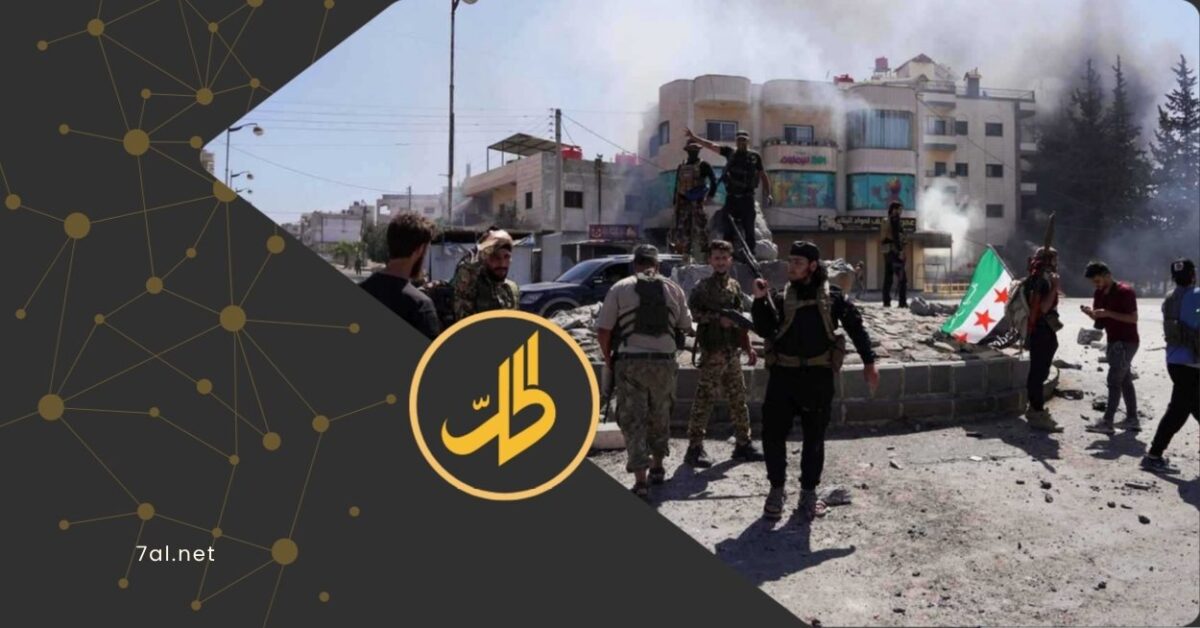
One year after the fall of Bashar al-Assad’s regime, Syria has made progress on the foreign policy front, breaking out of isolation, opening channels with the West and securing political support with the help of new allies such as Turkey, Saudi Arabia and Qatar. But this external progress does not necessarily reflect conditions inside Syria.
Signs of tension are mounting within the new regime’s support base, amid growing questions about the political system taking shape, its ability to accommodate Syria’s diversity, and its capacity to manage security challenges and unresolved issues.
In this context, Foreign Affairs, published by the Council on Foreign Relations, ran an article titled “Signs of Trouble Are Brewing in Syria,” noting that the international shift achieved by al-Sharaa would have been hard to imagine just a year ago.

But the magazine says these diplomatic gains conceal deep internal challenges. The approach that enabled Hayat Tahrir al-Sham, led by al-Sharaa, to reach Damascus is now hindering state-building.
The first of these problems is the concentration of power within a narrow circle, as political and security decisions remain confined to a limited group of former HTS leaders, while official institutions such as the government and parliament appear to exist only on paper and have limited real influence.
There are also no clear mechanisms for sharing power or holding the leadership accountable, amid the absence of a comprehensive political vision for the country’s future.
Minority concerns
The minority question is no less sensitive. Religious and ethnic minorities, along with segments of the Sunni majority, remain unconvinced of their place in the new Syria, amid fears of domination by a single political current.
These tensions became especially clear in the northeast, with the entry of transitional government forces into areas that had been under the control of the Syrian Democratic Forces for more than a decade.
Although the latest agreement between the two sides, which paves the way for integrating the SDF into state institutions, may ease tensions, the magazine says the process remains fragile and still needs to be completed.
It warns that a faltering transition could reproduce cycles of violence, threatening the gains made in international support.
A fragile transition
Despite al-Sharaa’s success in uniting dozens of armed factions into a single army without internal fighting, an impressive achievement, the political transition remains fragile.
The paper says the new authorities have not imposed a hard-line Islamist agenda, but have instead focused on institution-building and formed a government and parliament that include a range of figures, among them women and civil society representatives. Yet behind this apparent diversity, power is in fact concentrated in the hands of a narrow circle of former HTS leaders.
All parties have also been dissolved, without allowing alternatives to be formed, deepening fears of a new authoritarian system emerging.
Security challenges
These concerns have intensified after excessive force was used in some security operations, as happened in the coast and Suwayda, where hundreds of civilians were killed and sectarian tensions emerged.
The state is also still unable to impose full security, amid the activity of criminal networks and armed factions in several areas.
In the end, the magazine argues that the core of the problem is that the transition remains incomplete. The new institutions have so far failed to convince Syrians that they truly represent them or protect their interests, and the leadership, despite some tactical steps, has not made real political concessions or put forward a clear vision for how power will be shared.
State reconstruction has been treated as an administrative matter, when the political and social dimensions are no less important.
The road to stability
The magazine concludes that any long-term stability in Syria will require genuine political openness, based on broadening participation, strengthening institutions, allowing political pluralism and integrating all components, including the Kurds, on an equal footing.
The paper says that clinging to power, under this view, could erode domestic legitimacy, undermine the gains made abroad, and leave Syria’s future dependent on whether its leadership can convince Syrians that the new state represents them all, rather than serving a specific group.
The alternative is a state that enjoys international recognition but remains internally divided, making it vulnerable to repeated crises and perhaps new conflicts.
- How the Houthis Are Choking Yemen’s Peace Efforts with a Broad Escalation on the Ground
- Economy in the Wind: How Yemenis Are Paying the Price of Disrupted Shipping Routes
- Houthi Summer Centers: Factories for Indoctrination and Raising a “Scream” Generation
- The “Coalition of Necessity”: What Costa Rica’s Terrorism Designation of the Houthis Signifies
- Mojtaba Khamenei Runs Iran from His Bed as Photos Vanish and the Supreme Leader Makes a “Voice-Only” Appearance