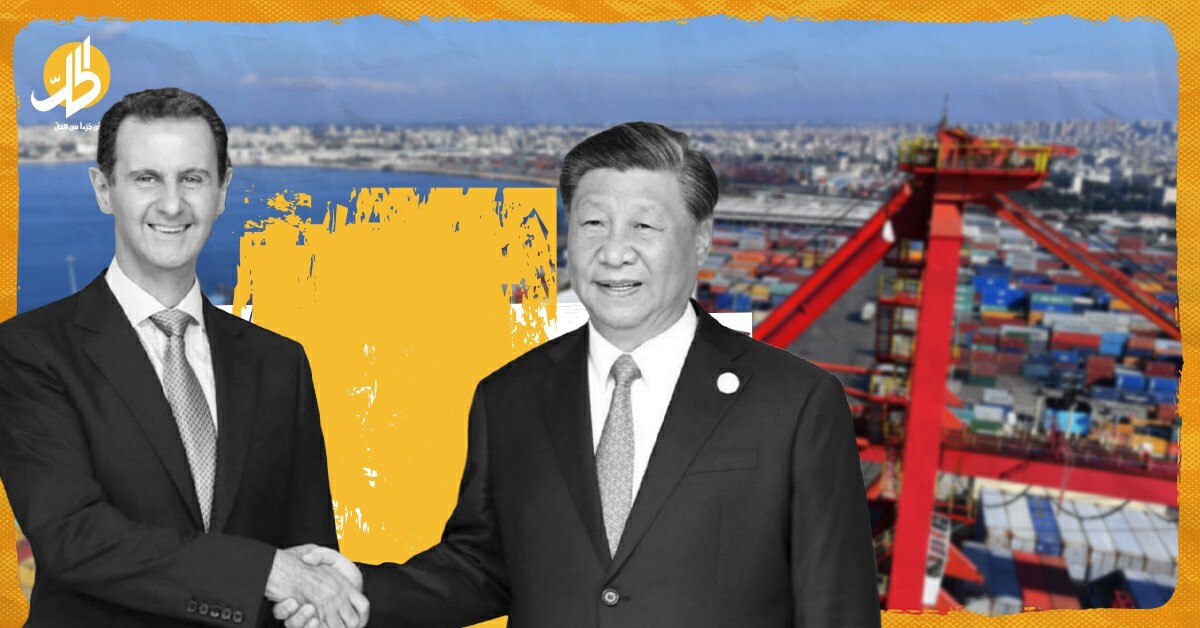
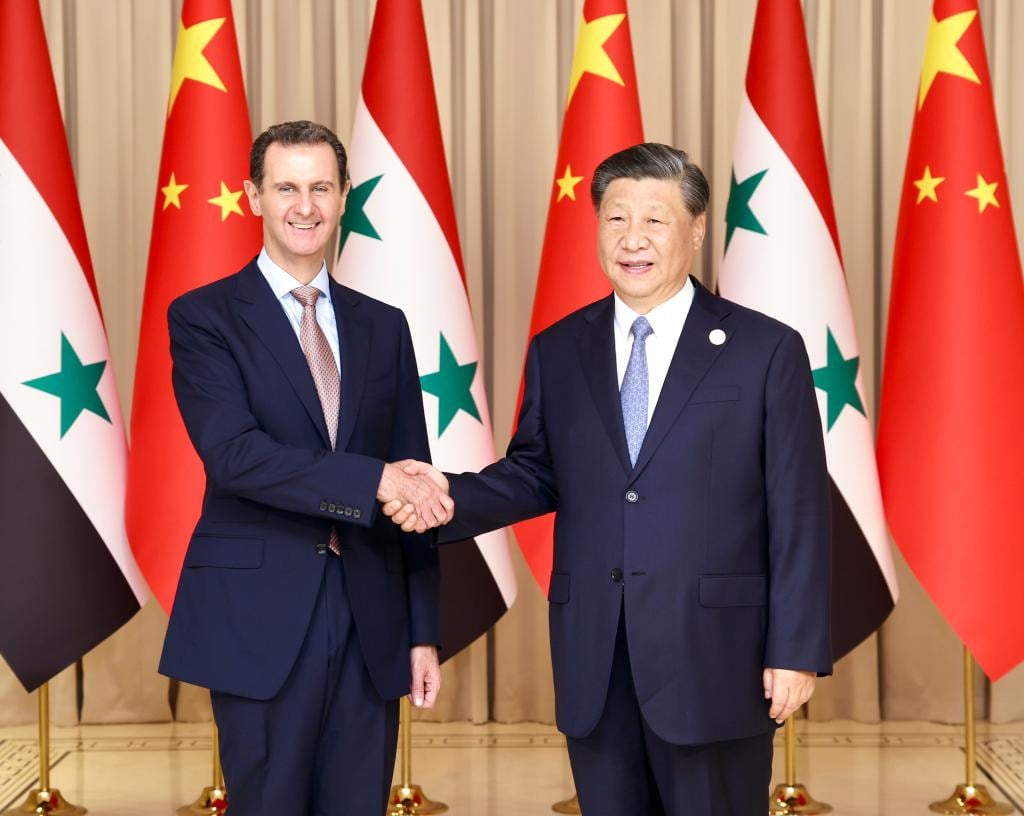
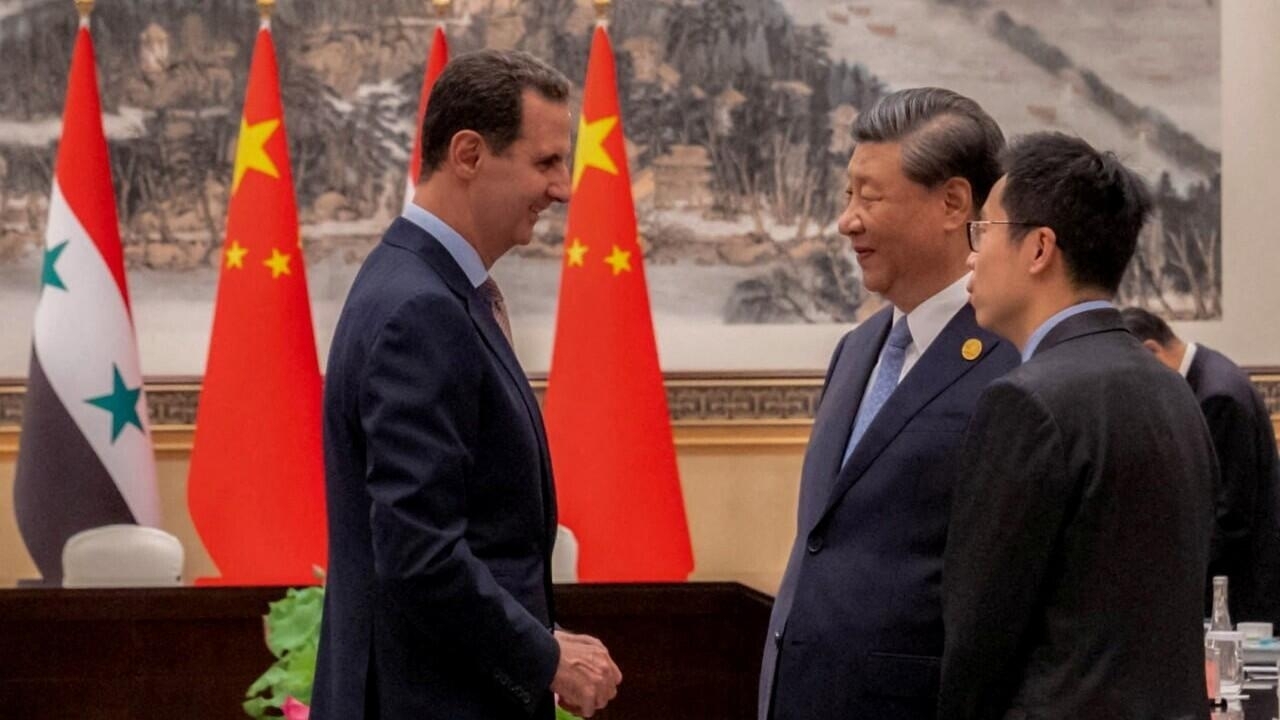
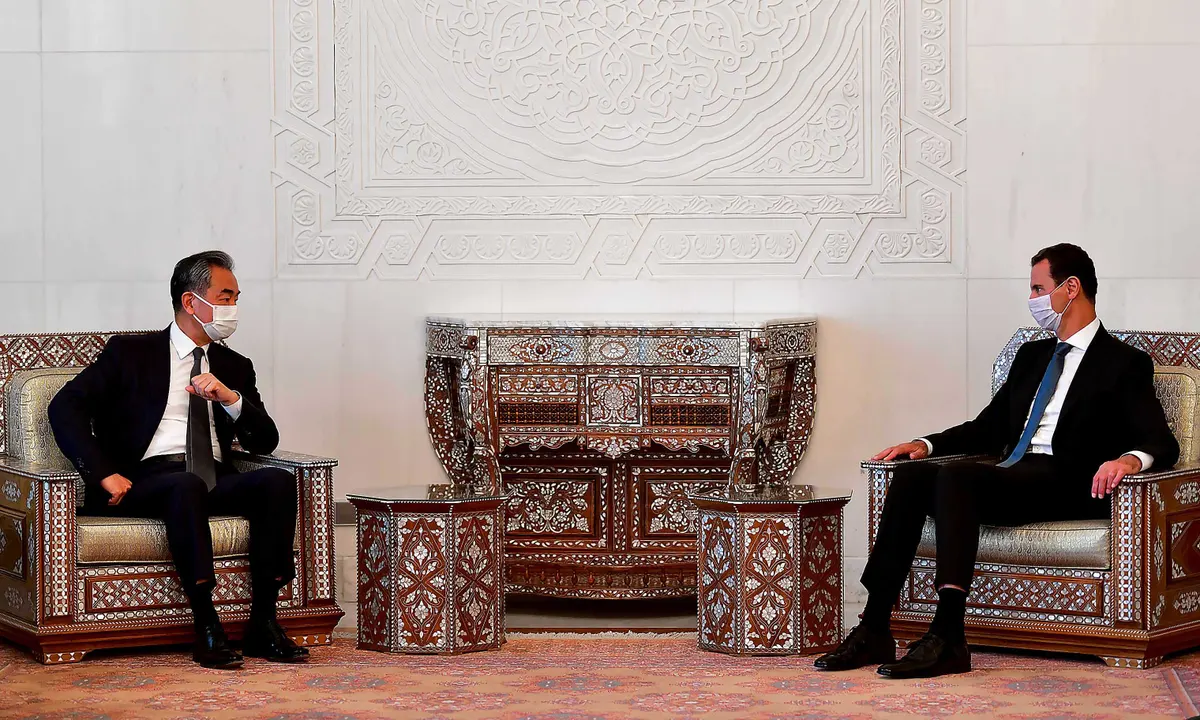
The meeting between Syrian President Bashar al-Assad and Chinese President Xi Jinping on September 22 represents an important step toward reintegrating Syria into the global diplomatic sphere. Even so, despite the considerable fanfare, the promises made by Chinese Foreign Minister Wang Yi to “elevate relations to a new level” are unlikely to materialize as investments in Syria’s financially distressed economy, for several reasons.
Assad’s visit to China and his signing of several agreements with the Chinese president do not constitute a major event, nor do they indicate an improvement in relations between the two countries or a Chinese desire to play a larger role in the Middle East. This is because the visit and the agreements do not necessarily mean that China will invest heavily in the Syrian economy, due to sanctions, war, corruption, and, most importantly, the current political administration.
What makes this issue more intriguing is that the policy of the Chinese Communist Party over the past two decades reveals why it has refrained from investing in Syria. There are several countries that drew Beijing’s interest, yet it did not invest in them because of the domestic turmoil they were experiencing. The Chinese investment rule says: “If you are stable and weak, you will get the yuan; but no matter how strong you are or how closely allied with us, you will not get our money as long as you are in a state of turmoil that threatens our interests.”
No Green Light for Chinese Investments
According to what was announced, three cooperation documents were signed between the Syrian and Chinese sides. The first was an economic cooperation agreement, the second a joint memorandum of understanding for exchange and cooperation in the field of economic development, and the third a memorandum of understanding on the shared framework for a cooperation plan within the Belt and Road Initiative.
These agreements, whose content has not been disclosed, support the idea that China refuses to invest in Syria not primarily out of fear of Western sanctions, but because of the country’s unclear political horizon. The evidence is abundant, foremost among it China’s massive investments in Sudan under Omar al-Bashir and in Zimbabwe under Robert Mugabe, when the political situation in both appeared stable.
The only other country that supports Syria economically in a meaningful way is Iran, and Assad now knows that Iran is trying to extract more concessions from him and his government in exchange for continued support. He is now trying to find alternative avenues of support.
Dr. Karam Shaar, a senior fellow at the Washington-based New Lines Institute, said in press statements that while Damascus’s main ally, Tehran, is demanding more from it, Syria has failed to act meaningfully on the recent rapprochement with Arab states.
The regional diplomatic push to welcome Syria’s return to the Arab League, according to Shaar, has in fact largely died out, as Assad has shown no sign of cooperation or interest, even though this rapprochement could have economically rescued the Damascus government, at least. Even so, Shaar believes China benefited from Assad’s visit by waving the Syria card at the West, saying: “We can support this regime that you hate.”
Agreements on Paper
Simply put, Dr. Shaar believes that Beijing would be more willing to invest in Syria if Assad engaged more with other Arab states and worked to ease concerns over Syria’s role in producing Captagon. Its investments could also be profitable if it accepted the gamble associated with the future of the Damascus government amid political instability.
On the other hand, the Syrian president hopes that China will offer economic pledges to invest in Syria. If China decides to invest seriously in Syrian infrastructure, it could help Syria overcome the consequences of war and economic devastation.
But can these promises be relied upon? This is what the Syrian researcher questions. China had previously promised to invest in Iran without implementing that on the ground, and Chinese policy uses investment promises as a means of political pressure on the West.
Researcher Shaar’s view can be summarized as follows: China makes promises but does not carry them out. It had previously promised investments of more than $40 billion in Iran, but did not translate that into reality. And just as Western countries use Taiwan as a pressure card against the government in Beijing, the latter also uses Syria for pressure.
The Syrian Political Administration and Attracting Investment
China does not follow a policy of neutrality and non-interference in the internal affairs of other states as it claims, according to former Chinese political analyst and diplomat Wu Yi in remarks to Al-Hal Net. Rather, it raises these slogans in order to avoid entering into an alliance that the Chinese Communist Party sees as a losing one.
According to Wu Yi’s estimates, Beijing fears exposure to the Western sanctions imposed on Syria, which prohibit or restrict economic, financial, and commercial dealings with Damascus and threaten its interests, companies, and citizens, even if that runs counter to its alliance. China sees investment in Syria as carrying high risks and low returns, given the war raging in the country.
The Chinese Communist Party also takes into account the unclear and unstable political situation in Syria. The Syrian government faces internal and external opposition, is subject to international and regional pressure, lacks legitimacy, representation, and consensus, and suffers from corruption, divisions, and conflicts.
Also, from the point of view of the members of the Chinese Communist Party, which directs the country’s policy, the Syrian political administration needs to undertake radical and comprehensive reforms in its political, economic, and security system; find political and diplomatic solutions to the Syrian crisis; and rebuild its relations with Arab, regional, and international states in order to improve the current situation in Syria and create an appropriate, attractive environment for investment. This is what Damascus has recently failed to do.
In Wu Yi’s view, the Syrian political administration has also failed to diversify sources of investment, financing, and cooperation through the Arab initiative; to broaden the circle of partners, friends, and allies; to achieve balance and harmony among interests, values, and principles; and to avoid excessive dependence on, or futile conflict with, any party or power. Instead, it has surrendered to the instructions of its traditional allies: Iran, Russia, and Lebanon’s Hezbollah.
The Political Solution Closest to China
This disclosure may not lead to a radical change in China’s position toward Syria. China has not explicitly or officially revealed the secret behind its reluctance to invest in Syria, but rather indirectly, through statements by Chinese Foreign Minister Wang Yi, who affirmed China’s support for Syria and said it regards Syria as a strategic partner only within the Belt and Road Initiative.
Accordingly, it can be concluded that China will not significantly or suddenly change its position toward Syria, but will continue to adopt a political stance. It has used its veto eight times to block United Nations resolutions against the Damascus government, most recently in July 2020, against extending United Nations cross-border aid to northwest Syria, where millions depend on international assistance.
According to the analyses of the former Chinese political analyst and diplomat, China’s decisions not to invest in Syria will not conflict with its economic interests in the region, as Beijing is primarily seeking to draw Damascus toward an initiative to resolve the Syrian crisis. The political settlement scenario is the one most preferred by China, even if it comes at the expense of a national unity government. Although it wants the current regime to remain in place, it prefers stability in the countries in which it wants to invest.
China is not an absolute ally of the current Damascus government, nor does it share with it a unified strategic vision. Beijing sees Syria as a trade and investment partner and seeks to strengthen its relations with all parties concerned with the crisis, even with the Syrian opposition if it assumes political power in the country.
Based on these data, Damascus’s previous statements do not reflect the economic reality between the two countries. China has not invested in Syria in any major or noticeable way, despite having the capacity and resources to do so. The reason is that China sees investment in Syria as carrying high risks and low returns, given the Western sanctions imposed on Syria, the war raging in the country, and the corruption and divisions within the current political administration.
In this context, we can understand that the agreements signed by Syrian President Bashar al-Assad during his visit to China, which relate to cooperation in the fields of health, culture, and development, are fragile and non-binding agreements. They do not represent a real Chinese commitment to invest in Syria; rather, they are a means for China to show its political support for Syria, to pressure the West to ease sanctions on Syria, and to preserve its strategic interests in the region.
Accordingly, China does not intend to invest in Syria at the present time, and it is waiting for an improvement in the political, economic, and security situation in the country, and for a change in the current political administration, before deciding to enter into large and profitable investment projects. This means that Syria needs to undertake radical and comprehensive reforms in its political, economic, and security system; find political and diplomatic solutions to the Syrian crisis; and rebuild its relations with Arab, regional, and international states in order to attract Chinese and other investments.
- How the Houthis Are Choking Yemen’s Peace Efforts with a Broad Escalation on the Ground
- Economy in the Wind: How Yemenis Are Paying the Price of Disrupted Shipping Routes
- Houthi Summer Centers: Factories for Indoctrination and Raising a “Scream” Generation
- The “Coalition of Necessity”: What Costa Rica’s Terrorism Designation of the Houthis Signifies
- Mojtaba Khamenei Runs Iran from His Bed as Photos Vanish and the Supreme Leader Makes a “Voice-Only” Appearance