Turkish sources revealed that talks are underway with Damascus aimed at transferring more than 250 women and children who are Turkish nationals from the Roj camp in al-Hasakah province in northeastern Syria over the coming months.
Reports indicated that in the wake of the evacuation of al-Hol camp, Turkish women and children believed to have been linked to ISIS began arriving in Turkey. They said that some women managed to cross the border with their children through irregular routes, while others are seeking to benefit from the “effective repentance law” after appointing lawyers inside Turkey.
Negotiations with Damascus
The Turkish website “kisadalga” reported that the results of the negotiations between Ankara and Damascus indicate that the Turkish authorities intend to repatriate more than 250 women who are wives of ISIS members, along with their children, who are being held in Roj camp, during the coming period.
Recent developments have once again cast a spotlight on Roj camp, which houses the wives and widows of ISIS fighters alongside their children, especially after Syrian government forces entered the cities of al-Hasakah and Qamishli in the country’s northeast and took control of al-Hol camp, which had been run by the Syrian Democratic Forces (SDF), then closed it and transferred the foreign residents there to Iraq.
According to Turkish media, most of the women linked to ISIS moved to Idlib after leaving al-Hol camp.
Roj camp
Roj camp, considered the second most dangerous camp after al-Hol, is located in the far northeast of Syria, near the point where the borders of Turkey, Iraq, and Syria meet.
The camp is known for housing women linked to fighters who spent years in the ranks of ISIS. Some of these women held leadership roles within the “Hisbah apparatus,” the group’s female security body, before ending up in this closed camp, where they care for children, most of whom are orphans.
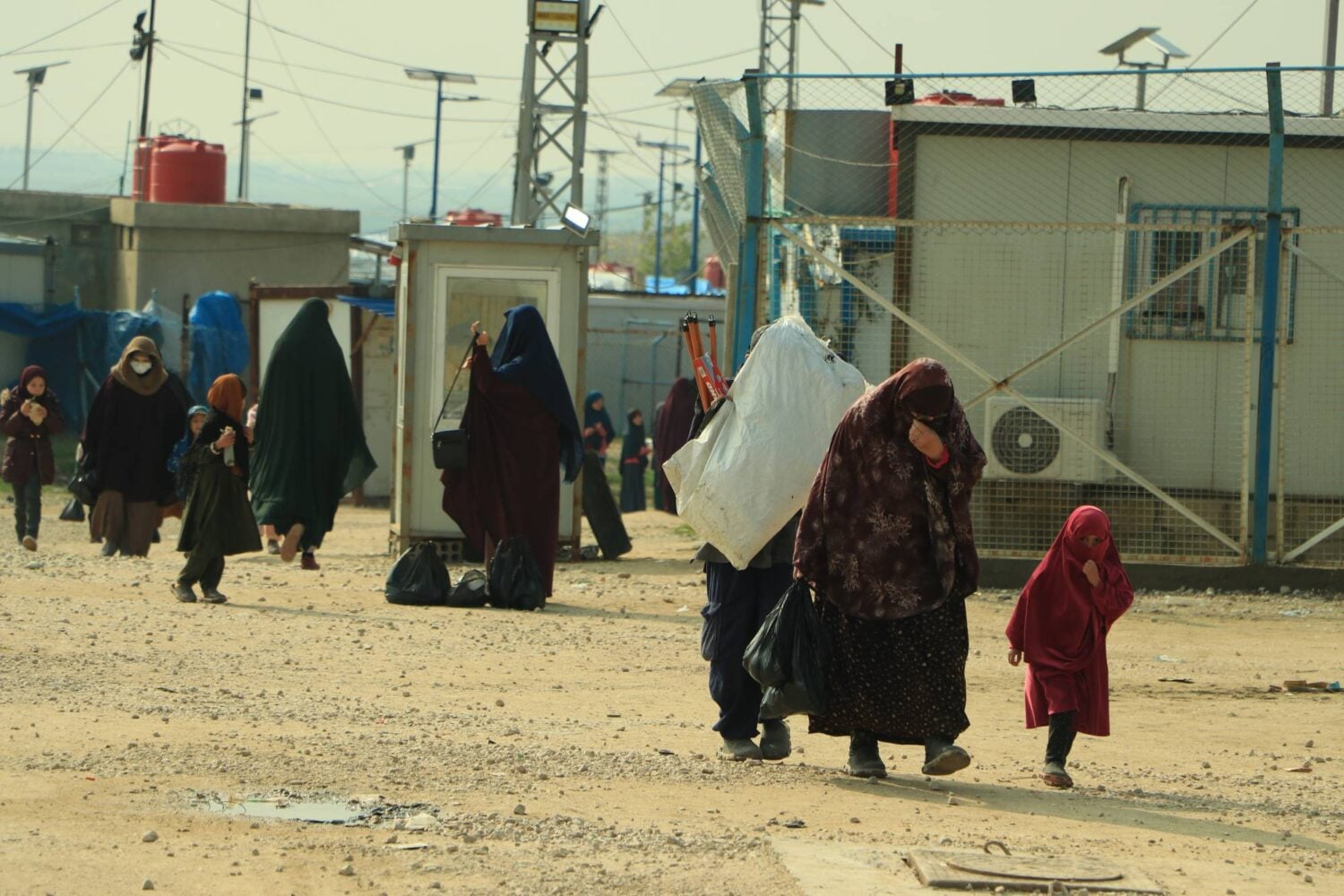
According to United Nations experts, Roj camp houses around 3,000 women and children, with children making up about 65 percent of the total population. More than 850 boys are also being held in prisons and other detention facilities, including what are known as rehabilitation centers, in areas of northeastern Syria, according to a report issued by the United Nations human rights office in Geneva in February 2023.
United Nations experts called on the various states and concerned parties in northeastern Syria to ensure the protection of these children and safeguard their interests.
Absence of rehabilitation programs
In the Turkish context, the head of the International Observatory for Extremism, Dr. Hilmi Demir, said that, to his knowledge, there are no data indicating the existence of specific rehabilitation or deradicalization programs targeting women and children linked to ISIS inside Turkey.
He added that he had reviewed some studies prepared by the Directorate of Religious Affairs and the Ministry of Family and Social Policies on this issue, based on media reports, but that he has no information confirming the implementation of a clearly defined deradicalization program covering a specified number of women and children over a specified period of time, with verifiable data.
Deradicalization programs are defined as preventive and therapeutic approaches aimed at rehabilitating extremist individuals or those at risk of extremism and enhancing their ability to resist violent ideology. They include tools such as social reintegration, digital education, and dialogue.
Routes of return to Turkey
The data show that the return of these women is not taking place as scattered individual cases, but rather within a clear pattern based on two parallel tracks: the first is legal or semi-legal, carried out through prior coordination with lawyers inside Turkey who arrange the returnees’ files and manage the procedures for surrendering themselves in a way that allows them to benefit from the “effective repentance law” through an organized mechanism rather than spontaneously; the second is irregular, consisting of infiltration and illegal border crossings. This indicates the existence of an existing movement network rather than a temporary phenomenon.
This return also plays a role that goes beyond the humanitarian or legal dimension, as the statements of some women are treated as an important intelligence resource, used to gather detailed information about the structure of ISIS, its networks, and the movements of its members inside Syria.
The rise of this phenomenon is directly linked to the developments that followed the evacuation of al-Hol camp, which marked a turning point that led to the redistribution of women and children and the opening of new transit routes, often passing from areas of northeastern Syria toward Idlib before attempts are made to cross into Turkish territory, whether through prior legal arrangements or through illegal infiltration.
Repatriating Turkish ISIS members
Iraqi authorities had previously announced that Ankara had agreed to receive Turkish citizens from among the thousands of detainees belonging to ISIS who were transferred to Iraq from Syria after the closure of camps and prisons that had been holding the group’s members there.
Iraq had received these detainees as part of an operation carried out in coordination with the United States, after the SDF withdrew and shut down detention centers that had held suspects accused of belonging to the group for nearly ten years.
Baghdad announced its intention to try these suspects under Iraqi law on charges related to “terrorism,” while repeatedly calling on other countries to repatriate their nationals from among these detainees.
Last month, a Turkish diplomatic source said that Ankara appreciates the efforts made by Baghdad to transfer more than 5,700 ISIS detainees from Syria to Iraq.
The source added that Turkish citizens were among these detainees, noting Turkey’s readiness to cooperate with the Iraqi authorities regarding its citizens, while praising Iraqi efforts in this regard.
Syrian-Turkish shortcomings
In sum, this issue reflects a complex overlap between security, legal, and humanitarian considerations, but it also raises serious questions about Ankara’s ability to manage this overlap efficiently.
The continued movement of women and children across more than one geographical arena, from northeastern Syria to Idlib and on to the Turkish border, reveals a reality in which official or semi-official channels operate in parallel with illegal routes, limiting the effectiveness of control and raising doubts about the actual capacities of the Syrian transitional government to manage this issue or the extent of its involvement in these movements.
The overlap between organized return routes and other illegal ones not only reflects the difficulty of management, but also suggests the presence of movement dynamics that remain active and capable of expanding in an unstable regional environment, weakening the assumption that this issue can be contained through traditional tools. It also raises fears about its future repercussions for the already fragile stability in Syria.
By contrast, the absence of declared and comprehensive rehabilitation programs inside Turkey stands out as an additional factor deepening this ambiguity, as the handling of returning cases remains governed by partial approaches split between the security and legal spheres, without a clear framework whose effectiveness can be measured.
With field transformations continuing in northeastern Syria, and the reshaping they impose on movement routes, Ankara appears to be facing an issue that exceeds its capacity for full control and remains open to unresolved trajectories whose repercussions go beyond the local framework to touch on broader questions related to how what remains of the group’s legacy and networks is to be managed.
- How the Houthis Are Choking Yemen’s Peace Efforts with a Broad Escalation on the Ground
- Economy in the Wind: How Yemenis Are Paying the Price of Disrupted Shipping Routes
- Houthi Summer Centers: Factories for Indoctrination and Raising a “Scream” Generation
- The “Coalition of Necessity”: What Costa Rica’s Terrorism Designation of the Houthis Signifies
- Mojtaba Khamenei Runs Iran from His Bed as Photos Vanish and the Supreme Leader Makes a “Voice-Only” Appearance