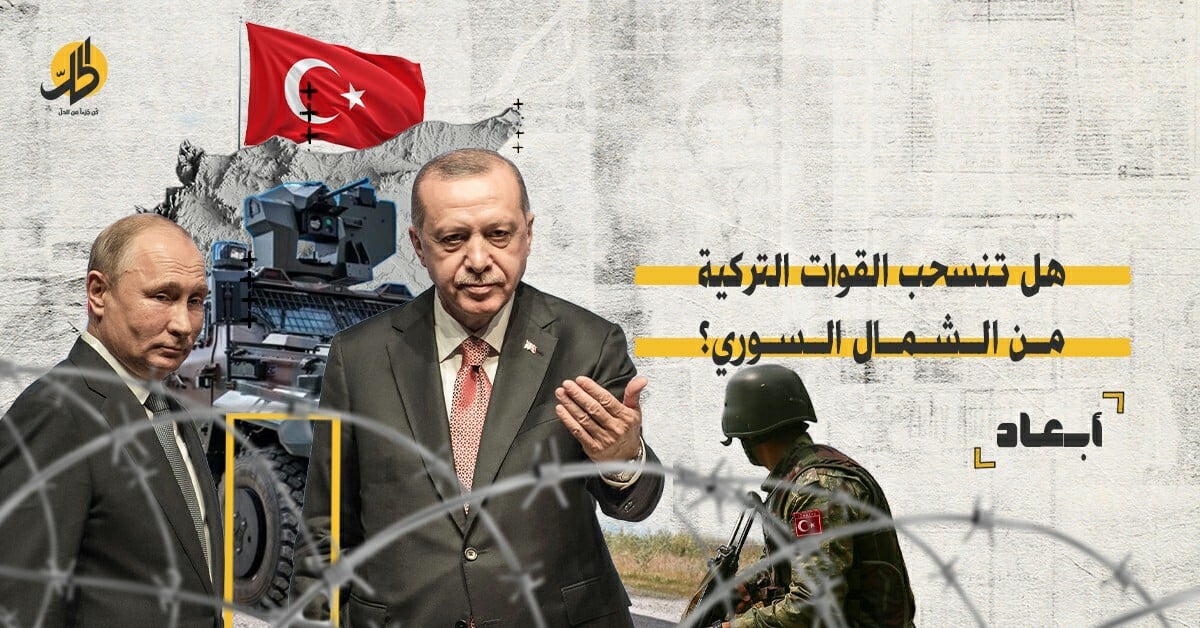
The obstacles standing in the way of any possible withdrawal of Turkish forces from northern Syria are considerable. Although Damascus is aware of this, it still makes such a withdrawal a key prerequisite for any political normalization process at the level of the two presidents.
Turkey, for its part, has its justifications—or pretexts—even though it has not sought to create a suitable environment for withdrawal. There is either containment of, or disregard for, Hay’at Tahrir al-Sham (formerly Jabhat al-Nusra), which is designated as a terrorist organization internationally, alongside the hardline Turkistan Islamic Party. So what fate awaits northwestern Syria under this terrorist presence?
Turkey fears a new wave of Syrian refugees heading its way if the Syrian army were to carry out any military action in northern Syria, were the Syrian condition to be met—something that is almost impossible. From this standpoint, Turkey has insisted, and continues to insist, on establishing a safe zone that would accommodate groups of refugees; only then, Ankara says, can the remaining outstanding issues between it and Damascus be discussed.
The central question in this context is how Turkish forces could withdraw from the northwest while the Syrian Democratic Forces (SDF) remain present in the northeast—forces that Ankara sees as the main justification for maintaining its military presence on Syrian soil. Over the past years, although Washington was a close ally of Ankara, it was unable to convince it that its continued hostility toward the Syrian Kurdish forces was misguided. On the basis of that hostility, several Turkish military operations were launched, helping shape Syria’s geography into what it is today. Indeed, the rapprochement and understanding between Russia and Turkey reached very high levels.
Instead of conditions being prepared for intra-Syrian rapprochement within the opposition between the SDF and the Coalition and its military wing, the National Army—both backed by Turkey—division and disagreement among these components only increased, while Turkey and Russia were making significant strides toward forging understandings over the division of northwestern Syria, before turning their attention to the northeast. From this angle, it is therefore unsurprising that Russian Foreign Minister Sergey Lavrov recently said that Russia and Turkey would discuss the idea of expanding the depth of Turkey’s intervention into Syrian territory to combat terrorism—in other words, a fresh update to the Adana Agreement. In reality, however, that means little as long as no changes on the ground take place, especially given the presence of International Coalition forces in the northeast.
Russia is using Turkey to needle the United States, but in practice this is all noise and no substance. The American presence, together with its allies, carries greater weight. Moreover, any Russian-Turkish-Syrian understandings regarding plans for the northeast are unlikely to align, because their objectives are not unified; each party has conflicting interests when it comes to the details and consequences.
Refugees, counterterrorism, and the protection of Turkey’s national security are the most prominent declared issues of concern to Ankara. Yet there are other, more specific matters that Ankara also cares about. So how could a withdrawal take place in the unrealistic manner demanded by Damascus, in exchange for Turkey losing a military presence that means a great deal to it politically and economically, all for the sake of further political rehabilitation of Assad?
Competing regional projects are also present, in one way or another, between Iran and Turkey. Ankara will not consider leaving Syrian territory before securing its economic and political gains more clearly. In addition, Turkey wants to demonstrate to the United States the strength of its foreign policy and military presence in neighboring countries, affirming that it is a country of major importance to Washington within NATO.
Erdoğan is in no hurry to meet Assad, and such a meeting would not bring him any political gains at present—quite the opposite. The one pushing this issue is Assad, with Putin behind him, in an effort to achieve the greatest possible gains, which may not materialize in the medium term. Thus, the Turkish president is once again investing in the Syrian file, this time through the issue of political normalization with Damascus and the promises and bargaining associated with it.
“Ab’ad” is a regular weekly political-analysis column written by Malek al-Hafez, editor-in-chief of Al-Hal Net.