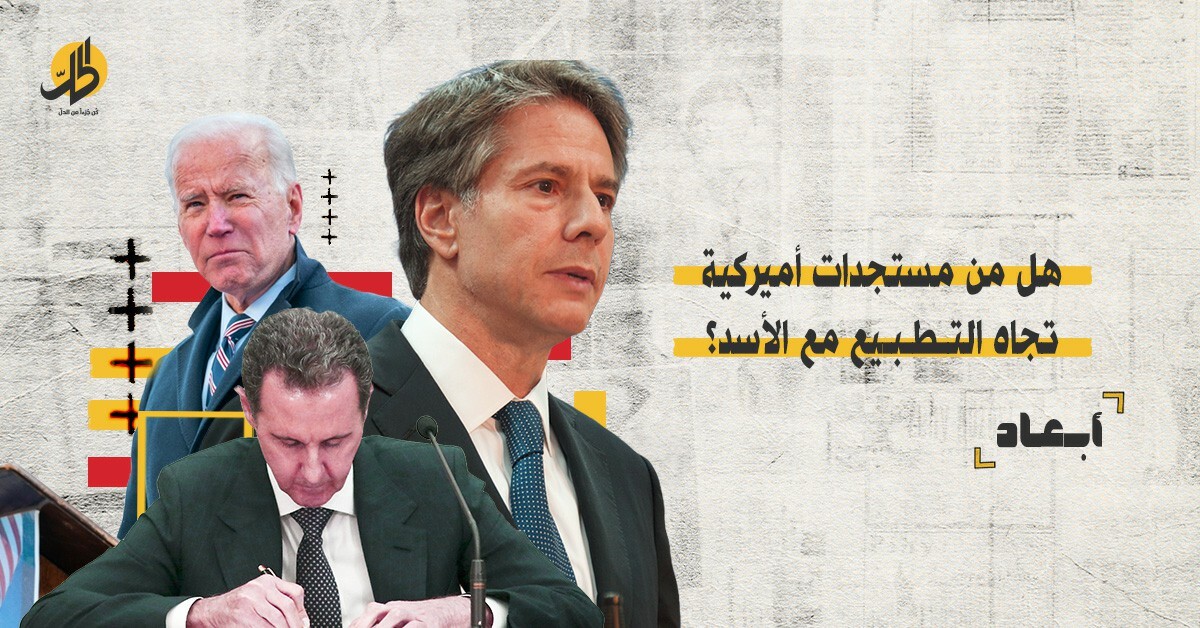
There has been much talk recently about U.S. moves, whether military ones on the Syrian border or political ones related to the issue itself. However, these reports are nothing more than speculation and claims based on routine activity within Washington’s foreign policy agenda.
In the recent period, Washington has sought to carry out a routine reassessment of the situation in Syria. Whatever the significance of such a step may be, it cannot be considered directly related to Arab normalization with Damascus or to whether Washington approves of its continuation.
There is nothing new on which to base expectations regarding Arab normalization with Damascus. The latter still faces several obligations and has shown no serious willingness to comply with them. In addition, the determinants of the U.S. view of the Syrian issue and how to deal with it are tied to several factors, none of which can be ignored.
Recently, Washington was clear regarding the issue of Arab normalization, indicating that it had stressed to regional partners speaking with Damascus that the goal of dialogue should be to improve humanitarian conditions and protect human rights and the security of Syrians.
At the same time, Washington also emphasizes that it will not normalize relations with Damascus in the absence of progress toward a political solution to the current conflict.
To begin with, the clear faltering of the path of Arab normalization with Damascus resembles, in several respects, the faltering and failure that surrounded the Arab Gas Pipeline project, which had been planned to pass through Syria. The reasons for failure were similar, namely the lack of seriousness on the part of Syria’s ruling authority in pursuing a path of political transition. This is not something Washington accepts, nor will it accept Damascus continuing to stall without any genuine transitional developments.
By contrast, Washington does not view the Syrian issue
through the lens of opportunities for Arab normalization with Damascus and where they may lead. Although it gave the green light to the Jordanian initiative on the Syrian issue, it assesses Damascus’s seriousness in parallel with the geostrategic situation there, the balance of power, and how that balance is affected by regional and international developments.
It is not possible to contemplate a U.S. withdrawal from Syria—at least militarily—as long as northeastern Syria remains threatened by military action under the banner of national security, and as long as the issue of jihadists and the remaining terrorist forces in northwestern Syria remains unresolved.
In parallel with that, on what basis could Washington reconcile itself to the idea of regional or international rapprochement with Damascus, including one involving Washington itself? What about the documented human rights violations and war crimes? How could any U.S. administration move past them unless there were positive indicators of real change in Damascus? Any shift in the U.S. outlook would require political signs, both domestically and externally, indicating the possibility of change, even though that remains unlikely and does not exceed 2 percent. Domestically, the two major parties in the United States are fully aware of the nature of the actions and statements of the ruling authority in Damascus.
Externally, the crisis caused by Russia’s invasion of Ukraine, and Russia’s arrogance—whose weaknesses are becoming increasingly apparent—carry the greatest weight in Washington, as does the impact of China’s economic rivalry with the United States. Assad’s alignment with Russia and China further complicates Damascus’s path toward a political settlement, if not destroying any hopes Assad may have in that regard altogether.
Regionally, countries in the region also face the danger posed by Syria’s role as a hub for the manufacture and trafficking of drugs under Iranian sponsorship. Tehran, for its part, does not stop at this issue in troubling the countries of the region. These are also issues that trouble Washington, which sees in them the weakness, decay, and dependence of the authority in Damascus on states that form an alliance hostile to it.
“Ab‘ad” is a weekly/periodic political analysis column written by Malek al-Hafez, editor-in-chief of Alhal Net.