

Turkey witnessed a decline in 2023 in the number of foreigners marrying compared with 2022, according to recent data issued by the Turkish Statistical Institute. Syrian men and women ranked second among foreigners marrying Turkish citizens during the past year.
According to the Turkish Statistical Institute, Syrian women married to Turkish men made up 11.3 percent, ranking second after Uzbek women. Meanwhile, Syrian men accounted for 19.2 percent of foreign grooms married to Turkish women, ranking second after Germans.
However, these statistics are not entirely accurate, since marriages and divorces often take place outside the framework of Turkish law through what is known as customary or religious marriage, or a “sheikh’s contract,” and are not recorded in the Turkish civil registry (nüfus). The phenomenon of Turkish men marrying Syrian women is not new, but it increased after the Syrian war and took on exploitative dimensions as a result of multiple factors, including poverty, need, and the search for stability, according to researchers and rights advocates.
A number of Syrian women say their marriages to Turkish men were successful experiences. Others, however, describe them as harsh and painful, ending in separation and the loss of their rights. They attribute this to rejection by Turkish society and its lack of acceptance of them as Syrians, as well as to the failure to officially register the marriage with Turkish authorities.
Motives and repercussions
The war raging in Syria since 2011 has driven millions of Syrians to seek safe haven in various countries, including Turkey, in search of stability and security. Given the security and economic difficulties, many Syrians find it hard to return home, making marriage to citizens of host countries an opportunity to achieve legal and economic stability.
This was confirmed by Dr. Talal Mustafa, a researcher at the Harmoon Center for Contemporary Studies. Speaking to Al-Hal Net, Mustafa said that several factors drive marriages between Syrian women and Turkish men, including the cultural closeness between the two neighboring countries and their many shared customs and traditions, in addition to the search for safety and stability and the need to improve living conditions amid poverty and a lack of job opportunities.
Dr. Mustafa also pointed to the religious aspect as one of the reasons behind these marriages, explaining that the “sheikh’s contract,” concluded in the presence of witnesses and a cleric, is considered part of Syrian culture. Despite this, this type of marriage is considered illegal in Turkey, raising problems related to legal recognition and rights.
Difficult economic conditions, the search for safety, and legal stability are some of the reasons that make marrying a Turkish man attractive to Syrian women
Wadha al-Othman
For her part, Wadha al-Othman, a social researcher and director of the Refqan Women’s Association, believes there are several factors pushing Syrian women to marry Turkish men. She noted that the effects of the war in Syria created harsh conditions, especially for women, who became more vulnerable to its repercussions. Difficult economic conditions, the search for safety, and legal stability are among the reasons that make marrying a Turkish man attractive to Syrian women, especially those who have lost family support and live in difficult circumstances.
Al-Othman added that the negative repercussions of these marriages, especially when they are not legally registered, expose women to the risk of separation without legal protection for their rights or the rights of their children. Such marriages can lead to feelings of inadequacy and social marginalization, and heighten women’s fear and anxiety that their husbands may abandon them.
Marriage experiences between success and failure
Zeinab, 25, went through a harsh marriage experience with a Turkish man that ended in divorce after she gave birth to a daughter, who is now four years old. Zeinab married a Turkish man who had been married before and was much older than her, and their marriage was an unregistered religious marriage, a “sheikh’s contract.” Even so, she had hoped to find stability and care in this marriage, especially since she was alone in Turkey and suffering from difficult economic conditions.
Zeinab told Al-Hal Net that Syrian girls are often exploited in their search for safety and stability, and because they have no provider, they settle for very little. But they soon discover the bitter reality after marriage.
Zeinab also pointed out that Turkish men tend to pay lower dowries to Syrian women than to Turkish women, and often only a small part of the dowry is paid upfront, with a promise to pay the rest later, something the husband often evades, as happened with her. After divorce, the Syrian wife loses all her rights, including the agreed dowry that was never fully paid, because the marriage was not officially registered and there are no legal obligations compelling the husband to honor it.
On the other hand, Zozan, 33, recounts her love story and marriage to a Turkish man she met after arriving in Turkey in 2011. Although he was married and had two daughters, he convinced her that his marriage was unstable and that he was in the process of separating from his first wife.
Although Zozan was subjected to physical violence by her Turkish husband and filed complaints supported by medical reports, she did not find justice from the Turkish authorities because they did not recognize the second marriage.
Zozan told Al-Hal Net that she married him through a customary religious contract while waiting for him to complete his divorce procedures, but later discovered that he had been lying and was still living with his wife and children. After a failed attempt to flee to Europe, during which she survived a boat sinking, she decided to return to him after they reconnected.
Despite being subjected to physical violence by her husband and filing complaints backed by medical reports, Zozan did not find justice from the authorities. But after becoming pregnant and giving birth to a child, her husband began treating her better, and she was finally able to officially register their marriage in 2021, which brought stability to her life after his first wife separated from him.
Legal adviser Ali Rashid al-Hassan told Al-Hal Net that many Syrian women marry through a customary “sheikh’s contract” despite knowing what Turkish law stipulates. He noted that in Turkey a second wife is not officially recognized, has no rights, and cannot inherit, since civil law does not permit polygamy. Regarding the increase in divorce cases, al-Hassan said this is because customary marriage is illegal and unrecognized, and because dowries for Syrian women are lower than those for Turkish women. As a result, husbands find divorce easy, since Turkish courts do not accept lawsuits from wives seeking recognition of the marriage, even if they have had children.
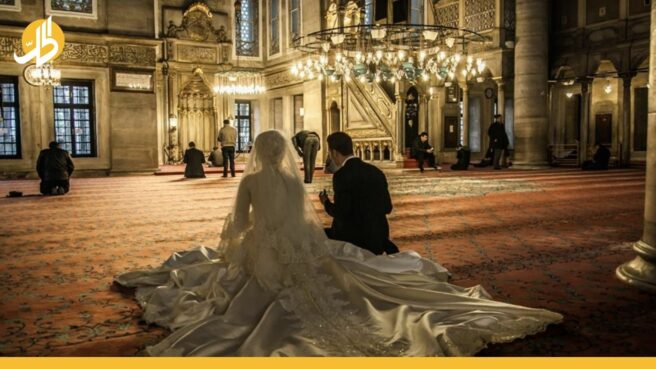
By contrast, there are many successful marriages that are legally registered, in cases where the Syrian woman is the first wife or marries a divorced or widowed Turkish man. In such cases, the wife obtains all her rights, especially since many young Turkish men marry for love and by choice, not with the intention of exploitation.
Speaking about her successful marriage, Kinda Yildiz told Al-Hal Net that she has been married to a Turkish man for two years. She met him by chance, and they fell in love after getting to know each other. The marriage was conducted legally and officially through the court, since her husband had not been married before, which made the union easier. Yildiz added that her husband gave her all her rights and even registered their home in her name, although she had not asked him for anything. She stressed the need to reject racism between Syrian and Turkish society, as the two are neighboring peoples who share many customs and traditions, as well as ties of kinship and marriage.
Meanwhile, Ella Badak, 35, who has been married to a Turkish man for seven years, said her marriage came about through the families, “a match destined to be,” and was duly registered in court, granting her full rights. She considered her experience of marrying a Turkish man successful despite some problems and obstacles caused by his family and Turkish society solely because she is Syrian, even though she is of Turkmen origin and has spoken Turkish fluently since childhood, in her words.
How is second marriage viewed in Turkey?
Marriage in Turkey is civil and must be completed only through municipalities, while religious marriage, although not prohibited, is recognized only if it takes place after the civil marriage for those who wish to do so. Turkish marriage law applies to foreigners residing in the country just as it applies to Turkish citizens, and is based on equality between men and women.
There are conditions that must be met to complete marriage procedures, such as both parties having reached the age of 18 and presenting proof of being unmarried, in addition to the strict condition that neither party be bound by another existing marriage. Polygamy is prohibited and punishable by law in Turkey, and a second wife has no legal rights or right to inheritance as long as her marriage is not legally registered.
As for the children of a second wife, Turkish writer and journalist Celal Demir told Al-Hal Net that they can be registered in the names of both father and mother by mutual consent without the need for a legally recognized marriage contract. If the husband refuses to register his children under his name, the second wife has the right to file a lawsuit against him. The court then conducts a DNA test, and once paternity is established, the children are registered in the names of the father and mother. However, the woman does not acquire the legal status of a wife; rather, she is considered a single mother of children resulting from a relationship outside the framework of legal marriage.
Attempts to raise awareness among Syrian women
Although second marriage is illegal, it exists socially and is widespread, Demir said. In some cases, custom is informally accommodated, allowing the second wife to claim she is a wife. But she does not inherit and receives no rights unless the husband voluntarily registers something in her name.
In light of the spread of Syrian women marrying Turkish men, with outcomes ranging from success to failure, questions are being raised about the role of the Free Syrian Lawyers group in Turkey in addressing these cases, in which Syrian women find themselves victims of exploitation because of poverty, need, and the desire for stability.
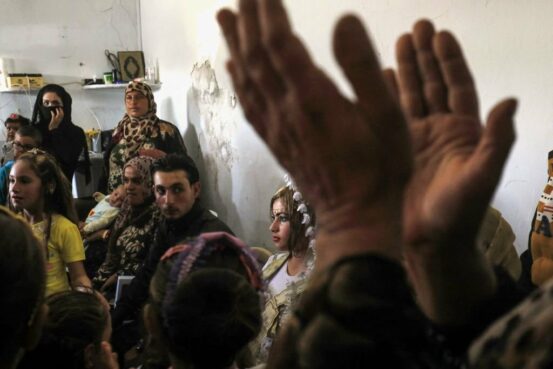
In an interview with Al-Hal Net, Suleiman al-Qarfan, a member of the council of the Syrian Lawyers Bar Association in Syria and Turkey, explained that at the beginning of displacement, Syrians were unaware of Turkish law prohibiting polygamy. This lack of awareness led many Syrian women to fall victim to exploitation. Al-Qarfan said that the bar association, in cooperation with the Free Lawyers Association and other civil society organizations, organized many seminars and workshops focused on introducing Turkish law and spreading awareness about it, warning of the danger of customary marriage in a country that relies on civil law and prohibits polygamy, which leads to wives and their children losing all their rights.
According to Suleiman, the phenomenon of marrying an already-married Turkish man is currently limited to Syrian women who have lost their provider and live in difficult financial conditions, pushing them to accept marriage despite knowing there is no legal guarantee protecting their marital rights.
Al-Qarfan confirmed that the bar association continues, in cooperation with the Syrian community in Gaziantep, to organize awareness meetings aimed at informing Syrian men and women about Turkish law and the dangers of marriage outside the legal framework, especially among minors.
- How the Houthis Are Choking Yemen’s Peace Efforts with a Broad Escalation on the Ground
- Economy in the Wind: How Yemenis Are Paying the Price of Disrupted Shipping Routes
- Houthi Summer Centers: Factories for Indoctrination and Raising a “Scream” Generation
- The “Coalition of Necessity”: What Costa Rica’s Terrorism Designation of the Houthis Signifies
- Mojtaba Khamenei Runs Iran from His Bed as Photos Vanish and the Supreme Leader Makes a “Voice-Only” Appearance