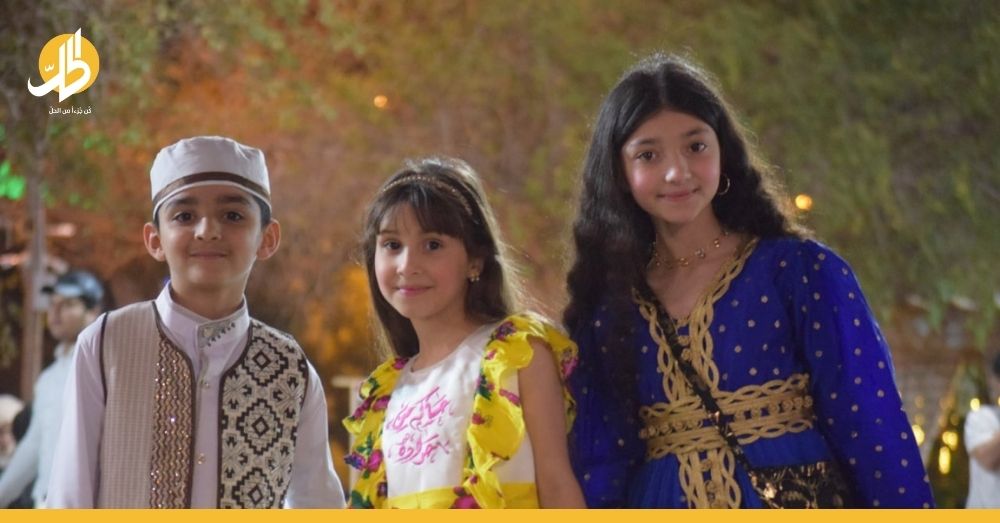
“Qarqi’an, Qarqi’an.. between Qusair and Ramidan”—with these words, children in Basra province in Iraq’s far south welcome the middle of Ramadan, chanting their traditional song while wearing special clothes.
The city, whose customs and traditions are close to those of the Gulf states, has long marked the fifteenth day of Ramadan with the “Qarqi’an” celebration, a tradition for which it is known alongside the Gulf countries, unlike the rest of Iraq’s provinces.
Read also: “The Deep State”.. An Iraqi drama that tries to portray political reality
Qarqi’an and Grandparents’ Memories
The “Qarqi’an” celebration is a heritage custom well known to the people of Basra. It resembles similar traditions in the Gulf states; children look forward to it in mid-Ramadan, while adults are reminded of the good old days.
Despite modernity and the social transformations Iraq has undergone over the past two decades as a result of various events, “Qarqi’an” has remained a popular custom preserved by the people of Basra. Children fill the neighborhoods on the nights of mid-Ramadan, and sweets are handed out to them after they chant the Qarqi’an song, following the Isha prayer.
Basra families traditionally dress children in Arab attire—a dishdasha or jalabiya, along with a cap—and give them a colorful cloth bag matching the cap, sewn by mothers especially for the occasion. Some children hang it around their necks. Young girls wear traditional dresses or carry a cloth bag in the same color as the dress, then go from house to house knocking on doors, while residents give them sweets and nuts.
Ahmed al-Rajhi, 37, from Basra, told Al-Hal Net that “Qarqi’an is part of the popular heritage of Basra province and its people, who are striving hard to preserve what remains of the customs and traditions of the good old days after modernity swept nearly everything away.”
He added that “there is no agreed-upon account of its origins. Some say it dates back to before the advent of Islam, while others link it to the commemoration of the birth of Imam Hasan, the grandson of the Prophet Muhammad and the second Imam in Shiism.”
According to al-Rajhi, Qarqi’an is “an opportunity to instill customs and traditions in children so as to preserve the identity of the city and its people, in addition to teaching them to lend a helping hand and assist others. That is why Basra’s longtime residents preserve this heritage.”
Read also: It hasn’t happened in a quarter century.. Ramadan will come twice this year
What Does Qarqi’an Mean?
Qarqi’an has more than one suggested meaning. Some say it comes from the phrase “qurrat al-ayn,” referring to something dear or joyful—here meaning “a joy to the Prophet Muhammad.” Others say the name comes from the Arabic expression for “knocking on the door,” since children in the past used to knock on doors to receive their gifts. There are also those who trace the word back to “qurrat al-ayn” as an expression of the joy of those fasting at the midpoint of Ramadan.
For the Qarqi’an celebration, sweets and nuts shops begin preparing early for this special Ramadan day to meet the demand of residents who are still keen to preserve this heritage custom, buying the treats either by the kilo and packing them themselves or purchasing ready-made wrapped packages.
Although the practice of going around the streets has declined in recent times, and the number of children roaming outside has become limited, the occasion has still managed to preserve itself within Basra households.
Read also: Iraq’s Ramadan drama: revival or setback?