

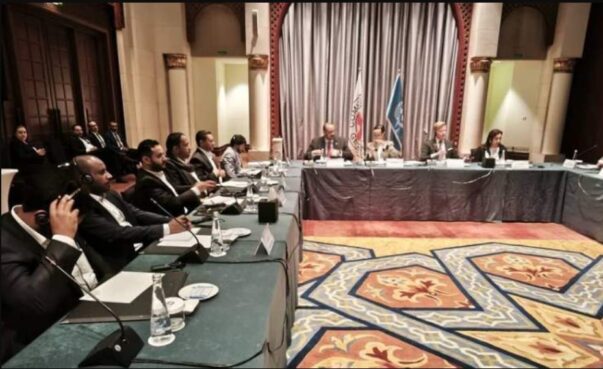
Negotiations over prisoners and abductees, currently underway in the Jordanian capital, Amman, under UN auspices, remain suspended between progress and deadlock. While a partial breakthrough has been made on some issues, disagreements persist over key matters, leaving the anticipated deal without a clear resolution.
Obstacles Hindering the Agreement
According to an informed source who spoke to “Al-Masdar Online,” discussions between the internationally recognized Yemeni government and the Iran-aligned Houthi group have made progress toward agreement on the lists of names included in the exchange deal.

But this progress has not yet translated into a final agreement, amid what the source described as “specific obstacles” hindering the completion of a final formula.
He explained that these obstacles, despite being limited compared with what has already been achieved, still require further discussion, noting that overcoming them depends on the seriousness of the parties, amid a clear divergence in how they are handling this humanitarian issue.
At the same time, the parties are maintaining a degree of media restraint, in what resembles a “calculated silence,” aimed at keeping the negotiating track alive. However, this calm does not negate the existence of real complications related to implementation mechanisms and guarantees of compliance—points that often obstruct agreements in their final stages.
The source also pointed to “maneuvering and calculations” on the part of the Houthi group, without providing further details. This aligns with previous accusations by the government that this issue is being used as a bargaining chip to secure political gains, rather than being treated as a humanitarian matter.
A Long Track and a Stalled Agreement
This round is an extension of a negotiating track that began months ago, as the two sides’ delegations arrived in Amman in early February to continue discussions on an exchange deal involving about 3,000 prisoners and abductees.

These talks are based on a preliminary agreement reached during the Muscat consultations at the end of last year, providing for the exchange of about 1,700 Houthi prisoners in return for 1,230 civilian abductees and prisoners from government forces.
Although an earlier deadline had been set to complete the implementation arrangements before January 23, including enabling the International Committee of the Red Cross to visit detention sites, implementation stalled amid an exchange of accusations between the two sides over responsibility for the obstruction.
A Deferred Agreement
So far, there is no clear timeline for concluding the current round, opening the door to multiple scenarios, ranging from a limited breakthrough to postponing unresolved issues to later rounds.
The issue of Yemeni prisoners remains a test of the parties’ ability to deal with humanitarian issues outside the calculations of war, at a time when thousands of families are still waiting for tangible results that will bring this suffering to an end.
- How the Houthis Are Choking Yemen’s Peace Efforts with a Broad Escalation on the Ground
- Economy in the Wind: How Yemenis Are Paying the Price of Disrupted Shipping Routes
- Houthi Summer Centers: Factories for Indoctrination and Raising a “Scream” Generation
- The “Coalition of Necessity”: What Costa Rica’s Terrorism Designation of the Houthis Signifies
- Mojtaba Khamenei Runs Iran from His Bed as Photos Vanish and the Supreme Leader Makes a “Voice-Only” Appearance