Against the backdrop of the war that has continued since late February 2026 between the United States and Israel on one side, and Iran and its regional arms on the other, debate is intensifying over a gap that appears increasingly clear between Tehran’s political rhetoric and the results of its policies on the ground.
While Iran’s leadership continues to promote the ideas of “resistance” and “sovereignty,” developments on the battlefield point to a different reality. The war’s repercussions are spreading across several countries in the region, with rising human and economic costs and no sign of any decisive strategic shift.
Resistance that dies in reality
For decades, the Iranian regime has raised the banner of “resistance” against Western and Israeli powers, claiming to lead a defensive project aimed at protecting “sovereignty” and the “dignity of peoples.”
But the current war has shown that these slogans were little more than mobilizing rhetoric designed to rally as many supporters as possible. From Iran to Iraq, Syria, Lebanon and Yemen, the result looks much the same: open-ended conflicts, crisis-ridden states, and peoples paying the price for choices they do not control.
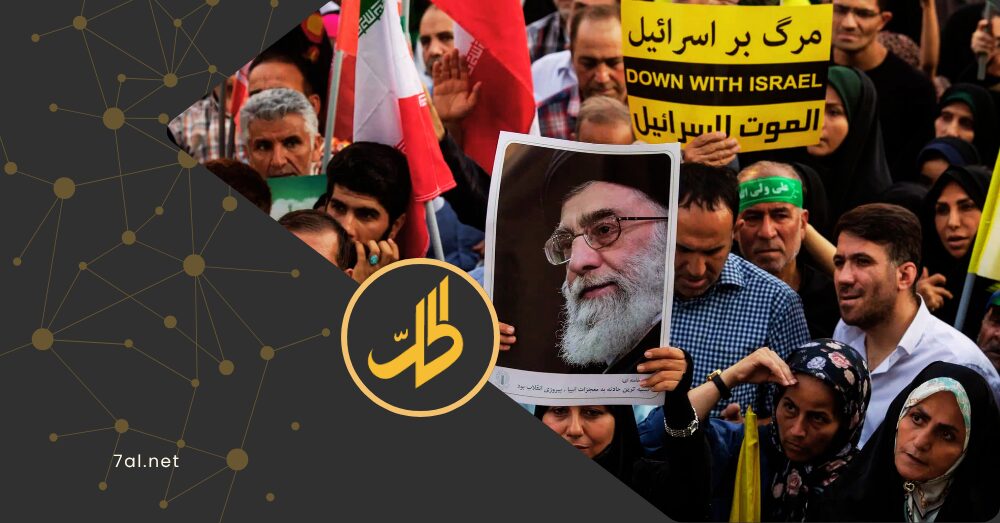
A woman holds a sign reading “Death to Israel” in three languages during a protest by supporters of the Iranian regime — Internet
These policies have failed to deliver even a minimum of stability. Instead, they have deepened fragility, while Iran itself faces mounting political and economic pressure at home.
A review of the war’s course makes clear that missile strikes or threats to close the Strait of Hormuz have not produced any qualitative shift in the confrontation, while US and Israeli strikes since Feb. 28 have hit military facilities and sensitive infrastructure inside Iran.
In this context, the rhetoric of “resistance” is losing its force on the battlefield. It has shifted from a mobilizing slogan to a path toward the loss of real sovereignty over political and military decision-making inside Iran itself, as recent developments have shown.
Lebanon: Hezbollah hijacks sovereignty
Lebanon is one of the clearest examples of how Iran’s slogans have turned into a destructive battlefield reality. At the start of the war, Hezbollah launched attacks on Israeli targets, prompting the Israeli army to carry out broad strikes in southern and northern Lebanon, with wider ground and air operations than in any previous truce.
Lebanese displaced people sleep on roads in Beirut after fleeing southern Lebanon because of Israeli shelling — Internet
The Lebanese government condemned these attacks by Hezbollah, carried out without a state decision, and stressed that the decision on war and peace must remain solely in the hands of the Lebanese state.
What stands out is that Iran’s narrative of “resistance” is translated in practice into military decisions taken outside the will of the Lebanese state. That has caused Lebanon heavy human and material losses, while the notion of sovereignty, meant to belong to the state, is ceded to decisions made by an unofficial force tied to Tehran.
Iraq: “The stateless entity drags the state into war”
The same pattern is repeated in Iraq, though in a different form. Shiite factions loyal to Tehran have joined the conflict by launching attacks on US and allied bases on Iraqi territory, even as the official authorities try to keep the country away from the escalation.
This overlap between Iran’s proxies and the Iraqi state’s official decision-making reflects a weakening of sovereignty and diverts state resources and capabilities toward regional agendas that do not serve the majority of the Iraqi people.
In this way, Iraq has shifted from a state with political decision-making power to a battleground for conflicts that go beyond its national interests, reinforcing the reality captured by the phrase: “the stateless entity drags the state into war.”
Yemen: The Houthis enter the war
Yemen’s Houthi group has made a major difference in the current war by deciding to enter the conflict directly. On March 28, the Houthis launched ballistic missiles toward Israel, declaring support for Iran and describing the war as a defense of the “resistance fronts.”
A protester holds a picture of Iranian leader Ali Khamenei during a Houthi supporters’ rally in solidarity with Iran in Sanaa — Internet
The move has also exposed divisions within the group itself. Informed sources said some senior leaders were not consulted before the decision was taken, underscoring the influence of Iranian rhetoric on critical decision-making inside the group.
The Houthis’ position overlooking the Bab al-Mandab Strait also poses a threat to international shipping, adding a further economic and security dimension to the ongoing crises.
Their entry into the war in this way appears to widen the conflict and extend what was known as the “axis of resistance,” while also increasing the costs of a war being borne by the peoples of countries that were not originally party to it.
The war has stripped Iran bare
What distinguishes the current war from previous battles is that it has made clear how the narratives of “sovereignty” and “resistance” were used as cover to expand regional influence at the expense of the sovereignty of the states involved.
Countries whose leaders raise slogans of self-defense are being turned into arenas for military decisions made outside their official institutions, as has been clearly seen in Lebanon, Iraq and Yemen.
This reality has deepened the fragility of state institutions and worsened economic and social crises, without delivering any meaningful gains to their peoples.
In the end, the gap between rhetoric and reality in the current war appears wider than in any previous conflict, raising serious questions about the future of stability in the region amid the growing role of Iran’s proxies in shaping the decisions of states and peoples paying a heavy price for this war.