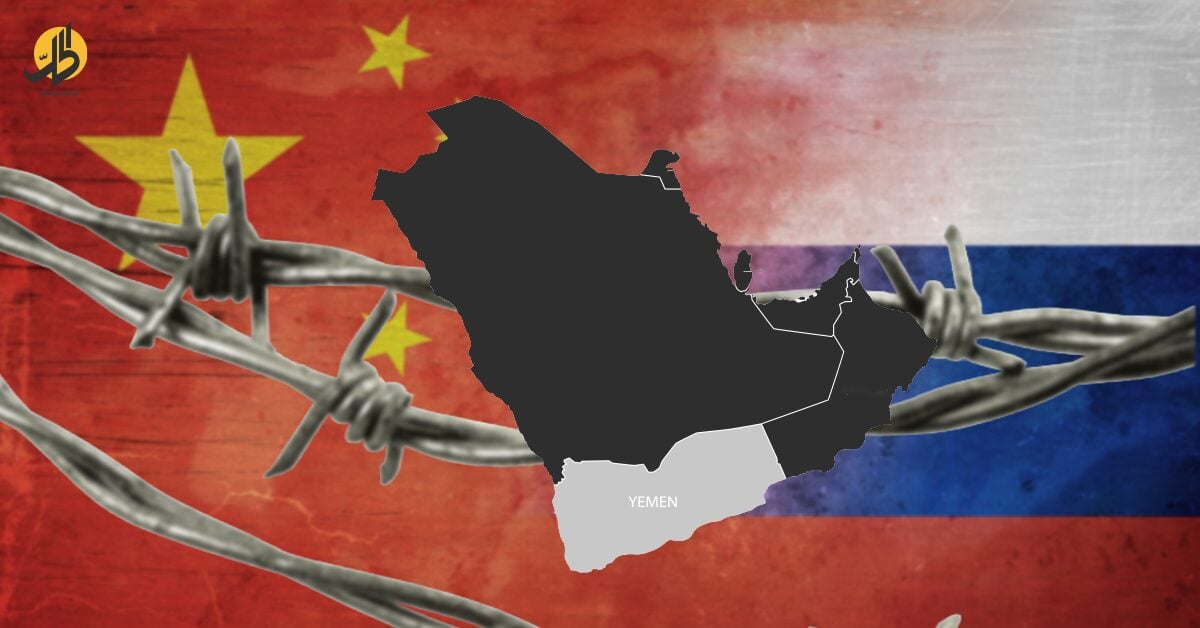
The Russian and Chinese veto in the United Nations Security Council a few days ago against the Gulf-backed draft resolution — specifically Bahrain’s — on ensuring the security of international navigation in the Strait of Hormuz, through which one-fifth of the world’s energy and liquefied natural gas supplies pass, was not surprising. Rather, the move appears expected and goes beyond the idea of Beijing and Moscow backing Tehran. It is one indicator of the complex and divergent balances that govern the two powers’ behavior in the Security Council, and it also reflects, in part, the underlying geopolitical struggle at the top of the world with the United States.
The Russian-Chinese veto sends an implicit message to Gulf states that relations with Moscow and Beijing remain governed by interests, not by hard security alliances that can be relied on in moments of sharp escalation.
Both Russia and China operate from an approach aimed at curbing Western influence and channeling it, or advancing it, through the Security Council, especially when a draft resolution is put forward that assigns responsibility to one side alone, giving Washington and its allies international cover to intensify pressure or widen military action. For that reason, the veto came as a necessary and direct procedural move, not to support Tehran but as part of calculations to protect a strategic partner, with Iran representing an important and functional element in the balance for both countries — whether as a counterweight to Western influence for Russia, or as an energy source and economic hub in China’s cross-border initiatives.
“Pragmatic relations with the Gulf, not hard alliances”
This position goes beyond the immediate crisis to reflect a broader struggle over the rules of the international order, amid fierce competition with the United States, whether covert or open. The rules taking shape through the war with Iran, and the implications they carry for regional security and energy security, touch on Beijing’s and Moscow’s interests and overlap with them. Thus, although the war may appear at first glance distant from China and Russia, it is deeply adjacent to their interests, something that became clear with the Security Council veto.
It therefore seems natural for Moscow and Beijing to seek to curb Western monopolization of the mechanisms of international legitimacy, according to the logic and vision of their management of regional and international politics and interests, and to block the entrenchment of precedents that could later be used against them or their allies and undermine their privileges.
Blocking the adoption of a binding resolution preserves room for political maneuvering and strengthens the two powers’ role in any future negotiating track, rather than leaving the initiative in the hands of parties that succeed in sidelining Moscow and Beijing in favor of international rivals. The veto therefore sends an implicit message to Gulf states that relations with Moscow and Beijing remain governed by interests, not by hard security alliances that can be relied on in moments of sharp escalation.
This position can only be understood in purely pragmatic terms, aimed at adjusting the balance of power and preventing rivals from making political gains, even if that comes at the expense of existing balances with other parties.
The Gulf faces a complex strategic test
Without question, this war is not only redrawing the map of control on the ground; it is first redefining the meaning of alliances. The war in Iran exposes differences on more than one level, whether in relation to functional partnerships or hard alliances, and whether they are tactical, temporary and limited, or strategic.
Accordingly, the moment of confrontation in the Middle East appears to be a sharp dividing line between the logic of interdependence and strategic alignment, as economic calculations recede before considerations of power and deterrence.
Within this framework, Gulf states find themselves facing a complex strategic test that goes beyond managing the current crisis to reassessing the entire structure of their international relations. The multipolarity that gave them wide room to maneuver in recent years could, under the pressure of major conflicts, turn into a burden that forces a redefinition of core reference points and the limits of openness to competing powers.
While the United States and Israel on one side, and Iran on the other, agreed to a full two-week ceasefire, part of the crisis will remain tied to the course of negotiations between the two sides in the Pakistani capital, Islamabad, especially regarding the Strait of Hormuz and freedom of navigation in this waterway.

The Strait of Hormuz is one of the world economy’s most vital arteries, carrying about 11% of total global trade, more than a quarter of seaborne oil trade, and nearly one-fifth of global consumption of oil and its derivatives, amounting to about 20 million barrels a day. The strait also handles close to one-fifth of global liquefied natural gas trade, making it an indispensable strategic hub for the stability of energy markets and international supply chains, according to press reports.
In this context, and alongside the escalation in military operations, navigation through the strait has been severely disrupted, with large numbers of tankers and cargo ships stranded on both sides. Tehran insists it will not allow the passage of what it calls “hostile ships,” while allowing vessels from other countries to pass after coordination with it.
The war in Iran and shifts in international alliances
Meanwhile, the war in Iran has emerged as a sharp turning point in the shape of international relations, the approach to alliances, and the balance of interests among states, pushing those issues onto different tracks after a full temporary military truce was reached.
Over the past decade, there has been notable rapprochement between Arab Gulf states, China and Russia on several levels, especially in energy. China relies heavily on imports of Gulf oil that pass through the Strait of Hormuz, and it was a direct and active mediator in the agreement between Saudi Arabia and Iran in what became known as the “Beijing Agreement.” This trajectory was further consolidated through the third meeting of the Saudi-Chinese-Iranian trilateral committee in December of last year.
But the picture looked different in a direct and immediate way as the war unfolded, and in the attacks Gulf states have faced repeatedly and directly since the war began in late February this year.
China and Russia on one side, and Iran on the other, have strategic and economic ties, but they remain tactical in managing the balance of interests and how to engage in the conflict.
This conflict has exposed a major contradiction in the balance of interests between China and Iran on one side and China and the Gulf states on the other, something that was clearly evident in the Security Council session last Tuesday.
At that time, the United Nations Security Council failed to adopt a draft resolution submitted by Bahrain on opening the Strait of Hormuz after Russia and China used their veto.
Bahrain introduced the draft on behalf of the UAE, Saudi Arabia, Qatar, Kuwait and Jordan, with the aim of securing maritime navigation in the “Arabian Gulf,” amid developments described as dangerous and affecting one of the most important waterways for international trade.
Eleven of the 15 Security Council members supported the draft resolution, while Pakistan and Colombia abstained.

After the vote, Bahraini Foreign Minister Abdullatif Al Zayani said the failure to adopt the resolution sends the wrong message that threats to navigation can go unanswered, adding that the draft was intended to ensure that sea lanes are not used as tools of pressure or blackmail.
To make the picture clearer, one can look at the Russian position, which aligned with China on this approach, when Russia’s representative Vasily Nebenzya said that his country voted against the draft resolution and considered that it was not based on an objective and balanced approach, and that it ignored the root causes of the crisis, above all the U.S. and Israeli strikes on Iran.
China’s representative Fu Cong said that the Bahraini draft resolution on the Strait of Hormuz contained one-sided condemnation and pressure.
By contrast, U.S. representative Michael Waltz said his country stands with Bahrain and the Gulf states, stressing the need to protect maritime navigation security.
Waltz accused Iran of continuing to escalate and target the interests of the United States, its allies and commercial vessels, noting that the Security Council had previously adopted resolutions calling for an end to these attacks.
This position made clear that international relations are governed only by the language of interests, and that what sometimes appears as contradictions in positions is nothing more than a reflection of temporary balances, while the full picture remains hostage to the current state of tension, in which developments on the ground become the decisive factor in shaping states’ positions.
Some decisions within international organizations, especially at decisive moments in the life of nations and states, carry major and serious significance. That is what appeared with the Russian and Chinese use of the veto in the United Nations Security Council, reviving a central question in geopolitics: how do major powers form their motives, and who appears to stand against their interests, away from the horizon of delicate balances and the tactical accommodations of active states.
The impact of the Russian-Chinese veto on Gulf policies
As the war in the Middle East enters its second month, it is revealing many negative repercussions for Arab Gulf states, which makes those countries keen to see military operations continue against the Iranian regime, which has targeted several vital and active sites in the UAE, Kuwait, Bahrain, Saudi Arabia and Qatar.
That did not prevent Russia and China from lining up in some way with Iran through the veto, and from overlooking the principle of relative interest with the Gulf states. This places the scope of their relations with Gulf countries in deep structural contradiction, and leaves room for caution and suspicion in the foreseeable future.
Russia and China approached Tuesday’s Security Council session from a single perspective: preventing rivals from reaping gains through the Security Council platform, regardless of how that affects their interests with the Gulf states.

The narrow room for maneuver that Gulf states adopted as they expanded cooperation with Russia and China while maintaining their partnership with the United States has become a defining point in shaping the future of those relations.
The war in the Middle East has created deep distinctions in Gulf states’ view of major powers and their network of interests, making pragmatism the dominant factor. Put more plainly, Gulf states’ alignment with the Western camp appears to have become clearer after the war.
- How the Houthis Are Choking Yemen’s Peace Efforts with a Broad Escalation on the Ground
- Economy in the Wind: How Yemenis Are Paying the Price of Disrupted Shipping Routes
- Houthi Summer Centers: Factories for Indoctrination and Raising a “Scream” Generation
- The “Coalition of Necessity”: What Costa Rica’s Terrorism Designation of the Houthis Signifies
- Mojtaba Khamenei Runs Iran from His Bed as Photos Vanish and the Supreme Leader Makes a “Voice-Only” Appearance