- How the Houthis Are Choking Yemen’s Peace Efforts with a Broad Escalation on the Ground
- Economy in the Wind: How Yemenis Are Paying the Price of Disrupted Shipping Routes
- Houthi Summer Centers: Factories for Indoctrination and Raising a “Scream” Generation
- The “Coalition of Necessity”: What Costa Rica’s Terrorism Designation of the Houthis Signifies
- Mojtaba Khamenei Runs Iran from His Bed as Photos Vanish and the Supreme Leader Makes a “Voice-Only” Appearance
Homs Residents Outraged Over Electricity Bills Running Into Millions of Syrian Pounds
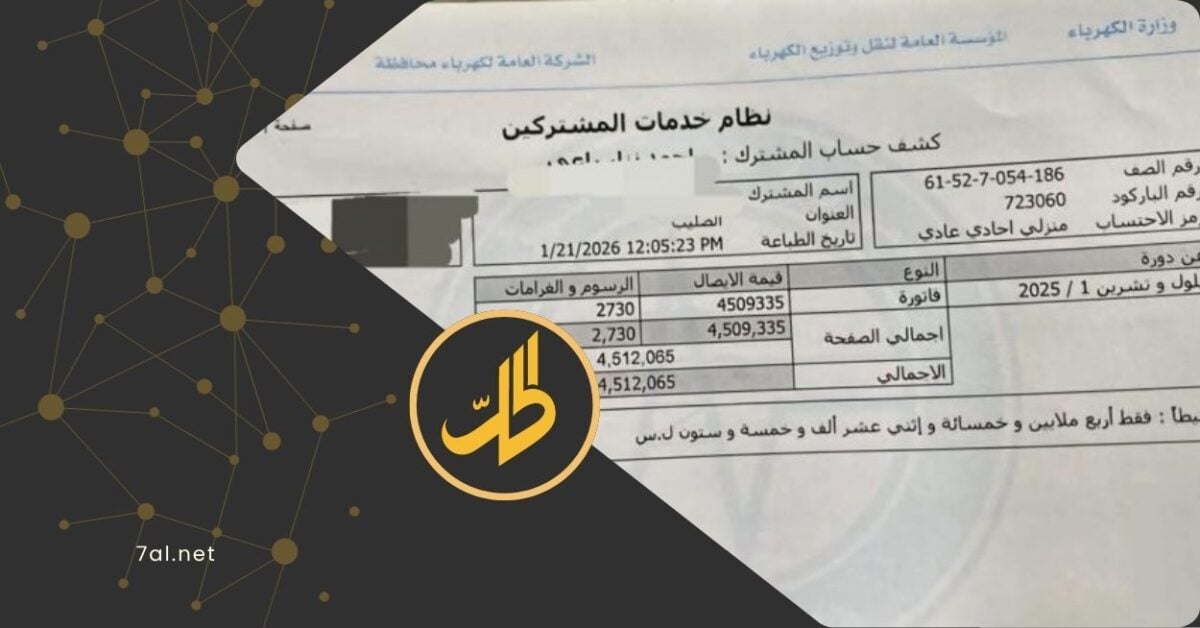
Amid mounting living pressures in Syria, the electricity bill crisis is back in focus as bills are issued at “fantastical” amounts that make paying them an economic disaster for Syrian families. This time in Homs, with the sixth billing cycle issued under the new tariff, unprecedented sums have been recorded, reaching millions of Syrian pounds in some cases.These steep amounts, which bear no relation to limited incomes or to the reality of intermittent electricity supply, have driven residents to flock in large numbers to file objections. As complaints spread, signs are emerging of problems in meter readings and consumption calculations, at a time when living-cost estimates suggest that more than 70% of the population cannot afford to pay basic utility bills.Electricity company centers in Homs have seen heavy crowds, with long lines of residents forming منذ early morning, amid anger and shock over the bills issued. Available data show bills of 325,000 Syrian pounds as a “fixed fee” for unoccupied homes, and others reaching 1.4 million pounds for a single billing cycle, after previous amounts had ranged between 1,500 and 80,000 pounds.There were also cases in which bills reached 6 million pounds, even though previous amounts had not exceeded 6,000 to 7,000 pounds, in addition to bills of 200,000 pounds for families with no fixed income who rely on aid. In contrast to these high figures, one striking anomaly was the issuance of bills showing almost no consumption, amounting to no more than 9 new Syrian pounds (about 900 old pounds), despite meter readers having checked the meters more than once, reflecting a clear failure in recording consumption across different billing cycles, according to the Syrian Observatory for Human Rights.Cross-checking accounts indicate a flaw in the meter-reading mechanism, with consumption sometimes recorded as “zero” despite an actual reading, causing usage to be carried over to later cycles and accumulate progressively. Complaints say actual electricity use is usually limited to essential appliances, with only restricted use of heating or cooling devices, while high bills have also been recorded for subscribers relying on solar power and disconnected from the grid for months.Fixed fees have also been imposed on unoccupied homes, while accumulated consumption has not been allowed to be spread over previous cycles to ease the burden. Subscribers warn that if this pattern continues, bills will balloon later, especially as accumulated consumption is calculated within higher tariff bands, sharply raising costs and turning the bills into an ever-growing cumulative burden.To file an objection, residents must present a personal ID, a photo of the meter and a previous bill, with results supposed to be issued within a week. In practice, however, the process is moving very slowly and centers are severely overcrowded, according to the same source. Complaints say the waiting begins before dawn without adequate organization, increasing tension among residents.The crisis is also having direct humanitarian consequences, as low-income families find themselves unable to pay the amounts imposed, especially amid the absence of fixed incomes or reliance on aid, as well as cases involving families supporting relatives with disabilities. The situation reflects a shift from a service problem to a compounded living crisis that affects people’s ability to get by day to day.Amid the growing complaints, no detailed official explanation has been issued for the high bills, with authorities only citing an administrative decision barring statements during this period, according to Syria TV. The Ministry of Energy had previously said the new tariff takes social groups into account, keeping low-consumption brackets within the subsidy range, and pointed to a plan to improve service and gradually increase supply hours as part of a reform path aimed at sustaining the sector.Under the approved tariff, consumption has been divided into four brackets, starting with a subsidized rate of 600 pounds for up to 300 kilowatt-hours, then 1,400 pounds for the next bracket, rising to 1,700 and 1,800 pounds per kilowatt-hour for higher consumption. But these figures have done little to ease criticism, as calls grow to cancel the new tariff or radically amend it, with warnings that keeping it in place will widen the circle of nonpayment and pile financial burdens on residents in Homs and across other provinces.

0 Comments
أقدم