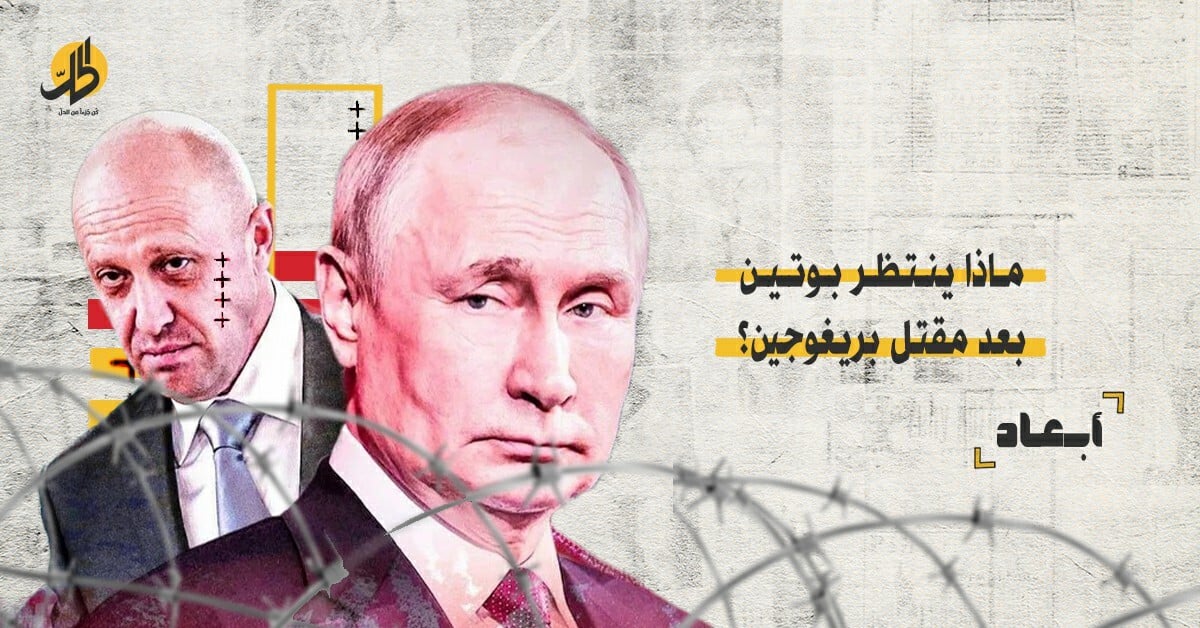
The killing of Yevgeny Prigozhin, leader of the Russian paramilitary mercenary group Wagner, raises many questions about the ramifications of the incident involving the crash—or possible downing—of the private plane carrying him between St. Petersburg and Moscow on Wednesday evening.
Putin’s revenge—if the incident was indeed orchestrated and he was responsible—came early and unexpectedly, only three months after Prigozhin’s acts of rebellion against Putin’s authority in Moscow. The first was in eastern Ukraine against the Russian army, and the second was Wagner’s attempted armed coup and seizure of the city of Rostov before advancing toward Moscow.
In reality, the coup attempt had far-reaching consequences. Putin’s revenge came early, and its apparent aim was to decapitate the threat looming over his authority in Moscow. The first rebellion, which did greater damage to the prestige of the Russian army exhausted in Ukraine, was followed by a second that also struck the prestige of Putin, his intelligence services, and his army inside Russian territory. After assessing the damage, Putin appears to have opted for revenge and elimination rather than the illusory pardon that Prigozhin seems to have believed in. The Russian president also seems to have found a suitable mechanism for managing the leadership of mercenaries not officially recognized by the state, through former military figures whose full and lasting loyalty would have to be to Putin personally. Even as he avoids acknowledging any act of revenge, he is unlikely to forgo the benefits he has gained from mercenary forces he deployed to various regions to expand his influence, most notably in western Africa.
The attempted armed coup last June was a crushing blow to the close relationship between Prigozhin and Putin. The latter appears to have wanted to win the army over to his side rather than back the mutinous commander and his associates, in exchange for reining in the militia, restructuring its forces, and possibly building a new core of unofficial special forces modeled on Wagner to project Putin’s influence beyond Russia’s borders—even though, before the invasion of Ukraine, he had regarded Wagner as a key tool for limiting the army’s room for maneuver against any potential threat that might emerge from within it.
Wagner’s rise to the forefront of Russia’s external military reach, officially since 2015, was an advanced stage in a long pattern of Russian rule over past decades that has relied in external battles and conflicts on irregular forces. Yet as the risks and obstacles facing Putin’s foreign ambitions grow, Russia’s expansion in western Africa has become a test of wills through which Putin has tried to show his adversaries that he can open several fronts of confrontation without affecting the main arena of conflict, namely Ukraine. But Putin’s losses, it seems, will continue to mount. He faced two difficult options: either keep the leader of Wagner, leaving open the possibility of further rebellious acts, or eliminate Prigozhin and gain some reassurance—while still having to take measures to prevent any political or military defections after the message sent by the plane’s crash/downing, a message bound to unsettle Russian officials.
Putin wanted to reinforce his vision, rooted in arrogance, and to cover up military, economic, and above all political losses through obstinacy and continued displays of power that are in fact weakening. But after Prigozhin’s mutiny, Moscow may no longer be able to continue relying on irregular forces through Wagner, even in less important arenas.
On the other hand, the possibility of divisions within the Russian army is increasing in light of setbacks in military operations on Ukrainian territory, as well as the enormous economic costs of the invasion, in addition to the number of people fleeing military service, all of which shows the extent to which society has broken with Putin’s expansionist delusions.
Recently, as Wagner’s role in Russian military operations in Ukraine declined, what remained of its influence was shifted toward the African continent, while some of its members were relocated to Belarus after the failed armed coup.
What Putin will face after Prigozhin’s death may be harder than what he went through after his illusions collided with the reality of his crumbling army in Ukraine and with the Western response to his ambitions in a way that is draining what remains of Moscow’s economic and military strength. Internal problems will be more difficult and severe for Putin’s government, as Russian discontent over the continuing invasion of Ukraine will expand to include a broad segment of military personnel as well as government officials who understood that obeying Putin’s foreign policy line was compulsory—otherwise, Prigozhin’s fate could await anyone who opposes the expansionist course. In any event, the growing rejection of the consequences of Russia’s invasion of Ukraine may strengthen dissenting voices, in parallel with the continued decline in Russian President Vladimir Putin’s electoral popularity.
* “Ab’ad” is a recurring weekly political analysis column written by Malek al-Hafez, editor-in-chief of Al-Hal Net.