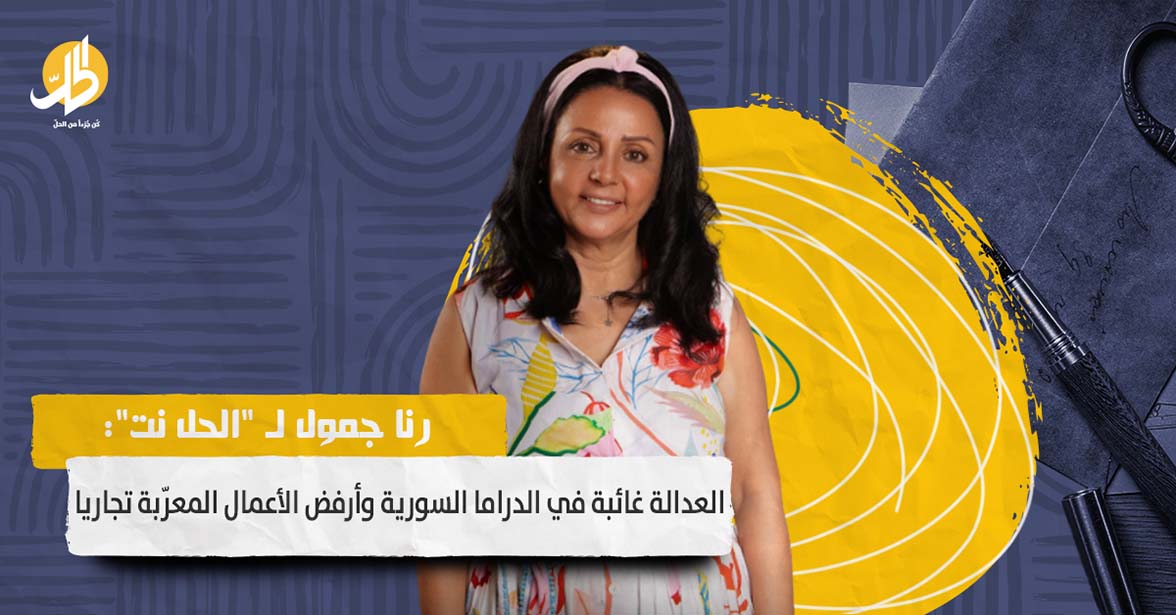
Recently, Syrian actress Rana Jammoul finished her participation in a short series titled “The Last Seat,” written by Louay Al-Nouri and directed by Osama Salama. The series consists of 15 episodes and comes as part of her current television drama work.
In an interview with “Al-Hal Net,” Jammoul explained that the series is a contemporary social drama that presents various family problems in a beautiful way that feels close to the audience.
She added: “Our family in the series is a small one made up of a mother and a father suffering from Alzheimer’s, and they have an only daughter. The husband’s brother tries to seize the house that shelters us. The work also addresses the problems of high school youth in the age of social media, its strong role in stirring up and creating problems, as well as its ability to solve them, in addition to bullying, class differences, and themes of wealth and poverty, chivalry and meanness.”
The Syrian actress expressed her hope that the work will achieve success and wide circulation because, as she says, “It was made with love, passion, and sincerity,” adding: “My experience of working with actress Yara Sabri was also special, and I was very happy with this partnership.”
Speaking about her character in the series, Rana Jammoul revealed that she plays a woman named “Ruba,” who married for love. Her husband is a distinguished mathematics professor who is subjected to grave injustice because of an arbitrary accusation, and his sensitivity and intelligence together lead him to develop Alzheimer’s. This forces “Ruba” to work in a restaurant under severe financial pressure. Yet she refuses to compromise her principles and beliefs, becoming like a lioness defending her dignity and her daughter’s dignity, and teaching the restaurant owner who tried to harass her daughter a lesson he will never forget.
Rana Jammoul… on cinema and artistic fairness
Despite Rana’s interest in cinema, which first opened the doors of fame to her through the famous film “Verbal Messages” alongside the veteran actor Fayez Qazq when she was still a student at the Higher Institute of Dramatic Arts, and despite her enduring passion for theater, evident in her many stage performances, she is, like any actor, unable to do without television because of the reach and financial support it offers—but only under specific, suitable conditions. She rejects chasing any role merely for money. She has portrayed many distinguished characters in successful works, including “Al-Zeer Salem” (2000), “Damascus Ya Basmat Hozn” (1992), “The Palestinian Diaspora” (2004), and many others.
Jammoul said in her interview with “Al-Hal Net”: “What most tempts and attracts me to television drama is the director, who makes working on a series with him a kind of pleasure. We study the script together until we reach creativity in the broad realm of art, in addition to the importance of the character I will play. Its inner world must be full of secrets that tempt me to uncover them and grasp the signals written into the text, so that I can help reveal its psychological dimensions. That is what gives me pleasure in artistic work.”
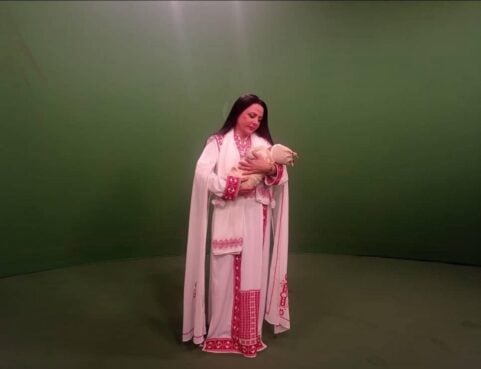
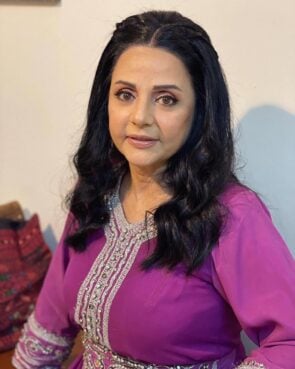
Regarding the many criticisms heard recently about some aspects of Syrian drama and about fairness in the distribution of roles, Jammoul stressed that such fairness is absent in television series and films—not only in Syria, but in most countries of the world—as some faces are repeated while others are absent.
She added: “An actor always needs to be given the opportunity to show his talents. He is like a child who rejoices if he feels that a line he delivered with deep feeling pleased the audience and they were convinced by it, and he is saddened if he is not given the chance to test his skills.”
Artistic comedy
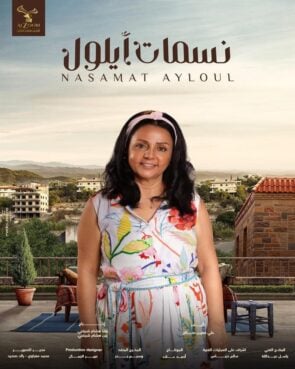
Since “Verbal Messages” (1991), Jammoul has presented many works marked by comedy, and she has been notably successful and effective in her choices. The latest was the series “September Breezes” with director Rasha Shurbatji during last Ramadan, which achieved remarkable success. She said of it: “The energy among the team was positive and tremendous, and affection also played a role in the work’s success, starting with Rasha and Yazan Shurbatji and extending to the actors and technicians. Thank God, we were able to achieve success, especially with the presence of important, beautiful, and enchanting filming locations. The visuals helped win the audience’s affection, as the viewer sees colors, beautiful nature, and costumes crafted with precision so that the artistic picture would be complete.”
As for the character of “Naima,” the kind aunt, she resembles many women in villages and the countryside, and the generosity we saw in her embodies the nature of kind-hearted rural people, according to Jammoul, who confirms: “I personally have an aunt and a grandmother who resemble Naima.”
Rana Jammoul stressed that comedy needs an intelligent script rich in all its elements, a harmonious cast, as well as costumes, accessories, décor, and music. Every element must be essential and deeply thought out, before the role of the director who masters his craft comes into play.
Theater and passion
Rana Jammoul is considered one of the few actresses in Syria who still hold fast to theater, something she always affirms in her choices, preferences, and in both her public and private remarks. When asked about theater in her professional life, she answered: “Yes, I am first and foremost a theater actress, and I adore this art and always belong to it. But theater in Syria needs major financial support, and it can truly thrive when that support is available, because the artistic personnel are present, talented, and experienced. Naturally, I lose enthusiasm under tight financial conditions, but I cannot stay away for long. I return to it through an experience that draws me in, for it is my first and last love. So I endure, get angry, move away, and then return to it.”
Away from theater, and regarding actors’ rush toward working in Arabized Turkish dramas, Jammoul confirmed that her absence from them is due to her dislike of this type of drama. She always wonders what drives a company or team to remake a work that has already been shown, without any real adaptation—copied without any distinctive imprint, with the same shots and dialogue—which makes her feel it is simply a commercial process built on the success of the original version.
The Syrian actress stressed that this adds nothing to the actor, to Syrian drama, or to its history. Syrian drama also possesses a strong group of writers, directors, and actors, and is rich in subjects that can be explored.
Life in Tunisia and the next steps
Rana Jammoul has currently chosen to live in Tunisia because of its culture and developed theater scene, revealing to “Al-Hal Net” that she will work there and will also contribute to teaching theater to women aged 35 to 70. She has obtained residency and is awaiting approval for her project.
Regarding her family life and balancing her work with her family, she answered happily: “I have managed to balance them to a great extent, but family always comes first. Some family relationships must be lived at the right time without delay, such as the relationship with one’s husband and children at certain stages of life. But I can pursue art at any time, and if I apologize for a role because of some circumstance, I have only lost that one opportunity. But I do not accept losing my family, and I feel that I have been successful with my family and its members.”
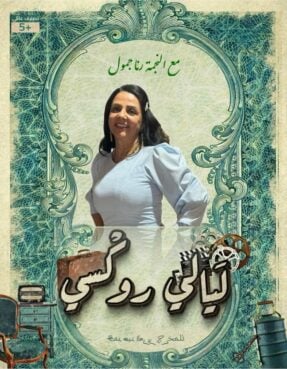
Jammoul revealed her artistic message, which she hopes reaches the audience: that a person should not get lost amid the rush of speed, superficiality, and the absence of depth; should not take things too lightly; and should return to human depth in order to distinguish between what is real and what is fake, and between what is enduring and what is superficial.
Jammoul added that she has the idea of directing a feature film and is also preparing, as part of her near-term plans, to direct a theatrical work. She expressed her hope of achieving what she aspires to: to keep showing variety in the characters she portrays and never stop acting. She also expressed her hope that Syria will enjoy security, peace, prosperity, and abundance, and that citizens will find relief from poverty and oppression. On the personal level, she wished for her children to achieve their goals and fulfill themselves.
- How the Houthis Are Choking Yemen’s Peace Efforts with a Broad Escalation on the Ground
- Economy in the Wind: How Yemenis Are Paying the Price of Disrupted Shipping Routes
- Houthi Summer Centers: Factories for Indoctrination and Raising a “Scream” Generation
- The “Coalition of Necessity”: What Costa Rica’s Terrorism Designation of the Houthis Signifies
- Mojtaba Khamenei Runs Iran from His Bed as Photos Vanish and the Supreme Leader Makes a “Voice-Only” Appearance