
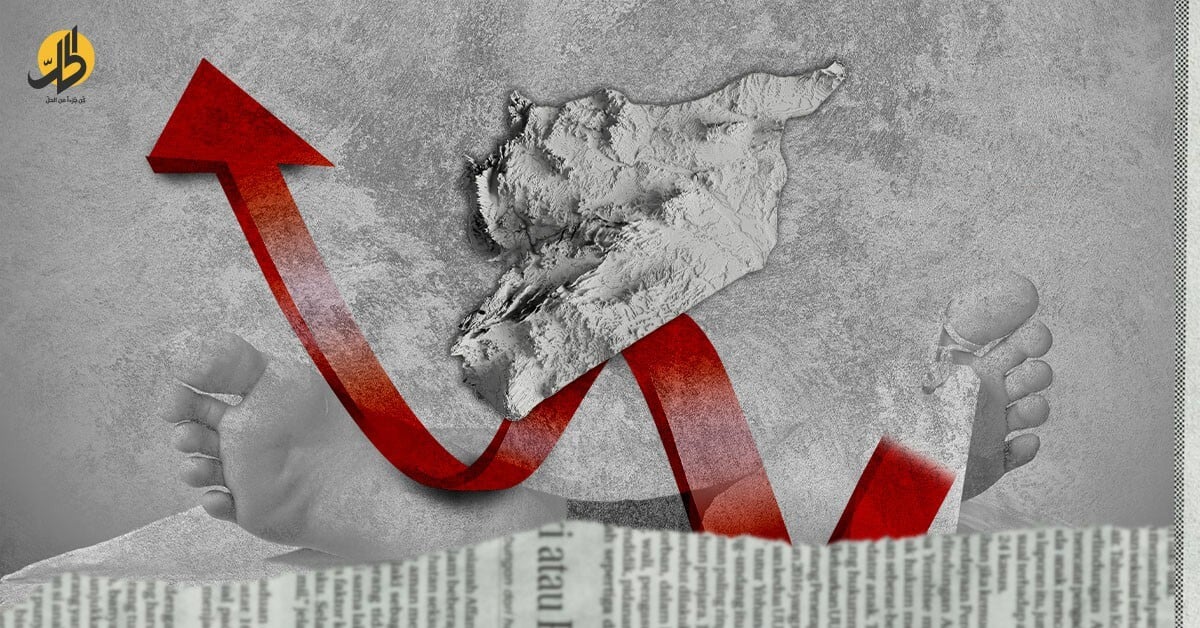
Wars have catastrophic consequences that weigh heavily on peoples living under the brutality of war and conflicts involving multiple parties. The longer they last, the more these negative consequences multiply, whether economic or social, directly affecting people’s psychological well-being and driving some members of society to take their own lives. As the war enters its fourteenth year, Syria is suffering from difficult economic conditions, with the currency losing its value and the country falling in most human rights indicators worldwide, in addition to harsh living conditions, the absence of the most basic necessities of life, no solutions on the near horizon, fading hopes for a breakthrough anytime soon, and a lack of security and stability throughout Syria.
The beginning of the current year has witnessed a noticeable increase in the suicide rate across all regions of Syria, regardless of the controlling authorities. According to the “Syrian Observatory for Human Rights“, the conditions the country is going through have led to a rise in suicides by various means, most of them among young people.
The suicide rate is rising, and young people are the victims
News of suicide or attempted suicide in Syria has become a recurring headline on an almost daily basis in newspapers, articles, and news bulletins. After suicide rates declined between 2022 and 2023, the relevant authorities have once again warned of rising suicide rates at the beginning of this year compared with previous years.
The Syria Response Coordinators team, which is active in northwest Syria, indicated in a report published on February 10 that the suicide rate had increased by 120 percent compared with the number of cases recorded last year. The source confirmed that children and young people are the most affected groups among the victims, with 12 suicide cases recorded during the past week.
The Health Directorate in Idlib recorded 22 suicide cases, including 4 children, since the beginning of the current year
For its part, the Health Directorate in Idlib recorded 22 suicide cases, including 4 children. Ghanem al-Khalil, director of public relations at the Health Directorate in Idlib, told Al-Hal Net that the phenomenon of suicide among young people and children has been increasing noticeably since the beginning of the year, and that “gas pills” remain the most widespread method among this group despite the precautionary measures taken by the Ministry of Agriculture in the Salvation Government, which is affiliated with Hayat Tahrir al-Sham, in distributing these pills and raising awareness about the dangers of ingesting them, which can lead to death. “Gas pills,” or “grain pills” as they are popularly known in northern Syria, are tablets used as a pesticide to preserve various grains from spoilage, but they have come to be used as a means of suicide.
Meanwhile, the General Authority of Forensic Medicine documented 28 suicide cases in areas under the control of the Syrian government since the beginning of 2024. These figures were confirmed to Al-Hal Net by an official in the General Authority of Forensic Medicine during a phone call.
In this context, psychologist Basel Namra explained that poor economic and social conditions create a kind of psychological disturbance and are among the main causes of suicide among children and adolescents. In addition, the use of narcotic substances, if present among this group, is one of the factors that can lead to suicide, alongside family problems and social difficulties.

Inaccurate statistics from the Syrian government
Zaher Hajjo, director-general of the General Authority of Forensic Medicine in Syria, told the local newspaper Al-Watan that during the past year the rate of suicide cases declined in areas under Syrian government control, with the authority recording 146 cases in its report across Aleppo, Damascus, Sweida, Hama, and Tartus.
The decline in suicide cases reached 0.16 percent, with methods varying between gunshot, hanging, stabbing, and poisoning. Areas under Syrian government control had witnessed 159 recorded suicide cases during the past year, according to the General Authority of Forensic Medicine in Syria. But a source from within the authority cast doubt on those figures. The source, who refused to disclose his name, told Al-Hal Net that the suicide cases reaching hospitals confirm that the figures announced by the responsible authorities are not accurate; rather, the suicide rate is much higher than what is officially declared.
The suicide cases reaching government hospitals confirm that the figures announced by the responsible authorities are not accurate; rather, the suicide rate is much higher than what is officially declared.
A source inside the Forensic Medicine Authority
The source also confirmed that most suicide cases result from a sense of life’s futility, the loss of identity among Syrian youth, poor living conditions, unemployment, and family disintegration. Other causes also exist, but they fall under exceptional cases and are not the general or most prominent pattern.
The same source pointed out that there are clear shortcomings in the forensic medicine sector, which suffers from a shortage of personnel and a drop in the number of doctors to one-third, explaining that the total number of practicing forensic physicians in all of Syria is only 52.
Behaviors preceding suicide
Psychological and social views differ regarding the phenomenon of suicide. According to psychology, a person who commits suicide is the victim of aggression directed inward at the self rather than outward toward society. The more integrated a person is in society, the less likely they are to turn to suicide; as the level of integration declines, the likelihood of suicide increases.
To understand suicide as a phenomenon that has become common in Syrian society, it is necessary to examine the behavior of the person considering it. There is no doubt that the decision is not impulsive, but rather comes as the inevitable result of clear behavioral signs. In this context, Asmaa al-Sweid, a specialist in the educational field, believes that a person thinking about suicide sends messages to those around them. These messages come in the form of clear changes suggesting discomfort and dissatisfaction with life, and may also appear in repeated phrases indicating a lack of desire to live or continue trying, or even reach an advanced stage in which the person expresses a desire to die. Al-Sweid added that the suicidal person may be seeking a state of comfort and safety that they believe can be found in death.
Al-Sweid also pointed out that there are certain behaviors shown by those thinking about suicide, such as withdrawal and isolation from their surroundings, in addition to feelings of inferiority and sadness, low self-worth, a diminished sense of deservingness, a negative self-image, and reduced hope in their future achievements.
Among the factors that can lead to suicide are bipolar disorder, bullying, or the loss of a family member in a tragic accident, in addition to other causes.
A new study published by the University of Nottingham in the UK indicated that suicidal thoughts dominate the brain in winter, but acting on them takes shape in spring and summer.
Brian O’Shea, the lead researcher in the study, said: “What is surprising is that spring is the time when people’s mood is supposed to improve, but in reality people are more at risk of suicide during it.”

Are there solutions to curb the phenomenon?
Syrians are suffering from difficult economic, living, and educational conditions across different parts of the country, and they face challenges that require a major international response and clear solidarity from humanitarian organizations operating in Syria. This comes amid the absence of effective institutions based on local community needs rather than external agendas, which further contributes to the spread of the phenomenon in Syrian society.
Baraa Jumaa, a psychosocial support specialist, told Al-Hal Net that there are indeed entities working to combat the phenomenon of suicide in Syria, but they do not operate on the basis of research and science, nor do they build a joint plan to reduce it. Jumaa believes there is a need for an official national body linked to a research institution that studies society, analyzes the factors, and takes all causes into account. The problem is serious and needs to be viewed with this level of breadth and depth, rather than being reduced to only psychological and living aspects.
Looking at the numbers and statistics, more than 90 percent of Syrians live below the poverty line, and more than 1.5 million are in need of urgent humanitarian assistance, in addition to more than two million displaced people in northwest Syria, more than 94 percent of whom suffer major difficulties in securing food.
According to a United Nations report published on March 11 this year, 16.7 million people inside Syria are in need of humanitarian assistance, the highest figure of its kind since the outbreak of the crisis, and the sharp decline in resources has left millions on the brink of hunger.
Syria was ranked among the six countries with the lowest levels of food security in the world, with 12.1 million people (more than half the population) suffering from food insecurity, and 2.9 million suffering from severe food insecurity.
There is no doubt that the spread of such a phenomenon means there are real factors that must be investigated, examined closely, and addressed collectively to curb it.
- How the Houthis Are Choking Yemen’s Peace Efforts with a Broad Escalation on the Ground
- Economy in the Wind: How Yemenis Are Paying the Price of Disrupted Shipping Routes
- Houthi Summer Centers: Factories for Indoctrination and Raising a “Scream” Generation
- The “Coalition of Necessity”: What Costa Rica’s Terrorism Designation of the Houthis Signifies
- Mojtaba Khamenei Runs Iran from His Bed as Photos Vanish and the Supreme Leader Makes a “Voice-Only” Appearance