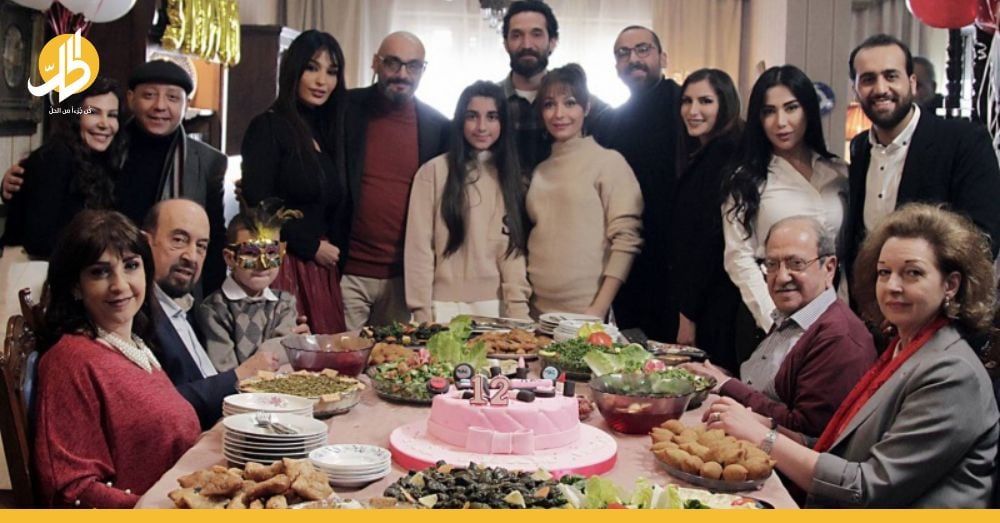
The series “On the Verge of Love,” which won over a good share of viewers from the moment its first episodes aired during the 2022 Ramadan drama season, did so partly because it was free of scenes depicting the events and repercussions of the Syrian war, and partly because it presented its stories in a warm, calm way, بعيد from Syrians’ current suffering.
The work also belongs to the tradition of older productions that viewers loved, such as “The Four Seasons,” “Forgiveness,” and “Tears of Defiance,” among others. It features stories of love and emotion and a warm atmosphere of bringing Syrian families back together. Naturally, this is something Syrian drama has largely lacked in recent years.
The series also highlights the nature of romantic relationships rooted in Syrian reality. But it appears that these storylines did not end the way the writer of “On the Verge of Love” had written them. Rather, the production company and the director changed the fate of some of the characters, according to a comment posted by the writer last Sunday.
The final episode sparked a wave of controversy and criticism over the poor quality of the finale, which some viewers found somewhat “shocking.” The love stories end in separation in a way that seems illogical given the events that unfolded throughout the series. Critics also said that the breakups and return to fleeting, superficial relationships in the final episode do not reflect the meaning of the show’s title, “On the Verge of Love.”
The writer of “On the Verge of Love” demands the episode be removed
After the final episode of “On the Verge of Love” aired last Sunday, the series’ writer, Fadi Qushqaji, immediately posted on his personal Facebook page, making shocking remarks against the director and the manager of the production company. He wrote: “After watching the final episode, I say this: this episode was completely rewritten by the ‘great’ writers Diana Jabbour and Bassem al-Salka… while claiming that this is their right under a ‘protocol’ that I don’t know which trash bin they found it in!!”
Qushqaji added, rejecting the change to the ending of the series: “Accordingly, I officially and publicly demand that Diana Jabbour (without titles), in her capacity as manager of the production company, remove my name from any future presentation of the work.”
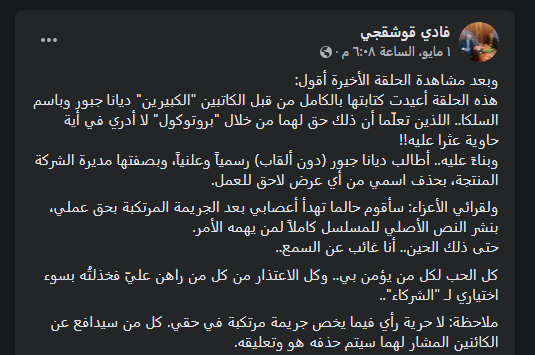
He added: “And to my dear readers: as soon as I calm down after the crime committed against my work, I will publish the original text of the series in full for whoever is interested. Until then, I won’t be responding. Much love to everyone who believes in me… and my apologies to everyone who bet on me and whom I let down through my poor choice of ‘partners’…”
He concluded by saying: “Note: there is no freedom of opinion when it comes to a crime committed against me. Anyone who defends the two people referred to will be deleted, along with their comment.”
You may also like: Syrian actor: Hugging is “less than normal” in drama
The changes that were made
Hours after criticizing the events of the final episode, the Syrian writer Fadi Qushqaji published another post explaining the changes made to the ending of the series. He wrote: “In the original text, the couple (Kinan and Hala) do not separate, and the ending of the pair (Nimr and Kinda) is left open. He cannot forget, and Alia urges him toward ‘forgiveness.’”
He continued: “The absurd scene in which a woman is allowed to enter her rival’s room in the hospital alone and spend several minutes with him… does not exist. They invented it.”
Qushqaji added: “The absurd dialogue between Nimr and Kinan, whose gist is ‘let’s go back to the old pattern, that is, to fleeting superficial relationships,’ in a series titled On the Verge of Love… I repeat: love. This dialogue does not exist. They invented it.” He concluded that there were several additional scenes invented by the director and the production company.
You may also like: Is Syrian drama realistic?
The production company threatens court action!
In the same context, Emar al-Sham, the production company behind “On the Verge of Love,” published a clarifying statement in response to writer Fadi Qushqaji’s remarks that “the director and the manager of the production company rewrote the final episode of the work.”
The statement said: “It is nothing new to point out that television is a collaborative medium, and that a director may make additions and modifications. Since this is part of the nature of television production, it is contractually documented in a way that guarantees the production company the right to make whatever changes it deems appropriate, especially when new artistic, production, or structural requirements arise and are not met. Any new interpretive version of a work may involve abridgment, addition, or a creator’s own reading,” according to the statement.
The company continued: “This text was not written over seven or nine years, as was claimed. Rather, a summary and six episodes were submitted to Emar al-Sham, and then it was written after contracting with the writer. Perhaps those episodes were indeed written years ago, but no company adopted the screenplay, whereas we found the first episodes encouraging enough to adopt the project.”
The production company also said that “the notes and suggestions came later, in parallel with the censorship assessment, which considered the text below the standard of our usual productions (the document is available for anyone who wants it). At that point, the writer’s behavior and attitude toward the company began to shift from partnership to hostility, as though, in the writer’s mind, it had become a premeditated step aimed at sabotaging the text.”
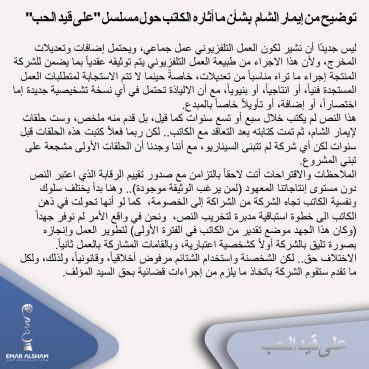
It added: “In fact, we spared no effort—and this effort was appreciated by the writer in the early period—to develop the work and complete it in a manner worthy, first, of the company as a legal entity, and second, of the distinguished figures participating in it.”
The company concluded its statement by saying: “Disagreement is a right, but making it personal and using insults is morally and legally unacceptable. Therefore, and in light of all the above, the company will take the necessary legal action against the writer.”
You may also like: Intelligence drama: a reality born purely from viewers’ imagination?