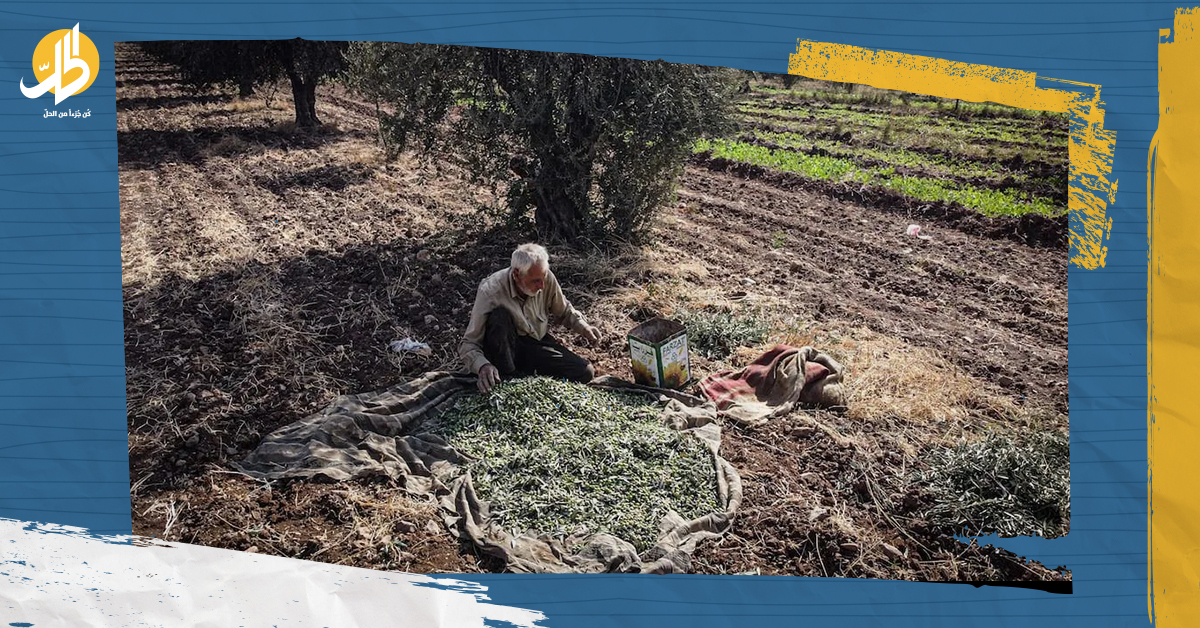
“If you don’t give to the tree, it won’t give to you,” says Maher al-Agha, a farmer who owns three hectares planted with olive trees, describing the difficulties he now faces during the harvest—difficulties that threaten his season, as they do the seasons of most farmers facing the same hardships.
Declining production
In addition to climate change, which has contributed to lower olive production in Syria, farmers are facing difficulties securing production inputs, rising fuel prices and transportation costs, as well as higher milling fees, amid the absence of government support for farmers.

Al-Agha said in his interview with “Al-Hal Net,” “Since the harvest began last month, we have been suffering from rising production costs across the board. We cannot sell at current prices, as transportation costs, pressing costs, and labor wages have all risen sharply, and there is no government support whatsoever.”
Al-Agha pointed to the criticism producers face over raising olive oil prices, but stressed that he has no choice but to increase prices because of higher costs, which consumers naturally end up bearing—especially in the absence of government support for farmers and the provision of production inputs that could reduce costs.
Rising costs
On that, he added, “Certainly, any reduction in production costs would be in the consumer’s interest, and the opposite is also true. Since costs are high, the consumer will pay for them. We have heard many promises about securing inputs and fuel at subsidized prices, but we have received nothing but promises.”
Syrian Oil Minister Bassam Tohme justified the lack of subsidized fuel support for farmers by citing the decline in the quantities of petroleum products available to the government.
Tohme said in remarks carried by the local newspaper “Al-Watan” that the quantity currently available for gasoline distribution is 3.5 million liters per day, while demand reaches 4.5 million liters, noting that it is not possible to distribute it at a faster pace unless pumping is increased, which is not currently possible, according to him.
Regarding diesel, he added, “For your information, the transport sector consumes 44 percent of the total distributed diesel, and we deliver diesel as a bulk allocation to each governorate. The governorate’s fuel committee has full authority to support whichever sector it chooses, and we have increased distribution quantities to support the mills, as well as to speed up the distribution of heating diesel.”
Hossam al-Khatib, a farmer who owns an olive grove in Tartus, confirmed that climate change has significantly reduced production, even though olive trees are known for their resilience in the face of water shortages and drought.
The olive tree is considered one of the oldest and most symbolic crops in the Mediterranean region. The Phoenicians were among those who developed olive cultivation around the Mediterranean, after which it spread to Europe, especially Spain, which is now the world’s largest producer and exporter.
One of the pests that olive farmers in Syria have been unable to combat, and which has affected this year’s production, is the olive fruit worm, according to farmers. It has begun to appear, and if it is not controlled, it is likely to negatively affect production. Farmers’ inability to fight it is due to their lack of pheromone traps, which used to be distributed by the Plant Protection Department in the Directorate of Agriculture.
Al-Khatib said in his interview with “Al-Hal Net,” “Our only source of income is under threat. We have known no trade or work other than olive farming and the olive oil trade since our grandfathers’ days. Now we are experiencing an unprecedented drop in production, and rising costs have only added to the suffering. In the end, we are accused of raising prices. In truth, there is no other option, as production costs have exhausted everyone.”
Loss of essentials
At the beginning of this year, the Council of Ministers approved the Economic Committee’s recommendation endorsing a proposal by the Ministry of Agriculture and Agrarian Reform to extend the Ministry of Economy and Foreign Trade’s decisions banning the export of several materials, including olive oil, until the end of 2022, whether in bulk or packaged in containers exceeding 5 liters in capacity.
In 2012, Syria ranked fifth globally in olive oil production, with output reaching 200,000 tons annually. It was preceded by Tunisia, Greece, Italy, and Spain. However, the successive blows dealt to farmers may contribute to a decline in its ranking this year because of lower olive production.
In a new development this year, Abeer Jawhar, director of the Olive Office at the Ministry of Agriculture, revealed in a statement to the local newspaper “Al-Watan” in mid-May that support for diesel and agricultural fertilizers is currently directed to certain crops such as wheat and citrus, while olives are still excluded.

Jawhar explained that the government has provided fertilizer support to citrus growers because citrus cultivation is concentrated in two governorates, where the cultivated areas are smaller than those planted with olives, which are grown across all Syrian governorates. Because fertilizer supplies are insufficient, supporting citrus is easier than supporting olives.
Jawhar also pointed out that the Ministry of Agriculture is counting on improved conditions and the future availability of materials to help olive farmers, noting that an alternative to nitrogen fertilizers distributed by agricultural banks—which olive growers can use and benefit from—is organic fertilizer, because it is widely available and cheaper than other types of fertilizer provided by the ministry.
Olive oil prices on the rise
The director of agriculture in Suwayda, Ayman Hamed, said in remarks to the local newspaper “Al-Watan” last Sunday that the decline in olive production this year was due to low rainfall during the previous two years. He noted that estimated olive production in Suwayda governorate alone this season is about 7,803 tons from 9,984 hectares under cultivation, including 1,640 tons of table olives and 6,165 tons for oil, with the resulting olive oil quantity expected to reach about 1,200 tons.
In the same context, olive farmers at the governorate center said they are waiting for the official olive pressing rate to be set, especially since last year’s rate was unfair to them: 165 Syrian pounds per kilogram on the condition that the pomace goes to the mill owner, and 200 Syrian pounds per kilogram if the pomace goes to the farmers.
The farmers pointed out that all these costs are compounded by pruning, spraying, and plowing wages, which will inevitably force them, under these circumstances and in order to recoup their expenses, to raise the selling price of olive oil, which last year ranged between 275,000 and 350,000 Syrian pounds per tin.
Statistics from the International Olive Council for the 2020-2021 season indicate that Syria is the leading Arab country in terms of per capita olive oil consumption. According to the council’s statistics—and the council is an intergovernmental organization comprising 44 countries that account for 98 percent of global olive oil production—per capita olive oil consumption in Syria is the highest in the Arab world and the fourth highest globally, at 4.6 liters annually.
It is worth noting that the number of olive trees in Syria stands at about 106 million, according to Ministry of Agriculture statistics, including 82 million fruit-bearing trees. Olive cultivation is distributed across the northern region—Idlib and Aleppo—at 46 percent; the central region—Homs and Hama—at 24 percent; the coastal region—Tartus and Latakia—at 18 percent; and the eastern region—Deir ez-Zor, Hasakah, and Raqqa—at 2 percent. The southern regions—Daraa and Suwayda—have also recently entered olive cultivation at a rapid pace, accounting for 10 percent, bringing expected production this year to more than 800,000 tons of olives and about 125,000 tons of olive oil.
You may also be interested in: “Maté is unavailable”.. Syria’s most popular drink faces a crisis