
About two weeks ago, while Iraq experienced a sudden nationwide blackout of its electricity grid amid scorching weather with temperatures reaching 50 degrees Celsius, I decided to take a short trip to the Iranian city of Ilam to escape the merciless heat. Ilam, the provincial capital, is 80 km from my home in Iraq, while I am only 5 kilometers from the Iranian border.
I arrived in Ilam from the border town of Badra in Iraq’s Wasit Province. The trip took only one hour, while for someone coming from the capital, Baghdad, it would take about 4 hours. Ilam is located in western Iran and is considered one of the country’s smaller cities in terms of population, with 580,000 residents. It is a Kurdish city and part of the geography of Greater Kurdistan, which stretches across four countries: Iraq, Iran, Turkey, and Syria. Ilam lies in Eastern Kurdistan.
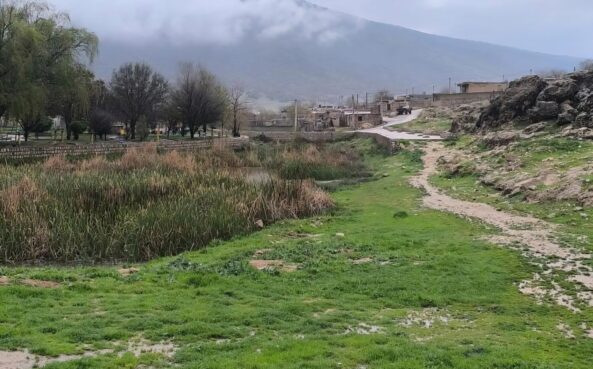
Ilam is a mountain city surrounded by greenery on all sides, and its summer weather is pleasant compared with other parts of the Middle East. In July and August, daytime temperatures range between just 33 and 35 degrees Celsius, while in countries such as Iraq they approach 50 degrees Celsius. At night, temperatures drop to a refreshing 20–25 degrees Celsius, which is why I chose it as a 3-day escape from the heat of my city.
Beyond its stunning natural beauty, I found a city living amid hidden crises that touch the daily lives of its residents, turning technology, the economy, and society into details that tell stories of challenges extending beyond its geographic boundaries. The impact of politics was evident in every aspect of life in the city.
The city and its people: between restrictions and a free spirit
On the social level, I noticed that residents speak Kurdish, specifically Southern Kurdish, “Khorani,” a dialect spoken by most Feyli Kurds. The people of Ilam are Feyli Kurds, many of them of Iraqi origin who once lived in old Baghdad neighborhoods such as al-Sadriyah, al-Kifah, and Aqd al-Akrad. Former Iraqi ruler Saddam Hussein deported them and stripped them of their citizenship on the pretext that they were not Iraqis, so they sought refuge in Ilam and Kermanshah, while some went to Tehran and other Iranian cities.
In Ilam, what is striking is the clear dominance of Iranian Kurdish women in the labor market; they make up about 60% of workers in malls, markets, restaurants, hotels, and other trades, and their strong presence gives the city a special character and distinctive dynamism.
The women of Ilam enjoy greater freedom in dress compared with Persian women. Some go out in the heart of the city unveiled, without wearing the hijab, while others wear it symbolically without fully covering their hair, and remove it with ease. As you move around the city, you find that they outnumber men among passersby.
The impact of war and politics on daily life
Saadi Street is the beating heart of life in Ilam. It was named in honor of the famous Persian poet Saadi Shirazi, whose statue stands in the middle of the street. The street is a vibrant commercial hub, home to many markets, malls, restaurants, and cafés. Activity there peaks from 5 p.m. until 9 p.m., when it fills with shoppers and visitors, and you can clearly see that women outnumber men there.
This main artery of the city has not been spared by crises; rather, it was directly affected by recent events, namely the Israeli-Iranian war. The first thing that caught my attention was the exceptional security measures imposed after the “12-day war.” When I tried to use GPS, I found that it was not working.
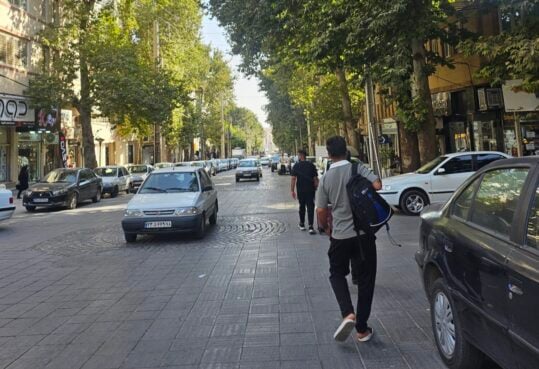
The taxi driver, to whom I tried to show the address of a farm in Karzan so I could go there, asked me with a bitter smile: “Have you heard about the Israeli bombardment?” He went on to say that the authorities had completely shut down the system as a precautionary measure, fearing it could be used to target and assassinate Iranian leaders and generals in Tehran, because investigations indicated that the assassinations of the country’s top military commanders and nuclear experts during the war at Israel’s hands were carried out through the GPS system.
This measure affected drivers in general, and taxi drivers in particular, and you could clearly see the irritation on their faces, because it sometimes causes them to lose their way in the streets and delays them from reaching their destinations, especially those far away and outside the city center.
The restrictions did not stop there. The internet in Ilam, and throughout Iran, is extremely restricted. Only WhatsApp was directly accessible, while all other platforms required the use of virtual private networks (VPNs), reflecting tight control over the digital space after the recent Israeli bombardment.
Khamenei mentioned warily and with caution
What caught my attention most was that the issue worrying local residents most was the daily power outage. Before the Israeli bombardment, electricity had never gone out, but now a two-hour daily outage has become normal. Despite its short duration, people are not used to it, and the moment the power cuts out, you can immediately see restlessness and annoyance on their faces.
These restrictions drive some people to curse and insult Iranian Supreme Leader Ayatollah Ali Khamenei. Even so, this is done cautiously: I noticed that taxi drivers do this rather comfortably when speaking to a tourist, while they do not do so in front of fellow Iranians.
When I asked a number of drivers I rode with about the boldness of insulting the Supreme Leader, they said they hesitate to curse Khamenei except among themselves or in front of those they believe are trustworthy, for fear of security repercussions. What I witnessed indicates that the military crisis was not merely a passing event, but one that left tangible effects on infrastructure and people’s lives.
An economic reality that benefits the tourist but burdens the citizen
The city of Ilam is considered an important economic artery for Iran, as it serves as a vital land outlet across the border with Iraq, specifically at the Mehran–Zurbatiya crossing, which links the city to Iraq’s Wasit Province. This border crossing sees the largest trade exchange between the two countries, especially during certain seasons each year, making it a strategic and vital point for the Iranian economy.
Despite that, the economic reality is entirely different for Iranians. When I arrived, the currency was unstable and heading downward. In just two days, the exchange rate for 100 US dollars jumped from 9 million tomans to 9.5 million tomans. This collapse in the value of the toman is the result of US sanctions imposed on the Iranian economy. What may seem like an advantage for a tourist carrying foreign currency is, in fact, a reflection of the economic burden borne by ordinary Iranians.
I experienced this contradiction myself, as I exchanged only about 50 US dollars during my 3-day trip. That amount was enough to rent a large apartment consisting of three rooms, a living room, and a balcony, go on sightseeing tours, eat delicious Iranian dishes, and buy souvenirs.
One example of this is that a large pizza costs a tourist only two US dollars, while that amount represents a steep price for an Iranian citizen, who can afford to buy such a meal only once a week. For a taxi driver to earn those two dollars, he must either make a 50-km trip or complete four rides within the city center itself.
Another example of the collapse in the Iranian economy is that you can rent a luxurious villa or an upscale farm equipped with every amenity, from a swimming pool to billiards, “fisheh,” and fruit-bearing grape, fig, and pomegranate trees, for only 25 US dollars per night. As for an ordinary farm—with the same amenities but of lower quality—the one I stayed in cost between 12 and 15 dollars.
Ilam: history and present
The city of Ilam, the capital of Ilam Province, is part of the historic land that was home to the ancient Elamite civilization. The city derived its name from this ancient civilization, whose history dates back to the fourth millennium BC.
The city also contains many summer resorts, castles, and important archaeological sites dating back to the Qajar era. Among the most prominent of these is Vali Castle, located in the heart of the city.
In the end, I left Ilam carrying a complex image in my memory. It is a city that holds an ancient history and is distinguished by stunning nature, but at the same time lives under the weight of geopolitical and economic crises. It is a city that refuses to let its spirit fade and continues to endure with a smile despite everything.