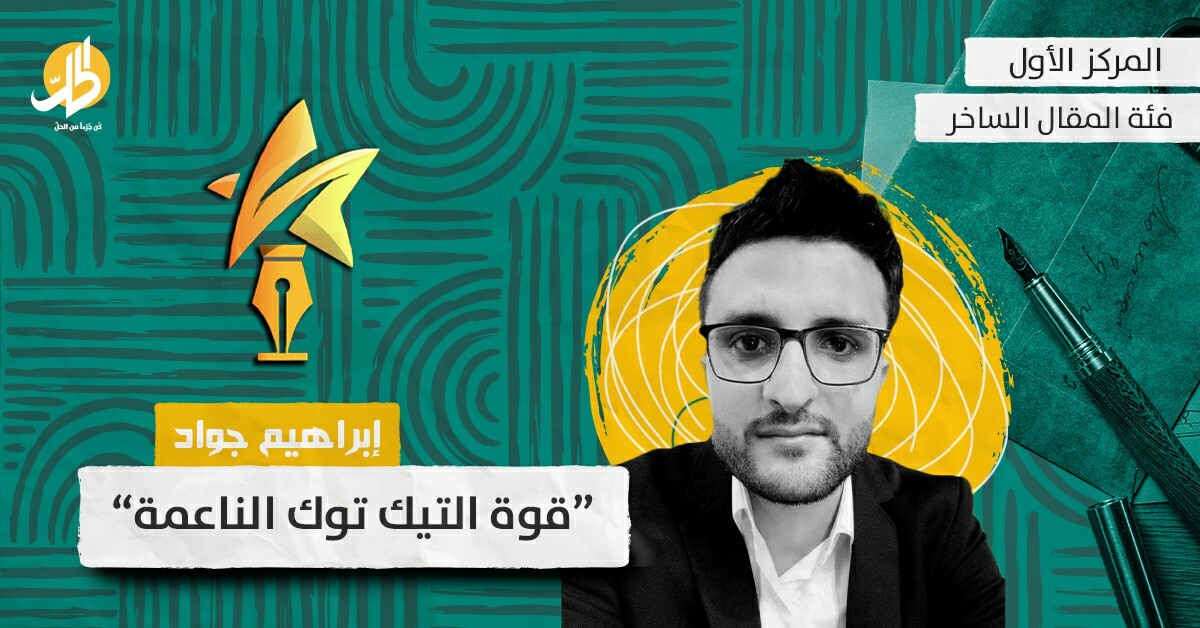
- This piece is published on the “Al-Hal Net” website after winning the Al-Hal Prize for Journalistic Creativity in the Satirical Article category (first place) for Syrian journalist Ibrahim Jawad. (This material is exclusive to Al-Hal Foundation. No part of it may be published or quoted without first contacting the foundation and obtaining permission.)
For days now, we have been chasing after my two twin nephews, who are not yet two years old, trying every trick we have learned in our less-than-practical working lives to provoke one of them into suddenly raising his index finger at us, with an angry face and knitted brows, just to make us laugh a little. Of course, when he raises it, he does not mean the finger used in the shahada; he means another finger altogether—one whose use, in real life, can leave people hurt.
When he raises his finger, his twin brother quickly jumps in and says in stammering, barely understandable words: Not this finger… not this one… let me teach you. And our laughter only grows louder.
I live in a house full of nothing but children, which naturally means it is not full of money. Lately, I have started telling these children apart by the songs they sing, and nothing tops the voice of the oldest among them and his famous tune: “Say hello to your mother, say hello.”
During the most recent FIFA World Cup, in the match between Argentina and the Netherlands, I was watching the game alone in the family room when my four-year-old nephew came in to watch with me.
I asked him, “Who are you supporting?” He said, “Messi.” A few moments later, one of the teams—I forget which—had a chance, the crowd roared, and the commentator’s voice rose. My nephew got excited and started singing, “Where’s Messi? We poked his eye out,” repeating it more than ten times until I kicked him out of the room so I could quietly watch the defeat of Messi, whom I hate.
Nothing I have mentioned in this short introduction—rich as it is in cultural information—has been pointless. What all these examples have in common is that they all came from the Chinese dance-video app TikTok, which has turned our children into parrots repeating things they do not understand.
This is the app on which our children spend hours and hours watching Dr. Food tussle over food with his wife Shorouq—may our sun never have risen on the day we came to know her. And then there is that child whose father sits beside him while the boy shouts in a loud, shrill voice, “Charge!” or some such catchphrase, while his father remains seated as if he had turned to stone. I would almost swear that if the boy started plucking his father’s mustache, the man still would not budge. Everything becomes bearable for the sake of the “giant TikTok lion,” which, they say, can later be sold for $300.
By the end of 2022, the dance app had reached 1.2 billion users, while projections had pointed to 1.8 billion. Thank God the other 6 billion people were spared this terrifying nightmare.
I do not really know whether it is a nightmare. At the very least, it allows a child to roam the world’s cultures in moments. When I was in the prime of my childhood—of which I experienced little more than the name—I struggled to get hold of a scrap of information from here or there, and whenever I received a new piece of information, it was as if I had gained the whole world in my torn socks. Even asking questions was forbidden to us at school and at home. From first grade through seventh, speaking or asking a question in class was very much like “Hassan” in the series Dayaa Dayaa, when he pulled the pin from a hand grenade and slowly began counting down the seconds before it exploded in his hand.
After seventh grade, we started seeing teachers who, after a two-hour lesson in Arab nationalism about the achievements of the “god of the state,” the “shepherd of shepherds,” the “judge of judges,” the “author of books,” and all the rest of that bombastic nonsense,
would say to us: “What questions do you have for us to answer?” I wish time could go back a little so I could ask him: “Explain to me what a question is, so that I may ask one.” I also imagined what would happen after such a question: the students would burst into laughter, the teacher would feel insulted, and then wipe the floor with me, in the very clothes whose colors had not changed much to begin with.
A while ago, the French newspaper Le Figaro published a report saying that the dance app is destroying our children’s minds because the version of TikTok used in China is different from the global one. In China, for example, children see nothing but scientific experiments, stories of successful people who climbed to the top, writers, doctors, engineers, and the list goes on. In the global version, by contrast, there is hardly any oversight. That sounds true enough, and I have often watched videos on TikTok that made me thank God for the blessing of headphones.
Elsewhere, one study—whose accuracy I do not know, though it sounds plausible—says that in China, if you ask a child what he wants to be in the future, he will say: an astronaut. But if you ask another child somewhere outside China, he may say: a social media influencer. And both would be right.
An astronaut or a social media influencer—either way, both promise a bright future, at least by the logic of chasing money and material gain.
But if you ask an Arab child, he will not say anything at all, because the future is the last thing on his mind. He will live as his fathers and grandfathers lived before him, leaving it all to God—so why think about his future when it has already been decreed for him?
TikTok is an app almost unmatched in its destructive effects, and Pakistan is nearly the only country in the world to have banned it after deciding it was a corrupting influence on society.
Other countries have banned it too, but each for its own reasons. India, for example, banned it because it wants to create an app of its own and profit from it instead of letting all that money go to China.
Recently, I heard that an Arab country had banned it, and I was delighted. Moments later, however, I learned that the ban had come because of the spread of false and fabricated news and insults directed at the leader.
When I saw the announcement for the Al-Hal Prize for Journalistic Creativity on Facebook, I rushed to the website to see how much the prizes were worth. We are all looking for quick money, just like the children of TikTok.
I found that the prize for investigative reporting was $700, which is a good amount. But writing investigative journalism is no easy matter, and it runs counter to my principles when it comes to making quick money.
I was about to leave the site, but then I said to myself: let’s keep going and see what else there is. Then I came across the satirical article category. True, the prize is not all that tempting, but it is worth a TikTok lion or two—and I can earn it without having to pluck anyone’s mustache for the sake of the dancing app’s challenges.