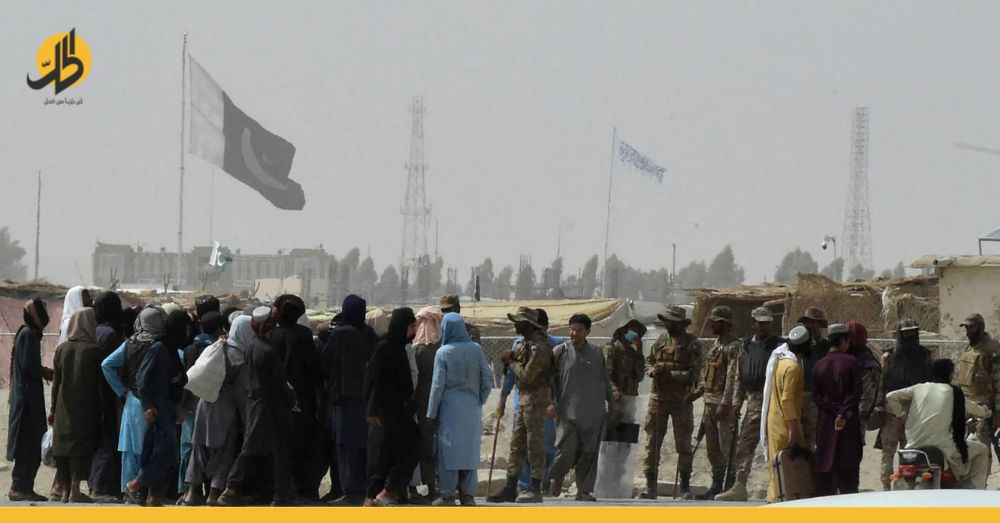
The Pakistani government’s decision to deport undocumented refugees, including about 1.73 million Afghans, and require them to leave the country is raising grave concerns, given the hostile policies currently in place in Afghanistan, in addition to the fact that a large proportion of Afghans are at odds with the “Taliban,” which took power about two years ago—especially ethnic minorities, civil society activists, journalists, human rights defenders, government officials, former members of the security forces, and of course women and girls in general.
What is causing fear among Afghans forced to return from Pakistan to their country is that their lives are under threat, given that a large proportion of them fled when the hardline Islamist “Taliban” took power. Researchers specializing in Islamist movements explain this as a result of the Taliban’s failure to govern the country, despite its boasts and promises at the beginning of its takeover that its rule would be more lenient than during its first period in power between 1996 and 2001, and its promotion of the idea that it would behave differently, especially with regard to domestic issues such as girls’ education, and externally with regard to terrorism.
However, all these promises were nothing but words on paper. The movement quickly returned to its strict interpretation of Islamic law that marked its rule in the 1990s, imposing severe restrictions on the freedom and movement of Afghan women and girls, and taking numerous steps to suppress women’s freedoms, particularly in the recent period.
Pakistan and the Decision to Deport Afghans
In that regard, the Interior Ministry in Pakistan’s caretaker government announced last Thursday that Pakistan is putting the final touches on a plan to deport all undocumented migrants. Islamabad had previously announced that November 1, 2023 would be the deadline to leave the country or face forced expulsion.
This decision was met with broad opposition. In this regard, the Office of the United Nations High Commissioner for Human Rights expressed deep concern over Pakistan’s announcement that it plans to deport unregistered foreign nationals remaining in the country after November 1, a measure that will disproportionately affect more than 1.4 million undocumented Afghans who remain in Pakistan.
Ravina Shamdasani, spokesperson for the Office, said, according to the official United Nations website, that “the Office of the High Commissioner for Human Rights urges the authorities to halt deportations, which are scheduled to begin on November 1.”
Shamdasani added: “We believe that many of those facing deportation will be at serious risk of human rights violations if returned to Afghanistan, including arrest, arbitrary detention, torture, cruel treatment, and other forms of inhuman treatment.”
More than two million undocumented Afghans live in Pakistan, and at least 600,000 of them left Afghanistan after the “Taliban” seized power in August 2021.
According to the Office of the High Commissioner for Human Rights, those most at risk among them are civil society activists, journalists, human rights defenders, government officials, former security force personnel, and of course women and girls in general, who are barred, as a result of the odious policies currently in force in Afghanistan, from attending secondary and higher education, from working in many sectors, and from participating in other aspects of daily and public life.
For their part, a group of former American diplomats and representatives of civil society organizations involved in resettlement called on Pakistan not to deport thousands of Afghans who had been waiting to obtain U.S. visas under an American program that relocates vulnerable Afghan refugees fleeing “Taliban” rule.
This request came in an open letter recently signed by 80 former U.S. officials, prominent figures, and resettlement groups, weeks after Pakistan announced a campaign against migrants living in the country illegally, according to the Associated Press.
The United Nations High Commissioner for Refugees and the International Organization for Migration say they have documented a sharp rise in returns to Afghanistan since the deadline was announced on October 3. An urgent report recently issued by the two organizations put the number of Afghans who had left Pakistan by October 15 at 59,780 people. Some 78 percent of returnees cited fear of arrest as the reason that drove them to leave Pakistan.
Returning to Shamdasani, she said: “As the deadline for deporting refugees approaches, we urge the Pakistani authorities to suspend the forced return of Afghan nationals before it is too late to avoid a human rights catastrophe,” while also calling for continued protection for those in need and ensuring that any future return is safe, dignified, voluntary, and in line with international law. She warned that any deportation process without an individual assessment of personal circumstances, including any mass deportation, amounts to forced return in violation of international human rights law, particularly the Convention against Torture and Other Cruel, Inhuman or Degrading Treatment or Punishment, to which Pakistan is a state party, and international refugee law.
Tragic Conditions
Mumtaz Zahra Baloch, spokesperson for Pakistan’s Foreign Ministry, indicated that this deportation decision would be implemented in stages and that they would not be expelled all at once. She added, according to Pakistani media, that “it may begin with those who have criminal records and are involved in crimes or smuggling activities, and we will examine each case individually.”
According to press reports, the decision was taken by the country’s civilian and military leaders in light of the increasing attacks carried out by Islamist militants, amid claims that Afghan nationals carried out 14 of the 24 suicide bombings that shook Pakistan this year.
For its part, Pakistan had for several years preferred the “Taliban” as the best option for ruling Afghanistan, but relations have deteriorated over the past two years, largely due to accusations that Islamists fighting the Pakistani state are operating from Afghan territory, while the “Taliban” deny this.
On the other hand, with winter approaching, the deportation of Afghans will worsen the already tragic humanitarian crisis in Afghanistan, where the country is grappling with the devastating impact of a series of earthquakes that struck Herat province this month, killing at least 1,400 people and injuring 1,800 others according to official figures.
According to the Office for the Coordination of Humanitarian Affairs, nearly 30 million people out of 43 million currently need relief assistance in Afghanistan, and there are also 3.3 million internally displaced persons.
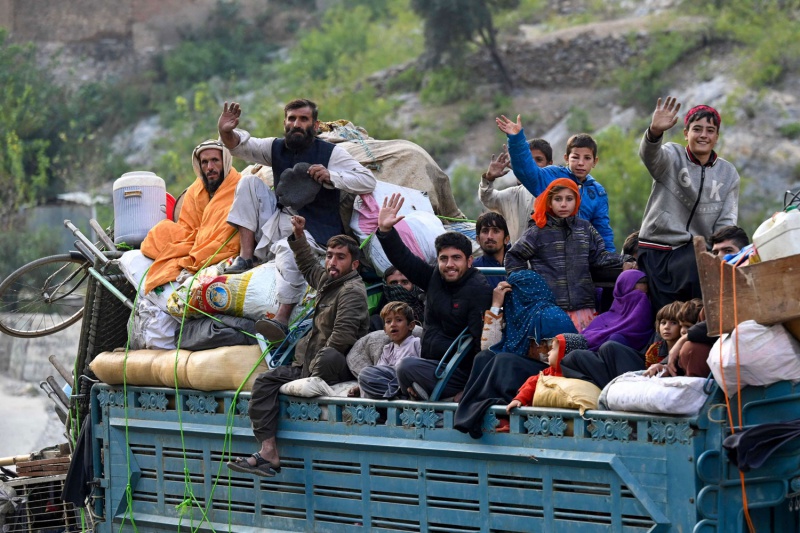
What is striking, however, is that as the deadline granted by the Pakistani government to undocumented refugees to leave the country approaches, Afghan refugees are streaming toward the Afghan-Pakistani border in northwestern Pakistan, where nearly a thousand families cross the Torkham crossing daily, while thousands wait at the border until procedures are completed and they can cross.

According to media reports, the local government in Nangarhar province, adjacent to Pakistan in eastern Afghanistan, said that during last Friday and Saturday, 2,460 Afghan families crossed the border and entered Nangarhar province, from where they moved on to different provinces and cities.
What is tragic is that the local Afghan government confirmed in a statement yesterday, Sunday, that “the central government in Afghanistan is taking every possible measure to provide the necessary services to returnees from Pakistan, but the influx of refugees in this manner and forcing them to return in such huge numbers exceeds the means and capabilities available to the Taliban government.”
Failure in Governance
Since taking power in Afghanistan, the “Taliban” government has issued a series of decisions that have tightened the noose on citizens and restricted rights and freedoms in the country, which has led to increased migration from the country and made people unwilling to return to their homeland.
These decisions concern restricting women’s freedom in Afghanistan, starting with closing schools and extending to requiring women to fully cover their faces in public places, with a preference for wearing the “burqa,” as well as depriving women of many jobs in the public sector and preventing them from traveling without a mahram outside their cities. It also issued a decision for television channels requiring female presenters to wear the niqab while presenting the news, and restricted freedom of expression and the press by imposing constraints on the media. As a result, hundreds of media institutions were forced to shut their doors, leaving thousands of media workers unemployed.
It has also taken measures including banning Afghan women from working in national and international non-governmental organizations in Afghanistan. It has also imposed other restrictions that limit the ability of women and girls to exercise human rights and fundamental freedoms.
There appear to be reasons behind the “Taliban’s” pattern of ruling the country, some of them shallow and superficial, as it claims that women do not adhere to proper Islamic dress, and as a result the government has taken decisions to suppress the freedom of Afghan women. But in reality this is not true.
It seems clear that this extremist movement does not believe in women’s rights in the first place, let alone recognize the existence and rights of minorities and other ethnic groups, such as the Shiite “Hazara” community, which has faced decades of persecution at the hands of the Sunni “Taliban,” who describe them as infidels.
Therefore, the “Taliban’s” failure to change its mentality and policies or to fulfill the promises it claimed to make was nothing more than an attempt to obtain international recognition and secure what it had long aspired to. This confirms that it has failed miserably in governing Afghanistan, and will be nothing more than a repressive regime that oppresses its people.
- How the Houthis Are Choking Yemen’s Peace Efforts with a Broad Escalation on the Ground
- Economy in the Wind: How Yemenis Are Paying the Price of Disrupted Shipping Routes
- Houthi Summer Centers: Factories for Indoctrination and Raising a “Scream” Generation
- The “Coalition of Necessity”: What Costa Rica’s Terrorism Designation of the Houthis Signifies
- Mojtaba Khamenei Runs Iran from His Bed as Photos Vanish and the Supreme Leader Makes a “Voice-Only” Appearance