
Since the start of the US-Israeli military operations on 28 February against Iran over its nuclear program and its proxies in the region, Iran has been trying to widen the scope of the conflict by targeting the Gulf states in order to drag the region into an open war.
Iran is targeting infrastructure, airports, oil and gas refineries, and seaports in those countries in an attempt to pressure its adversaries’ allies to stop the war.
Iran escalates its attacks on Saudi Arabia
The Saudi Ministry of Defense announced over the past 48 hours that it had intercepted 6 ballistic missiles launched toward cities and vital sites, including Riyadh, the Eastern Province, and Yanbu Port, while shrapnel from one of the missiles caused minor injuries and limited material damage in the capital.
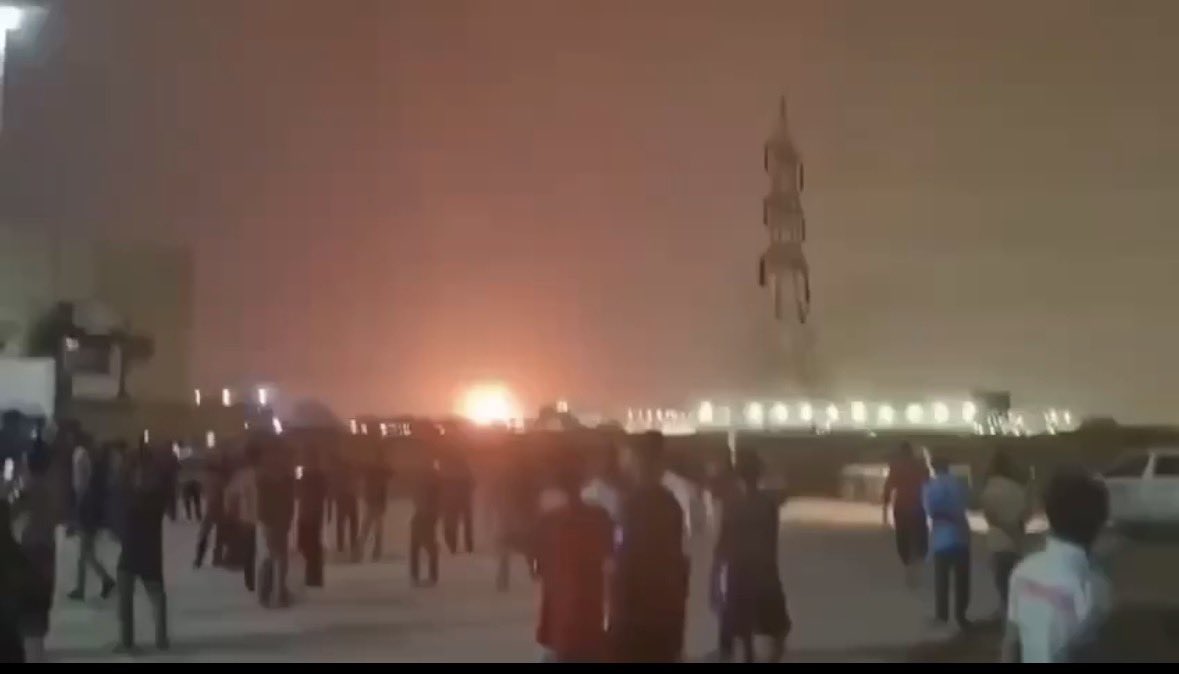
According to official statistics, Saudi Arabia intercepted about 35 drones over 48 hours that targeted energy and gas facilities in the Eastern Province and Riyadh, while one of them fell inside the Samref oil refinery.
Local sources say this is the first time since the start of the war that many residents of the capital, Riyadh, have heard explosions or received warning messages on their phones.
Yesterday, Wednesday, Iran’s Revolutionary Guard issued a warning to evacuate energy facilities in Qatar, Saudi Arabia, and the UAE, saying they would be targeted by airstrikes. This came after an Israeli strike targeted the South Pars gas field in Fars.
Analysts believe that intensifying Iranian attacks on infrastructure and oil and gas refineries in the Gulf states, especially Saudi Arabia, is aimed at pressuring Washington’s allies to stop the war.
Saudi Arabia warns
For his part, Saudi Foreign Minister Prince Faisal bin Farhan affirmed that “Iran’s attacks will deepen its isolation,” adding that its attacks on the Gulf states will not bring it any gains.
This came during a press conference at the conclusion of a consultative ministerial meeting of Arab and Islamic countries in Riyadh, where he said: “Our patience is not limitless.” He added: “Iran’s attacks on its neighbors are unjustified, and escalation will be met with escalation.”
The foreign minister said: “If Iran believes that the Gulf states are incapable of responding, its calculations are wrong,” noting that “Iran is going too far in attacking its neighbors while asking for solidarity.”
He pointed out that “the attacks will increase Iran’s isolation, as they were premeditated,” and also stressed that “Iranian inconsistency is not new; it is the challenge.”
The foreign minister added that “Iran’s insistence on violating the principles of good neighborliness has led to an erosion of trust in it,” and stressed that “there is coordination among the Gulf Cooperation Council states to confront the Iranian attacks. Iran is pursuing a policy of blackmail in order to achieve its goals.”
The minister affirmed that “Iran has always denied its support for militias and their destabilizing roles,” and warned that “its attacks on its neighbors will have consequences, and we will take the appropriate decisions to defend our country and our resources.”
On a separate note, Reuters said that the Gulf states had requested an urgent discussion at the United Nations Human Rights Council in Geneva regarding Iranian strikes on civilians and energy infrastructure across the Middle East.
The memorandum described the ballistic missile and drone strikes targeting Bahrain, Jordan, Kuwait, Oman, Qatar, Saudi Arabia, and the UAE as “a development causing grave concern for international peace and security,” given the serious repercussions for human rights.
Toll of the Iranian attacks
Over 19 days, Iran targeted 7 Arab countries with no fewer than 4,192 missiles and drones, in addition to an attack carried out by two fighter jets, according to a tally conducted by Anadolu Agency based on official data through Wednesday evening.
The UAE was the most targeted, followed by Kuwait, then Bahrain, Qatar, Saudi Arabia, and Jordan, while the Sultanate of Oman was the least targeted.
According to the tally, Iran targeted the UAE with 342 missiles and 1,699 drones, Kuwait with 260 missiles and 542 drones, Bahrain with 132 missiles and 234 drones, Qatar with 203 missiles and 87 drones, in addition to two fighter jets, Saudi Arabia with 38 missiles and 435 drones, Jordan, and the Sultanate of Oman with 16 drones.
Meanwhile, Israeli data released Wednesday evening show that more than 400 missiles, out of about 850 launched from Iran toward Israel since the start of the war, were equipped with cluster warheads.
According to figures cited by the Israeli Public Broadcasting Corporation, Kan 11, these missiles account for more than half of the total missiles used in the attacks, indicating extensive use of this type of munition in the recent strikes.
Observers believe that targeting the Gulf states is intended to pressure Washington’s allies in the region, in addition to shifting the battlefield and dispersing the fronts, a strategy Iran relies on in managing the escalation, especially after the sharp decline in the pace of its targeting of Israel compared with the early days.
- How the Houthis Are Choking Yemen’s Peace Efforts with a Broad Escalation on the Ground
- Economy in the Wind: How Yemenis Are Paying the Price of Disrupted Shipping Routes
- Houthi Summer Centers: Factories for Indoctrination and Raising a “Scream” Generation
- The “Coalition of Necessity”: What Costa Rica’s Terrorism Designation of the Houthis Signifies
- Mojtaba Khamenei Runs Iran from His Bed as Photos Vanish and the Supreme Leader Makes a “Voice-Only” Appearance