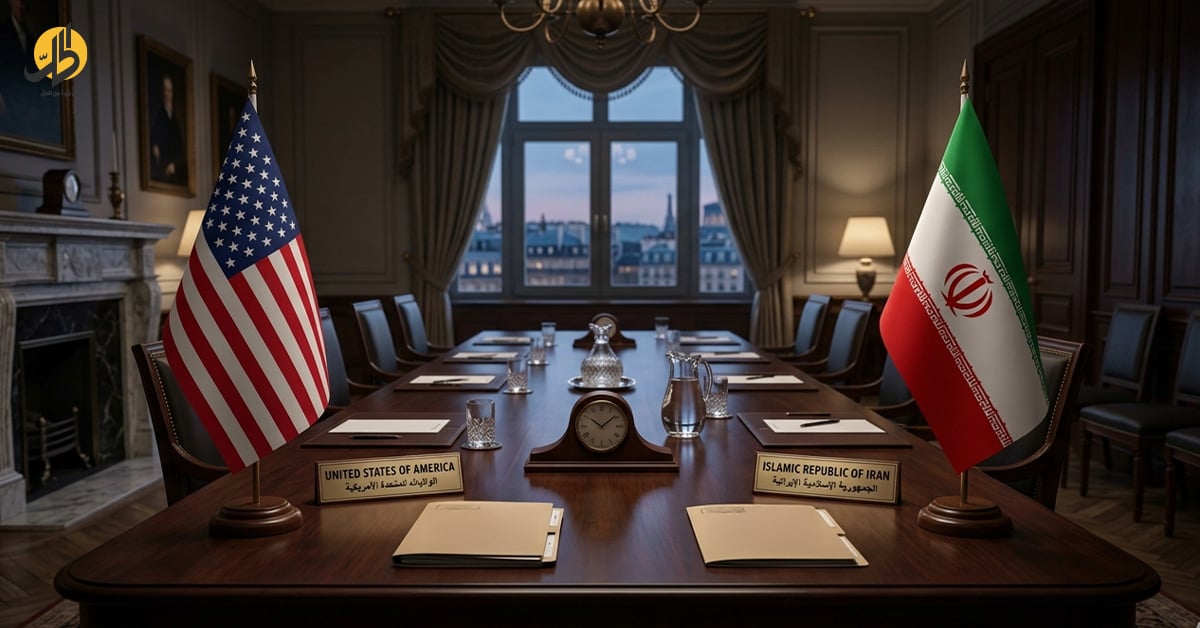
The crisis between the United States and Iran is heading toward a moment of acute uncertainty, as the pressure of military strikes intersects with the possibility of renewed diplomatic efforts in a scene that reflects each side’s attempt to improve its position ahead of any potential settlement.
Amid rising risks of slipping into a new phase of military operations and an expanding range of flashpoints, the anticipated negotiations between Washington and Tehran look increasingly like an attempt to manage the conflict on the brink of the abyss.
While media reports point to mediation efforts led by several countries aimed at de-escalating the situation in the Iranian theater, a number of scenarios are emerging that suggest the possibility of moving into a more advanced stage of the war between the United States and Israel on one side and Iran on the other.
Iranian Escalation Amid a Negotiating Track
Iran has consistently worked to activate the principle of “exporting the revolution,” transforming it from a sectarian and ideological doctrine into political action and on-the-ground practice in a way that raises the cost of escalation. At the same time, Iran realizes that the theater of this war extends beyond its own borders, and that its aims may go far beyond merely defeating its forces. This drives it to hold out for as long as possible and to draw the entire region into the repercussions of the conflict.
The doctrine of Iran’s “Revolutionary Guard” is based on the idea that the side that starts a war bears responsibility for determining how it ends, whether that ending is dramatic or unexpected. Iran did not wait for the temporary truce deadline to expire; instead, it openly escalated and laid out its own conditions for suspending military operations, including recognition of its control over the Strait of Hormuz, compensation for the attacks it has been subjected to, a guaranteed halt to attacks and assassinations, and the consolidation of its regional influence, according to media reports.
In a related development, CNN recently reported, citing U.S. intelligence assessments, that Iran had deployed additional military reinforcements to Khark Island over the past several weeks in anticipation of any possible U.S. military operation.
According to the same report, the island has multilayered fortifications, and shoulder-fired surface-to-air missiles have been transferred there, while Iran has planted naval mines around the island and its shores to prevent any attempted U.S. amphibious landing.
The U.S. network indicated that taking control of the island could require the deployment of a large American landing force, while quoting an informed source as saying that officials in President Donald Trump’s administration are still studying the feasibility of sending ground forces to the island.
Lack of Trust and the Regional Widening of Tensions
By contrast, a U.S. Defense Department official told media outlets that about 2,500 troops from the 82nd Airborne Division will head to the Middle East, adding that the forces set to be deployed include field command elements and logistical support from the 1st Brigade Combat Team.

Reports also differ regarding the course of negotiations between the United States and Iran, as U.S. President Donald Trump said the two countries had held productive talks, while Tehran denied this.
In any case, whatever the reality of these negotiations and however successful the efforts to open a breach toward a genuine negotiating track between the two sides may be, one fact remains: military pressure is escalating markedly in an effort to use it as leverage in negotiations.
Yet there is another reality that is difficult to ignore: the lack of trust between the two sides, which makes talk of a genuine truce leading to serious discussions about the “day after” extremely difficult, given each side’s goals and interests.
Accordingly, the difficulty of the situation this time lies in the widening scope of tensions, as developments indicate that several flashpoints in the war are igniting, with Iran having launched strikes against some Gulf states as well as Jordan and Turkey. This could push these states—particularly the United Arab Emirates and Saudi Arabia—to become part of this equation in order to undermine Iran’s military capabilities in a way that guarantees the safety of their territory and their geostrategic security. This also aligns with Washington’s conditions calling for curbing Iran’s influence in the Middle East.
Among the consequences of the elimination of senior leaders in Iran’s power hierarchy on the first day of the escalation was a clear shift in the structure of the regime toward the “Revolutionary Guard,” which means, one way or another, a stronger voice opposing negotiations with the West, especially regarding military capabilities linked to ballistic missiles and the uranium enrichment program, both of which are regarded as matters of sovereignty in the country.
Complications of the Negotiating Track
Accordingly, the approach to potential negotiations between the United States and Iran differs from any traditional diplomatic rounds or negotiating tracks, especially since they are taking shape on the threshold of conflict—or rather moving along the brink—in an attempt to avoid entering a phase in which it would be difficult to contain the conflict’s developments and repercussions.
Therefore, it is necessary for the parties involved to seriously and realistically understand the reasons that led to the collapse of the “Geneva 3” negotiations, which became the gateway through which the military operations that erupted at the end of last February emerged.
From this perspective, this round appears necessary because it represents the decisive stage before military operations evolve, whether in terms of their nature and degree of escalation or the possibility of involving other parties in the confrontation.
Therefore, the active forces engaged in field operations may seek to formulate a more logical, realistic, and flexible approach that would delineate the scope of the conflict and contain its boundaries, thereby preventing the region from sliding into broad and open confrontations.
Along those lines, the potential negotiations may, for both sides, be governed by a set of key determinants. While the United States seeks to regulate Iran’s behavior in line with its vision for managing regional balances in the coming decades—which requires imposing restrictions on the ballistic missile program and uranium enrichment—Tehran, for its part, is trying to move beyond the objective of regime change and secure recognition of its role as an influential power in the Middle East and a major actor in the regional balance of influence.
This divergence in objectives may constitute one of the most significant challenges facing the success of the anticipated negotiations, as any progress will depend on each side’s ability to manage the conflict with a degree of flexibility that allows it to move beyond the critical moment the region—and perhaps the international order as a whole—is going through.
Open Scenarios Between a Temporary Truce and Full Escalation
In light of all this, developments may be heading toward several divergent scenarios, though they all share one point: the two principal parties, the United States and Iran, will rely on the principle of “brinkmanship” in managing negotiations. The outcomes of negotiations between Washington and Tehran will range between war and politics, and between the tracks of diplomacy and maximum pressure.
Indicators suggest that Tehran may need a temporary truce as a direct result of the pressure of field operations, whether during the twelve-day war or the recent operations, in addition to the impact of economic sanctions. This may push it to adopt a scenario of “limited flexibility” by showing flexibility on some issues while holding fast to others, or by avoiding direct escalation against energy infrastructure facilities. This proposition is consistent with the threats of U.S. President Donald Trump and is also linked to reports that Pakistan may host a round of talks on a specific draft covering several points before the deadline set by Trump expires.
In this context, the end of the truce may open the door to the possibility of a successful round of negotiations, allowing subsequent rounds to address the remaining outstanding issues. Conversely, that round of negotiations may fail, which could lead to the return of military operations at the same pace without major escalation, allowing proxies to reactivate the negotiating track once again.
A third scenario remains—the bleakest one—namely a broader and more comprehensive escalation that could include strikes on energy facilities and military operations on Khark Island. In response, Tehran may push the Houthis to close the Bab al-Mandab Strait, placing the region before an exceptional emergency moment, especially with the entry of the Yemeni group loyal to Tehran into the war and the launching of ballistic missiles toward Israel.
However, this does not preclude a composite scenario that combines some elements of these possibilities, such that the deadline ends with a reality that reflects neither full escalation nor complete peace, but rather a formula allowing relative progress and the announcement of a new conditional deadline, which may be linked to securing passage through the Strait of Hormuz, as well as to conditions related to handing over enriched uranium and suspending activities connected to its enrichment.
- How the Houthis Are Choking Yemen’s Peace Efforts with a Broad Escalation on the Ground
- Economy in the Wind: How Yemenis Are Paying the Price of Disrupted Shipping Routes
- Houthi Summer Centers: Factories for Indoctrination and Raising a “Scream” Generation
- The “Coalition of Necessity”: What Costa Rica’s Terrorism Designation of the Houthis Signifies
- Mojtaba Khamenei Runs Iran from His Bed as Photos Vanish and the Supreme Leader Makes a “Voice-Only” Appearance