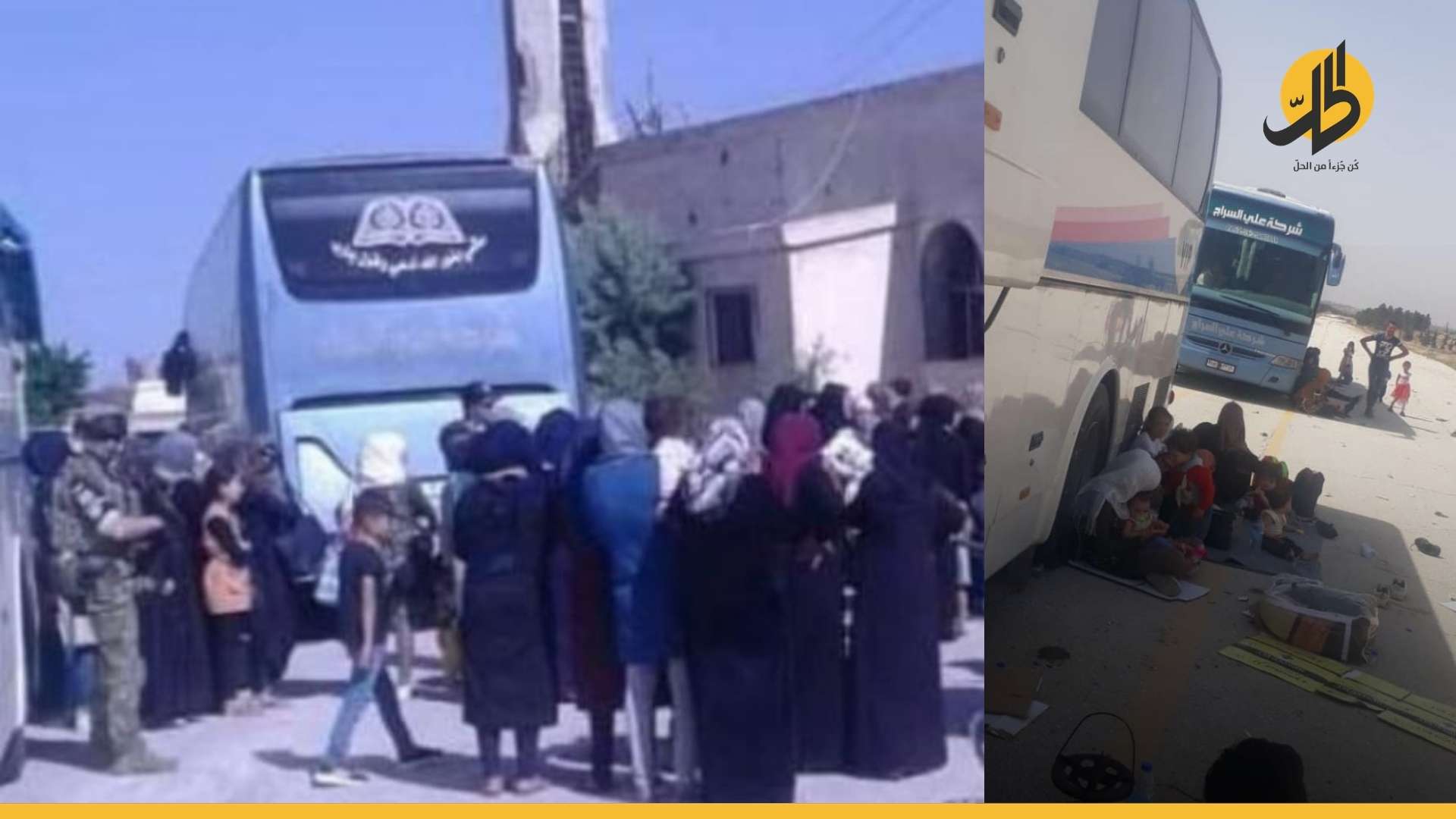
A source in the Ankara-backed “National Army” revealed on Friday that displaced residents of the town of “Umm Batna” in northern Quneitra are still stranded between Syrian government checkpoints and those of the National Army at the Abu al-Zandin crossing east of Aleppo.
The source, who asked not to be named, told Al-Hal Net: “Turkish intelligence has not yet issued orders to receive the displaced residents of the town located on the Syrian-Israeli border, on the grounds that Russia did not coordinate with Turkey بشأن the agreement concluded with the الأهالي.”
The source added that Turkey is ordering National Army personnel at the Abu al-Zandin crossing not to allow any convoy to enter without prior approval from Ankara, noting that the Turkish decision is aimed at preventing Russia from taking further steps in areas under Syrian government control.
Photos circulated by activists on social media on Friday revealed the poor health condition of the displaced people from Umm Batna. The images showed people in extremely poor medical condition, including children, while others were suffering from injuries of varying severity.
Over the past few days, the Syrian army and Russian military police had threatened the town’s residents with storming the town unless they agreed to the displacement of about 30 people and their families to northern Syria. An agreement was later reached stipulating the displacement of those slated for removal, in exchange for the Syrian government releasing two detainees from the town.
The negotiations were conducted through “Dirar al-Bashir,” who served as governor of Quneitra when opposition factions controlled the province, and who is one of the figures involved in the so-called “reconciliation.”
These developments came after a number of the town’s residents attacked a military checkpoint at the beginning of May because of abuses committed by checkpoint personnel against civilians.
For its part, the opposition National Coalition said the displacement of the people of “Umm Batna” was a new crime committed by the Syrian government with Russia’s participation.
The Coalition held the international community responsible for the continued policy of forced displacement.
The displacement of Quneitra residents is the first of its kind since the displacement campaigns stipulated by the Russian agreement with opposition factions, when regime forces, backed by Russia and Iranian militias, took control of southern Syria in August 2018.
Turkey has expanded militarily in Syria through the “National Army,” which consists of about 35,000 fighters. Turkey has established more than 50 military positions in Idlib and nearby areas south of Afrin in the western Aleppo countryside, under an agreement with Russia and Iran. Its declared aim is to monitor the “de-escalation” agreement in the Idlib area and the Aleppo countryside.
The Turkish army, accompanied by Syrian opposition factions, advanced into northern Syria in three campaigns: the first, “Euphrates Shield,” in 2016 in the area between Azaz and Jarabulus north of Aleppo; the second, “Olive Branch,” during which Turkey took control of the Afrin area in 2018; and the third, “Peace Spring,” during which it took control of the area of Tell Abyad north of Raqqa and Ras al-Ain northwest of al-Hasakah, east of the Euphrates River.