- How the Houthis Are Choking Yemen’s Peace Efforts with a Broad Escalation on the Ground
- Economy in the Wind: How Yemenis Are Paying the Price of Disrupted Shipping Routes
- Houthi Summer Centers: Factories for Indoctrination and Raising a “Scream” Generation
- The “Coalition of Necessity”: What Costa Rica’s Terrorism Designation of the Houthis Signifies
- Mojtaba Khamenei Runs Iran from His Bed as Photos Vanish and the Supreme Leader Makes a “Voice-Only” Appearance
On the Split and Internal Clash Between the Government and the Revolutionary Guard in Tehran
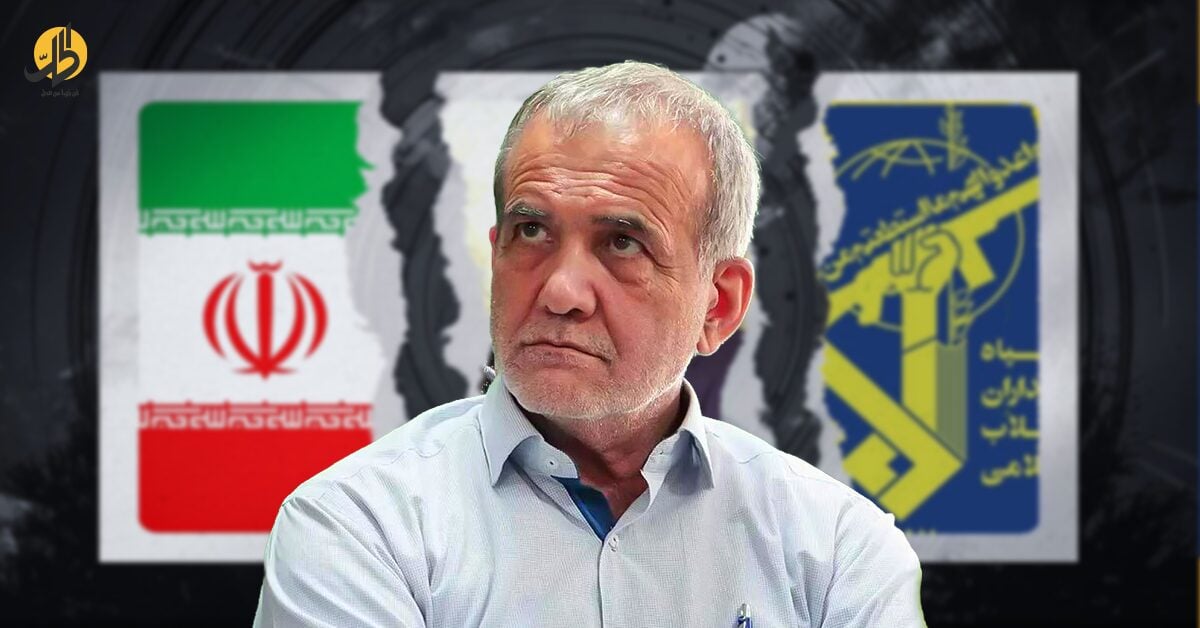
At the same time that the war between Iran on one side and the United States and Israel on the other continues, another struggle is unfolding inside Iran’s centers of power, no less dangerous than the first. The contest for influence between the Iranian Revolutionary Guard and the executive branch may have made Iran’s military response chaotic and haphazard, and there is also considerable disorder on the political front. That is why U.S. President Donald Trump said last March that it was difficult to negotiate with Iran, stressing that he did not know who was actually running the country or who spoke for it after most of its military and political leaders were eliminated in devastating strikes. He pointed to the existence of an “unclear leadership” and multiple factions.The Revolutionary Guard is exploiting the conditions of war to impose a new reality, seeking more powers and expanding its grip over the levers of the state under the pretext of war and military emergency. This suggests that the Revolutionary Guard is shifting from a military force tasked with defending the borders to a parallel authority that shapes foreign policy and controls financial resources, pushing the country toward an overt military model of rule.As a result, the rise in the Revolutionary Guard’s influence is undermining Iranian President Masoud Pezeshkian’s ability to make independent strategic decisions, especially on relations with neighboring countries and international negotiations. Tehran’s decisions on the nuclear file and regional issues have become largely tied to the leadership of the Iranian Revolutionary Guard, which could complicate Iran’s positions before Washington and its allies and increase the chances of miscalculated escalation in the ongoing regional conflict.“The Revolutionary Guard swallows the presidency’s powers”Amid a complex political landscape, Iranian President Pezeshkian faces a “complete political deadlock” as the Revolutionary Guard has shifted from a security partner to an alternative executive authority. According to reports by Iran International, the Revolutionary Guard has succeeded in curbing the government’s role by creating a security perimeter that isolates centers of power and blocks presidential decisions from being implemented. The peak of the tension came with the direct intervention of Commander Ahmad Vahidi to block the appointment of the intelligence minister, declaring that “war management” gives the Guard absolute authority over sovereign ministries.Israeli Channel 14 reported that Pezeshkian complained to one of his aides that he appeared to be “a hostage”, unable to resign or make decisions. This quiet takeover of presidential powers is fueled by uncertainty over the status of the new Supreme Leader, Mojtaba Khamenei. While the Supreme Leader has historically been the final arbiter in security appointments, the Revolutionary Guard has used this vacuum to install itself as the sole guardian of state security, reducing the president’s role to a minimum.Signs of the internal struggle in Iran have intensified as Pezeshkian has repeatedly failed to reach Mojtaba Khamenei, with all his requests for an urgent meeting reportedly ignored. Informed sources told the Hebrew-language channel that a “military council” of senior Revolutionary Guard generals has tightened its grip on the levers of decision-making and imposed a strict isolation around Mojtaba Khamenei, preventing any government reports from reaching him.These moves come alongside strong indications that the deterioration in Khamenei’s son’s health may have given the Revolutionary Guard the golden opportunity to monopolize power and sideline the government entirely. In this regard, political analyst Osama Al-Hatimi, who specializes in Iranian affairs, told Al-Hal Net: “It is no secret that the Revolutionary Guard has played an active role since its founding as an ideological military institution tasked with protecting the revolution. Therefore, activating its role at this time and trying to marginalize the civilian administration is consistent with the structure of the Iranian system itself.”According to the sources, what has further fueled the internal clashes is Pezeshkian’s criticism of the Revolutionary Guard’s approach of escalating tensions and continuing attacks on neighboring countries, particularly the Gulf, warning that the Iranian economy could collapse completely within three to four weeks if a ceasefire is not reached.“The Revolutionary Guard controls the Supreme Leader”Intelligence assessments indicate that Mojtaba Khamenei currently holds a largely symbolic position, while decision-making power has shifted to the remaining leadership of the Revolutionary Guard. U.S. officials said the hardline elements within the Guard have become increasingly influential, filling the vacuum left by the weakness of the political and religious leadership.A senior military official said Iran’s central command structure has deteriorated significantly, forcing the country to move to decentralized operations. Local commanders are now acting independently, without coordination from Tehran, a development that has reduced the effectiveness of Iran’s military operations.In this context, Al-Hatimi stresses that “the state of conflict and internal divisions in Iran will certainly have a negative impact on the Iranian state. The civilian administration may align itself with calls to reclaim its stripped powers and insist on holding onto them, which would draw it into a confrontation — not a military one, of course — with the Revolutionary Guard. That would create a contradiction between what the Guard seeks, namely escalation, and what the government wants, namely containment, in addition to the growing likelihood of public distrust on the one hand and outside attempts to exploit this gap to intensify pressure on the other.”Hajazi’s isolation to control the Supreme LeaderAt the same time, reports indicate that an unprecedented internal crisis is escalating within Mojtaba Khamenei’s inner circle. Some of those close to him are said to be seeking to sideline Ali Asghar Hajazi, an influential security figure in the office of the Supreme Leader. The tensions stem from Hajazi’s open opposition to Mojtaba Khamenei taking over the leadership.Hajazi had previously warned members of the Assembly of Experts that Mojtaba lacked the qualifications needed for leadership, and said hereditary succession ran counter to the principles set by Supreme Leader Ali Khamenei, according to press sources.According to the same source, Hajazi warned that promoting Mojtaba would effectively hand full control of the country to the Iranian Revolutionary Guard and permanently sideline civilian institutions.Al-Hatimi said: “Perhaps Hajazi’s isolation means control over the information gate. Those close to the new Supreme Leader want to control what he hears and sees, to ensure that his decisions align with the military council’s direction or the wing led by the Revolutionary Guard, and to prevent any reports that might call for de-escalation or reform from reaching him.”Al-Hatimi explains that “this may be what helps us understand the ambiguity surrounding Mojtaba Khamenei as the current Supreme Leader and the extent of the Revolutionary Guard’s keenness to control and direct him in order to continue the hardline approach while strengthening military dominance over civilian institutions. For this reason, many civilian officials in provinces and sensitive ministries have been replaced by former or current Revolutionary Guard officers to ensure unity of command, which will in turn lead to a clear militarization of rule. That is their main goal.”
0 Comments
أقدم