
The Mneen municipality in the Damascus countryside has announced a new package of measures to regulate public behavior, including restrictions on clothing, trade and daily activities, prompting widespread criticism and fears of curbs on personal freedoms.
Presented as a step to protect “community values,” the measures have sparked a broad debate over the extent of local authorities’ intervention in residents’ daily lives and whether they conflict with Syria’s constitutional declaration.
Details of the measures
The decision issued by the executive office of Mneen’s municipal council included a series of instructions it said were aimed at “preserving the values, morals, customs and traditions of the town,” covering multiple areas of public life.
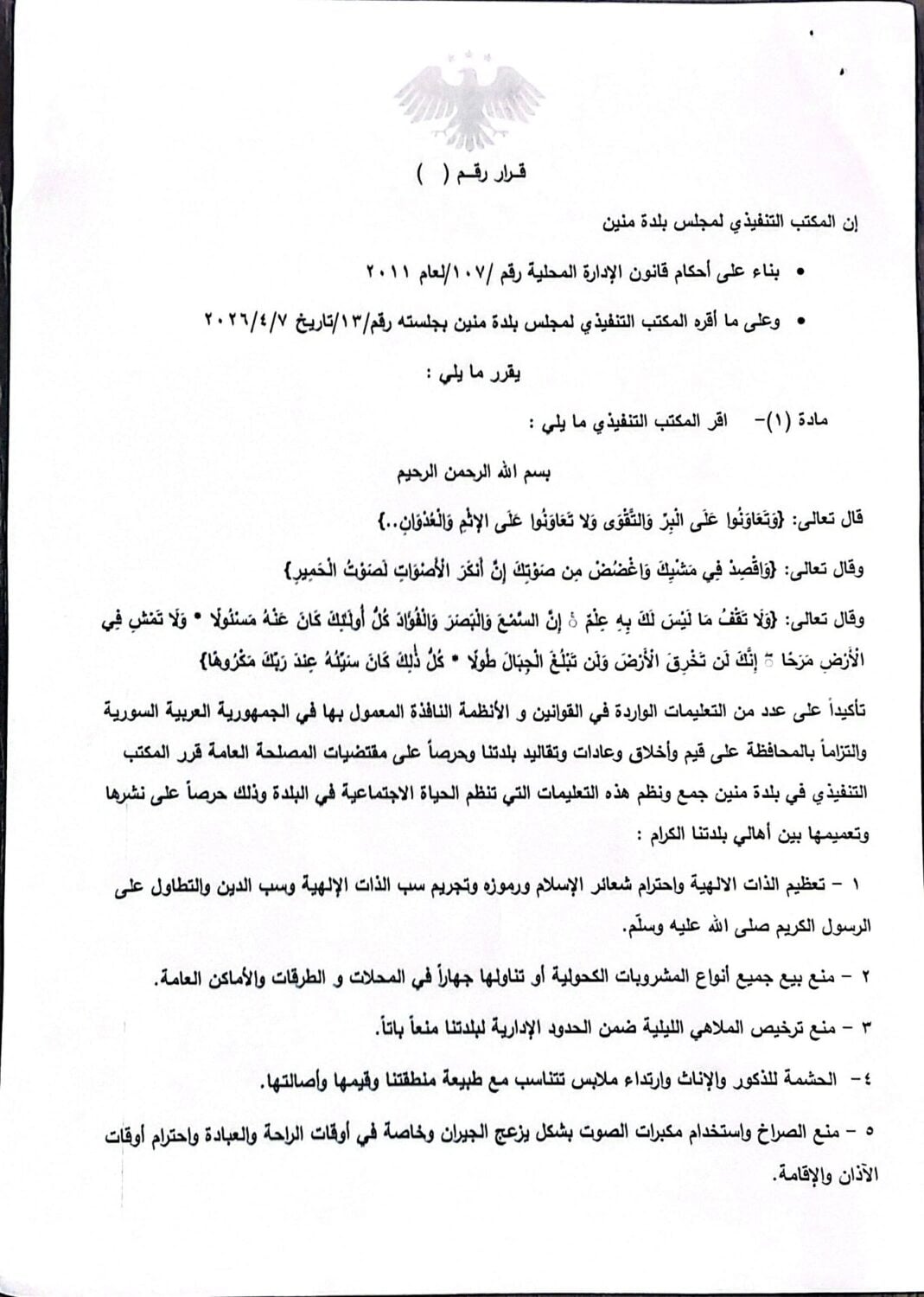
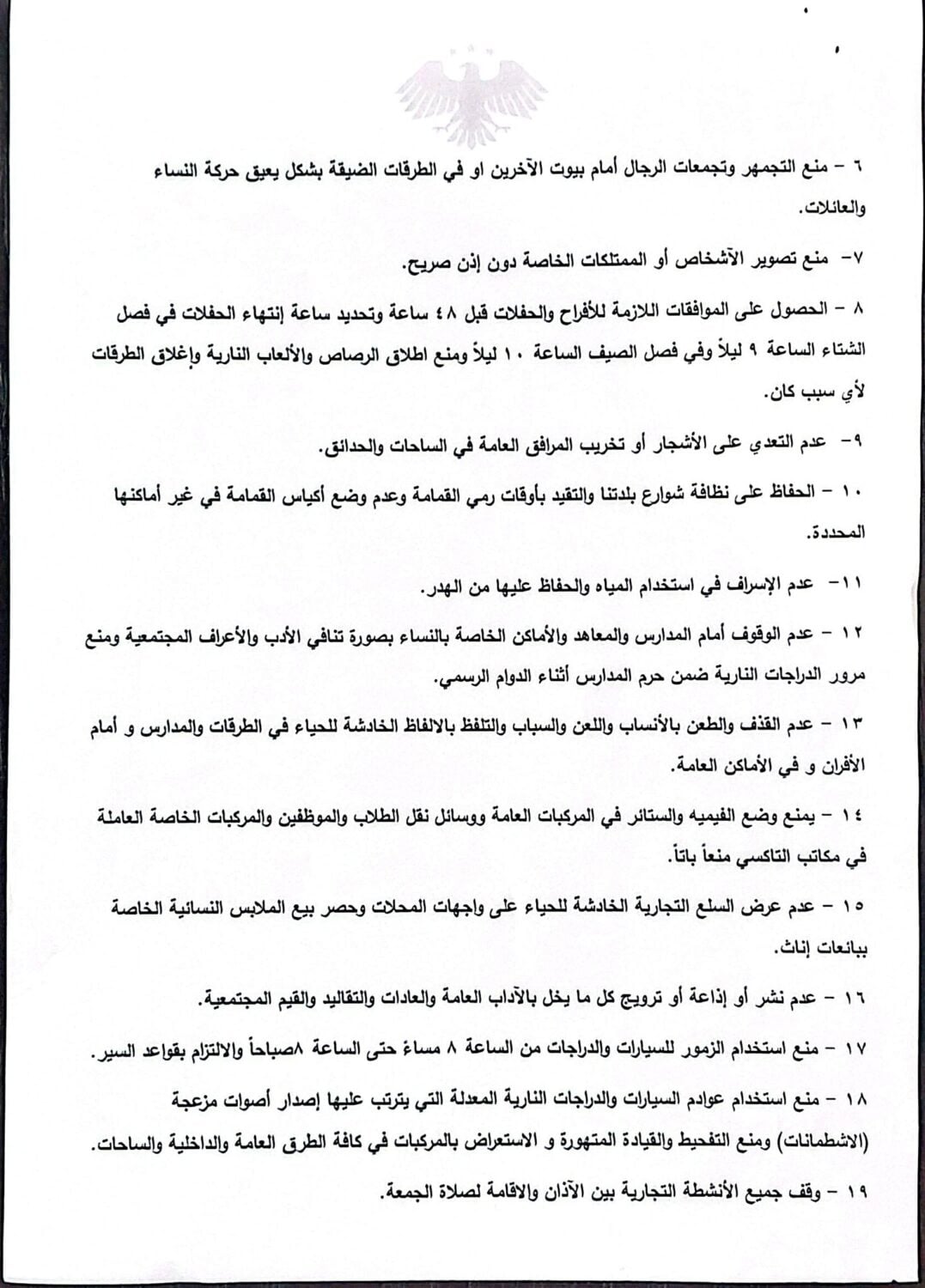
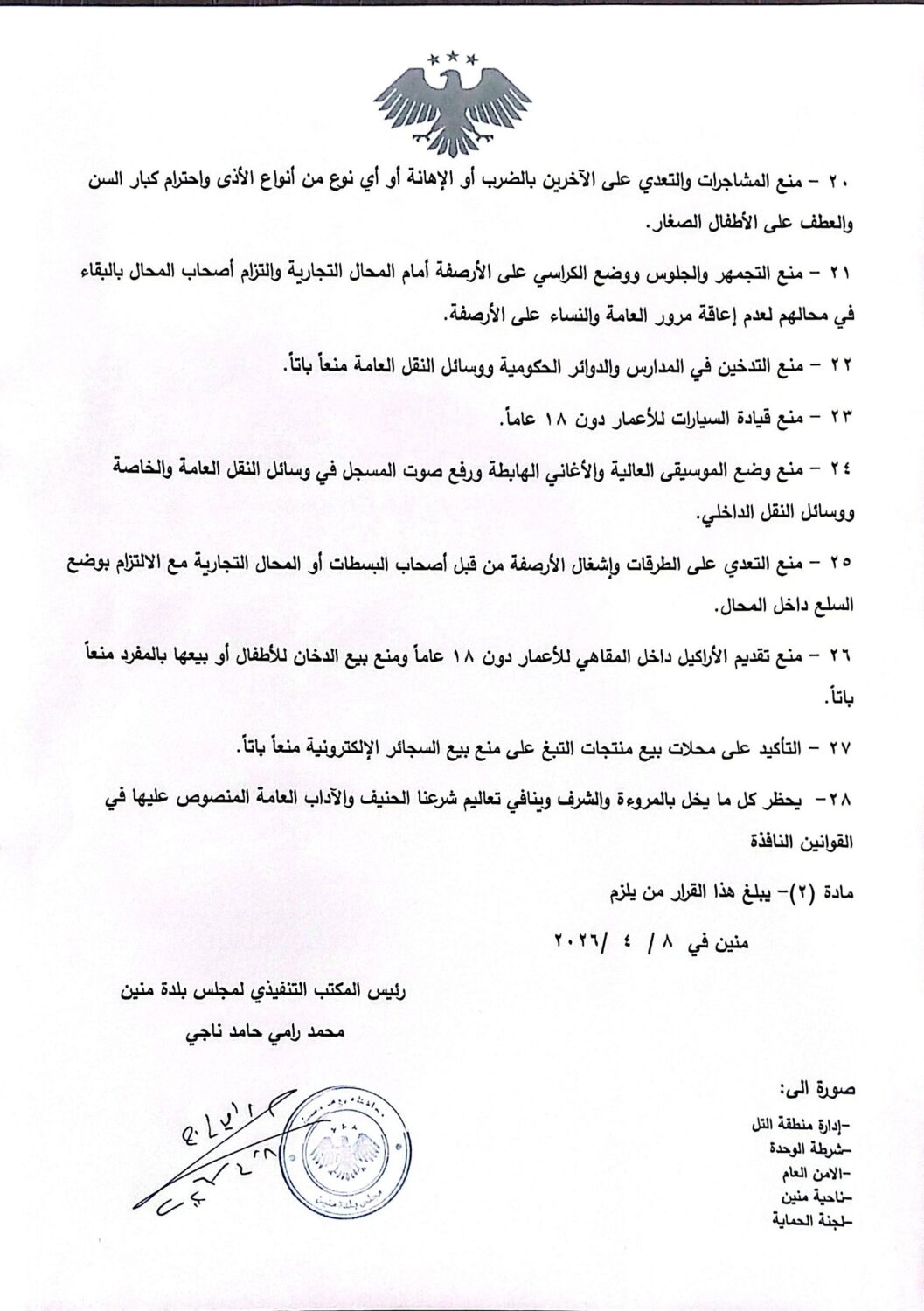
The instructions criminalized blasphemy, banned the sale of all kinds of alcoholic beverages and prohibited licensing nightclubs. They also imposed what it described as “modesty” for men and women, calling for clothing “appropriate to the nature of the area and its values.”
The measures also extended to commerce, stipulating that goods deemed “indecent” must not be displayed in shop windows and that women’s clothing may only be sold by female vendors. They also required businesses to close between the call to prayer and the start of Friday prayers.
In another provision, smoking was banned in schools, government offices and public transport, along with the playing of “loud” music or what it described as “vulgar songs” on public and private transport. The decision also completely banned the sale of e-cigarettes.
Criticism and warnings
The measures drew a wave of criticism, most notably from the “Liberal Front” in the town of al-Tall, which said what was happening went beyond regulating public affairs and amounted to “interfering in the finest details of residents’ lives.”
In a statement, the front said Mneen’s municipal council had “openly declared that it will preserve virtue and morals,” arguing that this could open the door to broader intrusions into individuals’ private lives. It added that what was happening looked like “a race to impose restrictions,” with no connection to improving services or meeting people’s needs.
The front said virtue “cannot be imposed by force,” but is based on freedom of choice and respect for human dignity, warning that turning local government into a guardian of individual behavior could backfire.
It also said the measures conflict with explicit constitutional provisions on freedom of movement, freedom of expression, freedom of belief, the right to privacy and the right to cultural and social life, in addition to violating core principles of the International Covenant on Civil and Political Rights, which Syria has ratified.
Journalist Yaman Amouri wrote on X: “In a country where everyone does as they please, it has become normal to find a municipal council, whose job should be service and administration within its geographic area, deciding the personal freedoms of people. Instead of paving roads, cleaning neighborhoods, fixing street lighting, and issuing building permits or ordering the demolition of violations, its job has become deciding who should dress down, who should dress up, who smokes and who drinks.”
Amouri added: “The job of the governorate or municipality has become banning alcoholic drinks (al-Sham), banning makeup in state offices (Latakia), banning men from selling in women’s clothing stores (al-Tall), banning mixed parties (Souq Wadi Barada), and now (Mneen) issuing a decree to preserve the town’s values, morals, customs and traditions and the requirements of the public interest.” In this way, the line between “service” and “moral policing” has been lost.
According to legal specialists, the provisions in Mneen’s decision restrict personal and social freedoms, and issuing such measures falls outside the authority of municipal councils.
Human rights advocates say decisions of this kind by local councils “strike at the core of citizens’ fundamental rights” and set a dangerous precedent for the expansion of administrative authority at the expense of constitutional rights.
The controversy comes as observers point to a rise in similar measures in several areas of Syria, reviving questions about the powers granted to municipalities and governorates to enact laws affecting personal rights.