Much has been said about women—in books, novels, poems, and religions; in the media, in life, and in dreams. Yet most of what has been said, is being said, and will be said remains on paper, because despite everything, women still occupy a lower place than men, even in the eyes of those who have written the most lavish poems and words about them. Had that condescending view not existed, this day would not exist. International Women’s Day reminds us of one truth: we invest the very being of women in volumes of writing instead of changing how we view them in real life and dispelling the discrimination between us in favor of equality.
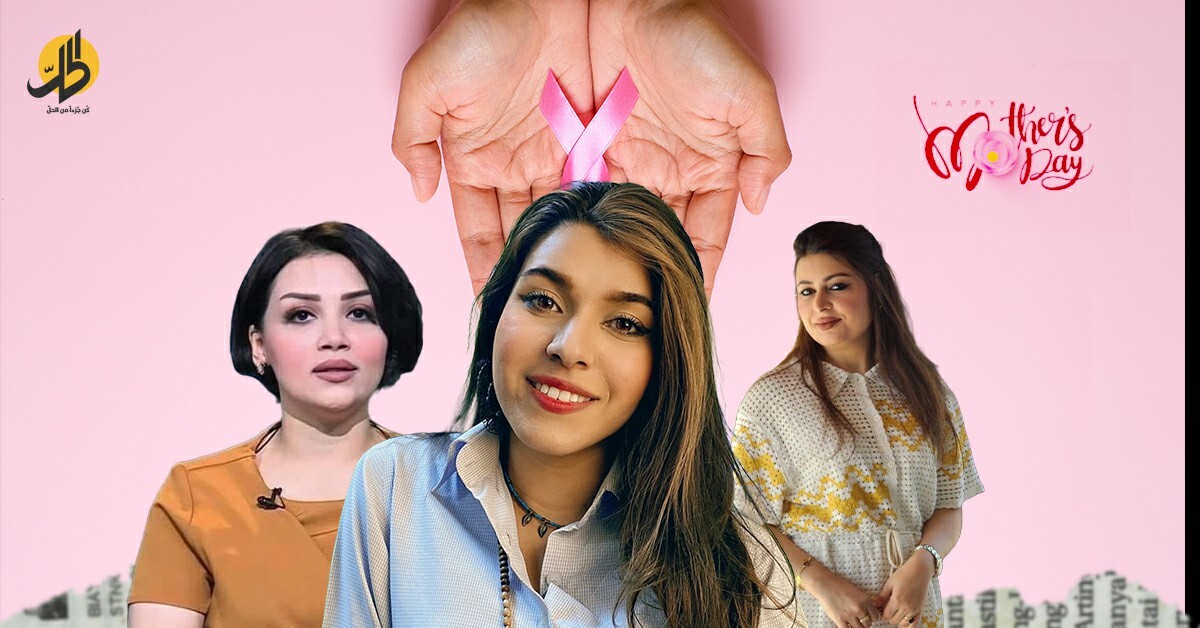
This day comes to remind us that women are like mountains: they endure every kind of climate and remain lofty and steadfast in the face of challenges, striving for glory and distinction. There are many women who have truly shown perseverance and defiance, especially in our region, which has yet to move beyond reactionary ideas about women. Iraqi society is no exception, and here—on the occasion of International Women’s Day—we have carefully chosen three Iraqi women from different fields to spotlight their successes under a magnifying lens, as part of celebrating successful women on their day.
Aya Mansour: Defeating the Bullies!
There are many words that could describe Aya Mansour, yet none seem precise enough for this young Iraqi woman, who spends her days among ordinary people, morning and evening, bringing their lives to the attention of the officials responsible for them—officials who sit in luxurious offices, offer no service, and consume the livelihood of ordinary people without conscience. Aya also reveals that life to those who do not know how such people live. Aya is, above all, a storyteller.
Mansour, whose face carries the scent of old Baghdad and whose eyes hold the remnants of the capital’s fading heritage, is a gifted writer and poet. That later led her to journalism, where she writes and documents the lives of people and society for Arab, foreign, and local media institutions. Aya tells people’s stories almost daily, including through her Instagram space under the banner “A Story on My Way.”
Aya is made of Sumerian clay. Her family roots are in southern Iraq, though she was born in Baghdad on November 11, 1992. She completed her studies in mathematics at the Teachers Institute in Al-Mansour in 2012, and began publishing her writing in newspapers more than fifteen years ago. Then, in 2014, she gathered her poetic texts into her first published book, Forest of Fingers, issued by Arab Scientific Publishers.
As is often the case in Middle Eastern societies, a woman’s success is not easily accepted, and Aya experienced exactly that. In Iraq, she faced a fierce bullying campaign after her first publication, led by elite circles that were supposed to be enlightened. It was bullying disguised as criticism—but not a single real critique of her book emerged, because they had not even read it. The attack targeted Aya herself, out of fear of her success.
“Bullying”—and no other word, the Iraqi writer stressed during a radio interview with Monte Carlo Doualiya. “I never imagined this reality existed in the Iraqi cultural sphere (…) The talk is always about my appearance, my skin color, and my private life. I believe the problem is not with me personally, but with every young woman who enters this field.” Yet that bullying left Aya facing one crossroads with two paths: either challenge it and continue, or step aside and withdraw. She chose the first path, achieving one success after another and defeating the bullies.
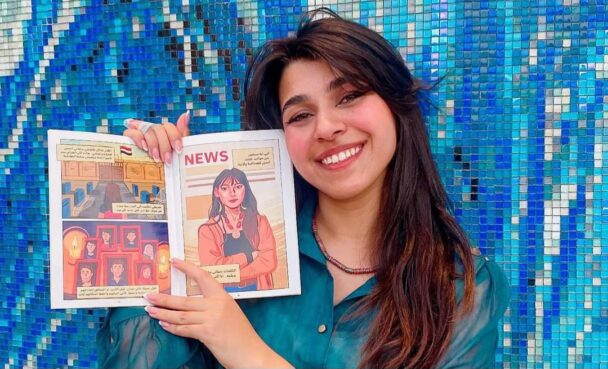
After Forest of Fingers, four more works by Aya Mansour appeared: She Sings Alone, a poetry collection published in 2017 and translated into French; Alice in Baghdad, an educational entertainment story about Baghdad’s districts, published in 2017; Solar Portrait, a short-story collection published in 2019; and the play Invisible, centered on the stories of Iraqi women as part of the Darboona project on women’s challenges in Iraqi society, staged at the Academy of Arts in Berlin in 2016.
Professionally, Aya has worked for more than a decade in many outlets, most notably Al-Shabaka magazine and Al-Sabah newspaper, both affiliated with the Iraqi Media Network, as well as the website Yalla. She has also written for Al-Alam, Al-Alam Al-Jadeed, and As-Safir, and for the websites Al-Magharib, Al Jazeera Net, Raseef 22, Daraj, the Arabic edition of Vice, and Independent Arabia. Today, she works for the Iraqi News Agency (INA).
Like my neighbor’s hair, my hair
is a broom for my bygone days
which I threw into a bin
for everyone sweeps away the dust of memory
Aya Mansour
This poetic heir to Nazik al-Malaika and Lamia Abbas Amara has been celebrated in many evening gatherings, morning forums, and seminars across Egypt, Lebanon, Oman, Turkey, France, Germany, and of course Iraq. She has received many awards and honors, including the “Creativity Award” from the “Hadath Ahlami” initiative of the “Volunteers for Iraq” organization in 2015, the “Excellence and Creativity” shield from the Baghdad International Fair in 2019, the National Syndicate of Iraqi Journalists Award in 2019, and the “Success Shield” from the Youth Leadership Forum in Istanbul in 2019.
In recognition of her achievements while still in the springtime of her life and creativity, the Iraqi Al-Amal Association selected her as one of four inspiring Iraqi women featured in a printed and illustrated book titled You Choose, which tells her story. It was published in the summer of 2023 and distributed to students in Iraqi schools. This is Aya, born in a time of wars, who says: “I bring war victims back to life by writing about them as part of remaking life—like the policeman who fell dead and no one carried him for hours.”
Ansam Salman: The Struggle Continues!
Ansam Salman’s story is different from Aya’s and Mona’s. Her field is more directly tied to the meaning of this day, which is dedicated to defending women’s rights and freedom. From an early age, Salman devoted her life to people—and to women in particular—supporting and defending them. Her humanitarian path began with instinctive acts of decency. Ten years after one passing incident during her university days, when she stood up for a male student and a female student, she was honored by one of them—now an employee, then a student—who had searched for her for years. When he found her, he gave her a diamond ring in gratitude for a gesture she herself had forgotten, though its impact remained engraved in his heart. Perhaps that was her greatest honor, because it was a deeply human one.
Ansam is Baghdadi, Samarrai, and Wasiti—a blend of Iraq from center to south to north. She was born on April 24, 1990, in the year of war and sanctions, and spent her adolescence in the furnace of a brutal sectarian war that consumed everything. Yet despite her young age, she did not fear death. She walked through Baghdad’s streets past piled-up corpses on her way to school, pursuing her dream without fear, as though repeating: “We walked in steps written for us… and whoever’s fate is in a land will die in no land but it.”
“Little by little,” as Seta Hagopian says—this is how Ansam, who holds a bachelor’s degree in translation from the College of Arts at Al-Mustansiriya University with a specialization in English, entered the world of civil society 12 years ago. After years of work and volunteering in rights organizations, she founded the dream of her life: the AISEN Organization for Human Rights and Sustainable Development, which continues to grow day by day. Today, Ansam is among Iraq’s most prominent activists and defenders of women’s and human rights.
Ansam was born into an environment that expected women to be housewives, care for the home, and adhere to religious teachings. They were expected to wear the hijab and respect clerics in order to earn God’s pleasure in this life and the next. “That was the box our collective mind was locked inside, but I broke that box at puberty. I discovered that the door to God is open, not closed; the way to Him is through confrontation, not surrender.” She has made confrontation the title of her life and never hesitates in it—with those near and far, the good and the wicked alike. “Confrontation dispels doubt and affirms the truth.”
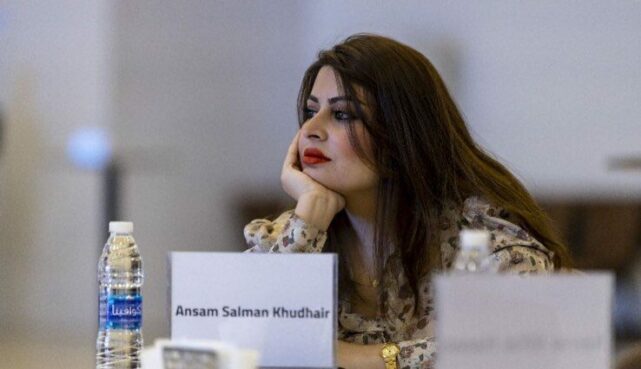
Ansam has participated in and organized many marches and vigils in the path of advocacy and rights. Perhaps the three most prominent activities she organized were the “She Has a Right” vigil on this very day five years ago in Baghdad’s Tahrir Square in 2019—a protest against patriarchal authority that deprives women of their rights, abuses them, and kills them; then the most famous women’s march of the October Uprising, under the hashtag “The Pink March,” in February 2020, in response to the religious current that rejected women mixing with men in the October protests; not to mention her organization of an “October” vigil on the first anniversary of the October Uprising in open confrontation with political corruption in Iraq.
Ansam struggles to raise women’s awareness in the face of society’s marginalization and to confront violence against them. That is why, in nearly every domestic violence case or murder of a woman under the banner of “false honor,” Iraqi and Arab television channels turn to Ansam Salman. On one occasion, she even broke down in tears during a televised interview under the weight of the responsibility carried by her and a handful of other women defenders in her field, because “the patch is small and the tear is big,” as the late monologist Aziz Ali used to say.
The door to God is open, not closed; the way to Him is through confrontation, not surrender
Ansam Salman
During the years of war against داعش (ISIS), Ansam worked with the Red Crescent to provide relief to displaced people by visiting them in camps. After the cities were liberated from the grip of the extremist group, she contributed to projects aimed at strengthening peace in the liberated areas. She also succeeded in helping many women launch their own livelihoods—sometimes by opening sewing workshops, sometimes by finding them work in the private sector, and at other times by opening small shops for them. Despite all she has achieved, volunteer and relief work has remained alive within her, and she has never left it behind.
Ansam has received dozens of honors, including one yesterday from the Dutch Embassy in Baghdad on the occasion of Women’s Day, and another on this same occasion a year ago for her efforts in the field of rights. She has been invited to many forums as a representative of Iraqi women in the United States, the Netherlands, Tunisia, Turkey, Lebanon, Jordan, and elsewhere. She is among the founders of the “Alliance 21 for Women’s Empowerment and Development,” and she served as public relations coordinator for UN Women in Iraq. Her dream is for her organization—which she considers her home—to attain a voice heard regionally and internationally, so it can speak for the wronged and the oppressed. For Ansam, the struggle continues.
Mona Sami: The Screen Icon!
Those who dream do not lose; dreams come true no matter how long they take. That is exactly what happened with Mona Sami. Since childhood, she dreamed of becoming a news anchor. She used to read newspapers in a broadcaster’s cadence while sitting in her father’s lap, and he planted in her mind the idea that she should become a presenter. After two and a half decades of life, she entered the field and achieved more than she had dreamed of. Instead of becoming only a news anchor, she became a standout presenter, and her name became synonymous with one of Iraq’s most prominent political programs: From a Fourth Angle.
Mona carries the bright spirit of Baghdad within her. Baghdadi by birth and belonging, she spreads joy wherever she goes. She used to teach chemistry in secondary schools, in keeping with her family’s well-known educational roots, but she never abandoned the dream. Then suddenly she decided to take the challenge and turn that dream into reality, trusting that success would make her mother accept her new path: media instead of teaching. And that is exactly what happened. Today, she has been voted Iraq’s best media personality for the past two years according to a poll by the National News Center, and less than a week ago she won the Atwar Bahjat Award for Media Creativity.
COVID-19 marked the turning point in Mona Sami’s life. After lockdown and school closures, she decided to make use of her free time by chasing her old dream. In July 2020, she went to Iraq 24, a channel preparing to launch into the Iraqi media scene, and after three weeks the dream became reality. In August of that same year, she presented her first news bulletin—her first appearance, and the channel’s first appearance as well. They were born together, in a sense. From there, the story began. Though her time at Iraq 24 was brief, fame came with her current station, Al-Rabiaa.
At Al-Rabiaa, Mona initially thought only of becoming a news anchor as well, but the station manager told her she was better suited to presenting programs. She was afraid, but he encouraged her and promised to return her to news anchoring if the experiment failed. Instead, she became a program host, and From a Fourth Angle became her gateway to fame—a political show she continues to present to this day. It achieved remarkable success in record time, and since then she has been “the screen icon,” as her audience calls her.
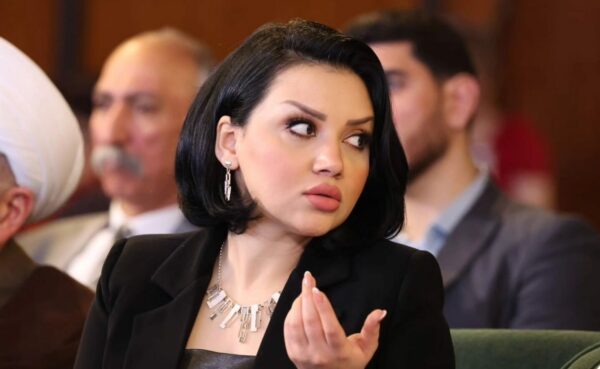
Success has many enemies, and Mona has not been spared smear campaigns. Many online attacks have targeted her, in addition to bouts of bullying over her height. But in the “Something Forgotten Podcast,” she responds with the confidence of someone secure in herself, quoting the late Mahmoud Darwish: “Beautiful women are the short ones…” As for the smear campaigns, she has met them with the wisdom: “If speech is silver, silence is golden.”
Speaking of smear campaigns, it is to Mona’s credit that she firmly faced the attack by followers of the Sadrist Movement on Al-Rabiaa channel a year and a half ago, when it was vandalized over a misunderstanding related to one of its episodes. She did not leave the channel despite all the political pressure brought against her, nor did she leave Baghdad despite the security threat hanging over her life. She remained steadfast, unafraid of any outcome. That is challenge in its truest sense.
My skill in public speaking is what strengthened my desire to enter the media field
Mona Sami
Mona Sami was born on June 21, 1992, with the cool breezes of summer back then—not the blazing summer of today. From an early age, she excelled at public speaking and took part in most of the activities and plays organized by Iraq’s education directorates. In secondary school, she won first place in public speaking among all schools in Iraq. “My skill in public speaking is what strengthened my desire to enter the media field.”
Mona is often described as the “mother of problems,” because she hosts politicians and others, and some on-air fireworks sometimes follow. But at the same time, she is also, in her own words, “quick to tears,” something shown even more clearly through her humanitarian program Ramadan Kareem, which she presented in 2022 and 2023. In closing, despite her success—praised by all near and far—she says: “I don’t yet like myself as a media professional. I still need to improve.” What Mona does not realize, however, is that she is maturing and growing by the hour, not by the day.