The surprise military attacks launched by the Izz ad-Din al-Qassam Brigades, the military wing of Hamas, against Israel on October 7 have prompted a new regional repositioning among political Islamist groups. These groups are trying to capitalize on the impact and repercussions of the current events, following their developments closely in order to exploit the weight of the Palestinian cause in the minds of the region’s peoples and, in one way or another, use it to address and recalibrate their own crisis-ridden situation. Over the past decade, these groups have been in retreat, as in Egypt and Tunisia. Islamist organizations are benefiting greatly from the current, intensifying military scene, exploiting Israeli attacks to shape ideologically charged public opinion in their favor by winning humanitarian sympathy.
The National Salvation Front—of which Ennahda, the political arm of the Muslim Brotherhood in Tunisia, is one of the largest components—has reinforced this trend. Through its political and propagandistic rhetoric, it is helping raise the level of mobilization on both humanitarian and ideological grounds for pragmatic purposes tied to its complicated situation after the decline of its political role in Tunisia, as well as the fact that its leaders and members are under judicial investigation over accusations related to terrorism and sending individuals to conflict zones in Syria and Libya.
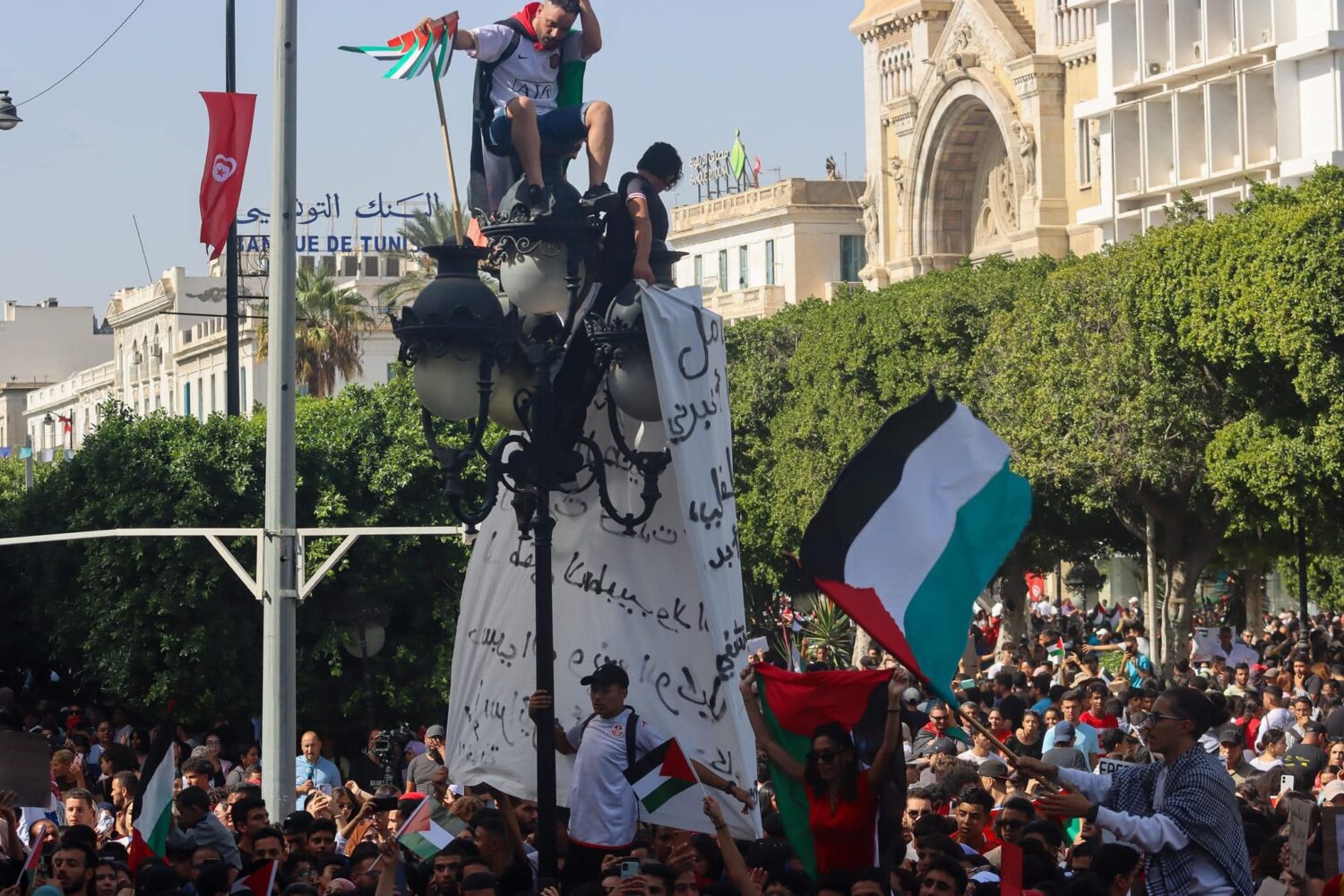
This is in addition to corruption and the destruction of documents related to the alleged involvement of some of them in assassinations in Tunisia, as in the cases of the two leftist leaders Chokri Belaid and Mohamed Brahmi. Here, the Islamist movement dominates the scene through repeated calls to participate in the marches and demonstrations it organizes under the slogan of “supporting the resistance and backing Gaza” in response to the Israeli bombardment.
Tunisia’s Muslim Brotherhood and Investing in Crises
There is an important methodological point that is difficult to ignore when looking at the National Salvation Front’s attempt to return once again to the Tunisian street and find an environment that gives Ennahda an opportunity to reconnect with citizens, who have turned their backs on the movement and its causes over recent months. This has driven it to invest in this moment for tactical goals it hopes to achieve—sometimes at the level of social engagement, and at other times through shared spaces with political forces and parties. Ultimately, it also seeks to increase the chances of rapprochement with the presidency, whose political rhetoric has intensified because of the current events.
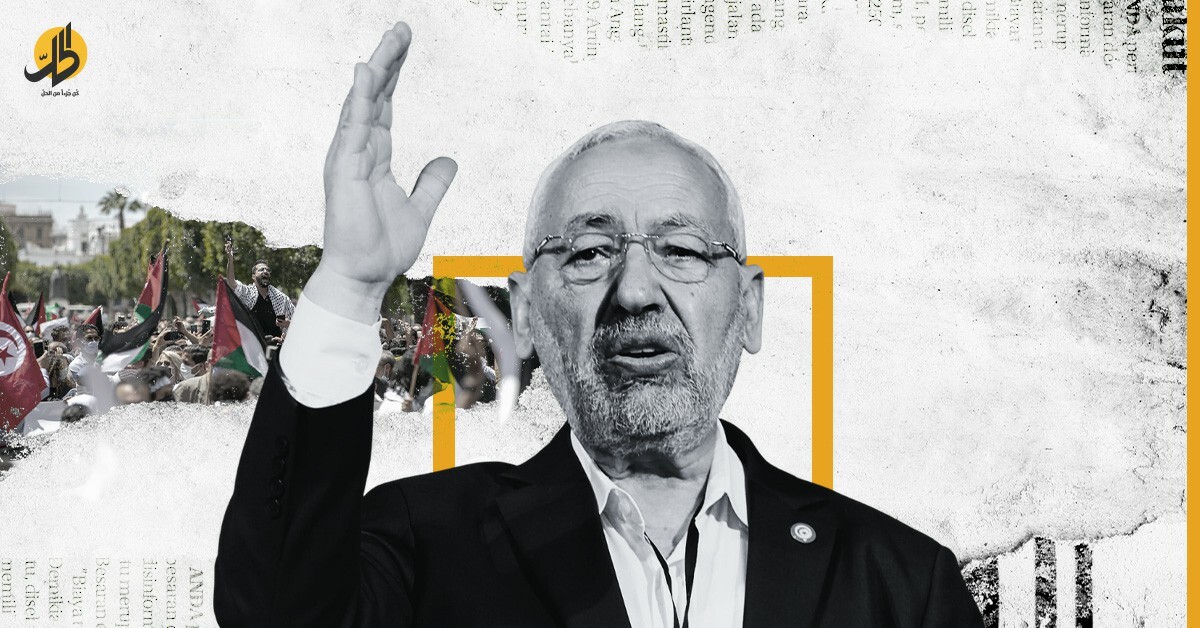
Ennahda has suffered successive blows from the regime of Tunisian President Kais Saied since the measures of July 25, 2021, and the decisions to arrest a number of the movement’s leaders, including acting head Mondher Ounissi and its historic leader Rached Ghannouchi. This prompted Ghannouchi, at the beginning of this month, to announce a hunger strike in support of a number of those arrested in the case of conspiring against state security, who made the same decision in an effort to bring the case back before public opinion and stir public sympathy. However, the course of events surrounding the Palestinian cause and the field conflict that erupted through Operation “Al-Aqsa Flood,” followed by the Israeli response through Operation “Iron Swords,” has given the Tunisian opposition represented by political Islamist groups a new ability to exploit the event in their favor and take to the streets without facing pressure from state security institutions, while conveying their arguments and perceptions to the public without harassment.
Moreover, this may place their political position alongside that of President Kais Saied, sending an indirect message about the possibility of a minimal understanding that could allow both sides to sit down once again and negotiate a political approach in the foreseeable future—while taking into account how difficult that would be, given that the Tunisian president’s mindset and decisions appear to have moved beyond such an option.
Returning to the Political Sphere
There is an urgent need to understand the fluidity of events in the Gaza Strip, the escalation scenarios that could open multiple theaters amid a tense regional environment and a troubled international system, and the grave risks and consequences this entails for the shape of the current regional order and the safeguards necessary for its stability—especially given Tehran’s direct involvement, as the Shiite version of political Islam, through a series of official statements by Foreign Minister Hossein Amir-Abdollahian, who operates according to the mullahs’ pragmatic and expansionist agenda. Tehran benefits from the multiplicity of political and military flashpoints, which eases direct pressure on it.
On the other hand, this also gives its ally Russia an opportunity to catch its breath and reshuffle its cards in its military conflict with Ukraine, the West, and the United States. It is also important to view the National Salvation Front’s engagement with these events in Tunisia as going beyond the region’s routine reflex of automatic sympathy with and support for the Palestinians.
However, this time the calls for demonstrations coincided with both popular and official hostility toward Ennahda and its leaders. Therefore, the National Salvation Front—the Islamist movement’s main political vehicle—and its head, Ahmed Najib Chebbi, hope to seize any populist opening that could bring them back into Tunisian political life, especially since the Front is keen to merge slogans related to Tunisia’s internal situation with the protest marches. This was evident in the repeated display of banners reading, “The revolution continues from Tunisia to Palestine,” and others saying, “From Tunisia to Palestine, loyal to the blood of the martyrs.”
This opportunistic ideological line can also be traced by closely examining the statement issued in the name of Ahmed Najib Chebbi, head of the National Salvation Front, and published by the movement on its official Facebook page at the outset of the operations launched by Hamas. The statement was filled with expressions of support and endorsement, in addition to explicit attacks on Arab-Israeli normalization. It deliberately ignored—true to the Islamists’ long-standing evasive style—the fact that Muslim Brotherhood organizations across the Middle East had, after the events of September 11, 2001, reached understandings with the United States on establishing normal relations with Israel. This places the statements and declarations issued amid escalating events in the realm of opportunistic instrumentalization and tactical maneuvering in pursuit of temporary goals that could be reversed at any moment. This is perhaps evident in the statement itself:
“The National Salvation Front follows with great pride and honor the extraordinary heroic feats being written by the valiant Palestinian resistance on the land of occupied Palestine in defense of Al-Aqsa and in support of the steadfast heroic Palestinian prisoners. What the occupied territories are witnessing in these immortal hours is a bright page in the record of Palestinian steadfastness and its heroic battles over more than seventy years, during which people, trees, and stones have paid the price for the cowardice of many Arab regimes, the complicity of some of them, and the rush toward normalization in exchange for scraps of aid or flimsy guarantees to perpetuate their stay in power …”
In support of the same line, the group known as the “Coordination of Families of Political Detainees,” in connection with what is known as the case of conspiring against state security, organized a solidarity evening for the Palestinian cause in the middle of this month under the telling title: “What is not achieved through resistance is achieved through more resistance.” It was a highly mobilizing formulation with a marked inclination toward violence.
Ennahda’s determination—through the National Salvation Front and its head Ahmed Najib Chebbi—not to miss the opportunity to invest in the Palestinian cause and its religious symbolism, to further the religious framing of the conflict, and to harness the state of mobilization filling Arab publics in a way that restores its political standing in the local and regional public sphere, is hardly different from its traditional positions over past decades. Yet in the foreseeable future, it is difficult to favor any scenario that would enable Ennahda to re-emerge in Tunisian politics without passing through several steps and stages that move beyond the movement in its original form and also beyond its first and historic leadership, represented by Rached Ghannouchi.
- How the Houthis Are Choking Yemen’s Peace Efforts with a Broad Escalation on the Ground
- Economy in the Wind: How Yemenis Are Paying the Price of Disrupted Shipping Routes
- Houthi Summer Centers: Factories for Indoctrination and Raising a “Scream” Generation
- The “Coalition of Necessity”: What Costa Rica’s Terrorism Designation of the Houthis Signifies
- Mojtaba Khamenei Runs Iran from His Bed as Photos Vanish and the Supreme Leader Makes a “Voice-Only” Appearance