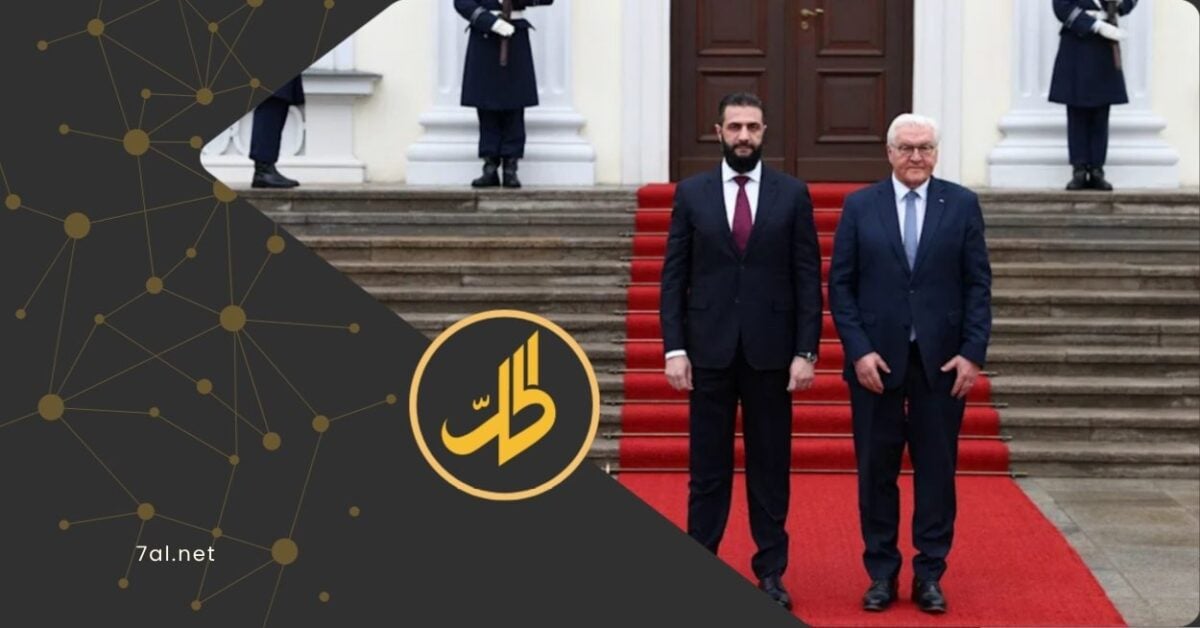
The visit of Syria’s transitional president, Ahmed al-Sharaa, to Berlin has raised questions about the aims of the trip. While the issue of returning Syrian refugees has come to the fore, political circles in Germany believe al-Sharaa is pursuing other objectives as well.
Although the visit clearly carried an official character, it also opened the door to debate within political and media circles.
Seeking Legitimacy and Reconstruction
Germany’s Bild newspaper believes that President al-Sharaa, who took power in Syria in December 2024 after the fall of the Assad regime, is working to build good relations with the West, driven by an urgent need for reconstruction funding.

The World Bank had estimated the cost of rebuilding Syria at around $216 billion, after more than 14 years of war that devastated the country and inflicted severe damage on infrastructure and the economy.
The newspaper says that “al-Sharaa’s appearance alongside German President Frank-Walter Steinmeier and Chancellor Friedrich Merz gives him an image closer to that of a recognized political leader, rather than a controversial figure.”
That appearance alongside the German president and chancellor could translate into financial support that al-Sharaa may receive from the European Union.
The newspaper attributed this shift to a striking change in his appearance, as he replaced military attire with a formal suit, signaling an attempt to recast himself. During the visit, he is also staying at the luxury Ritz-Carlton hotel, in a scene that reinforces the visit’s formal, protocol-driven nature.
The newspaper indicates that the immediate goal appears to be primarily economic. Through official meetings, alongside his participation in a German-Syrian economic meeting, the visit reflects an attempt to open channels of cooperation that could later translate into financial support for rebuilding the country.
Meanwhile, Germany’s Taz newspaper believes that this objective of the visit dominates all aspects of German policy toward Syria.
The newspaper adds that even the financial aid announced by Merz is aimed primarily at pushing as many Syrians as possible to leave, or deporting them, as the chancellor admits almost explicitly.
The newspaper concludes that the idea is this: if living conditions in Syria improve, it will be easier to strip Syrians living here of their protection status.
A Contradiction Between Berlin’s Values and al-Sharaa
Germany’s Die Welt said that al-Sharaa’s reception by the highest representatives of the German state appears cynical to liberal Syrians here in Germany.
The newspaper says that the controversial statements made by Steinmeier regarding the Iran war and Gaza last week were not enough; he went even further, warmly shaking the bloodstained hands of Syria’s new president, Ahmed al-Sharaa. This is in line with the congratulatory cables Steinmeier had previously sent to hardline Islamists in Iran, which at the time had sparked a wave of astonishment.
The newspaper also conveyed broader criticism, describing the scene as “the wrong signal,” in reference to what it considered a contradiction between the values Berlin proclaims and the nature of the figure it is receiving.
The newspaper added that recognizing al-Sharaa could encourage other extremists to win civil wars with greater brutality, then quickly seek recognition from Western democracies.
The newspaper noted that after the fall of the Assad regime, al-Sharaa’s forces killed thousands of people and committed numerous killings of women and massacres against minorities.
Returning 80 Percent in 3 Years
German Chancellor Friedrich Merz said on Monday that Berlin and Damascus would work together to return hundreds of thousands of Syrian refugees, who have an important role in rebuilding their country, as he put it.
Merz added at a press conference after a meeting in Berlin with al-Sharaa that many Syrian refugees have made major contributions in Germany, but that most of them want to return to their homes.
He explained that about 80 percent of Syrians in Germany, where between 700,000 and 800,000 are seeking asylum, are expected to return to their country over the next three years.
He stressed that priority would be given to “those who have lost the right to lawful residence,” noting that this applies in particular to perpetrators of crimes.
Reuters said that Merz’s coalition government imposed stricter controls when it took office last year, amid growing support for the anti-immigration Alternative for Germany party, following former Chancellor Angela Merkel’s decision to accept around one million asylum seekers from countries including Syria and Afghanistan.
Merz said Germany wants to support the reconstruction process in Syria and is working with the government in Damascus to help those wishing to return.
Merz confirmed that “over the past few weeks, we have drawn up an ambitious joint action program for reconstruction and return, and it is now being implemented.”
- How the Houthis Are Choking Yemen’s Peace Efforts with a Broad Escalation on the Ground
- Economy in the Wind: How Yemenis Are Paying the Price of Disrupted Shipping Routes
- Houthi Summer Centers: Factories for Indoctrination and Raising a “Scream” Generation
- The “Coalition of Necessity”: What Costa Rica’s Terrorism Designation of the Houthis Signifies
- Mojtaba Khamenei Runs Iran from His Bed as Photos Vanish and the Supreme Leader Makes a “Voice-Only” Appearance