

Jordan’s Ministry of Industry, Trade and Supply announced on Wednesday, 1 April 2026, a new set of decisions regulating the entry of Syrian goods into the Jordanian market, marking a notable shift in trade policy between the two countries. The measures included lifting previous restrictions that had limited imports, while imposing protective duties on a number of products.
At the same time, Syrian business circles welcomed the step, while expressing reservations about the level of the duties imposed.
Lifting restrictions while imposing customs duties
Jordan’s Ministry of Industry, Trade and Supply issued Decision No. 34 of 2026, based on directives from the Prime Ministry and recommendations from the Economic Modernization and Development Committee, according to Roya News. The decision stipulates the cancellation of a package of previous decisions issued in 2019, 2020, 2021, and 2025, which had imposed restrictions on the import of Syrian products into the kingdom.
Alongside this opening, the Jordanian authorities imposed protective customs duties on a specified list of Syrian goods, with a clear focus on the food industries and textiles sectors. These duties are intended to protect Jordanian domestic products from competition and regulate the market in a way that ensures national industries are not harmed, as part of a policy balancing trade liberalization with the requirements of economic protection.
Syrian welcome and reservations over the duties
The Damascus Chamber of Commerce described the Jordanian decision as a positive step that would support bilateral economic relations and revive Syrian exports, especially with the decision to allow the entry of goods that had previously been subject to bans or restrictions. In a statement issued Wednesday through its official channels, the chamber noted that it had repeatedly called for reopening the Jordanian market through meetings with the Jordanian ambassador in Damascus and the head of the Jordan Chambers of Commerce Federation, in addition to raising the issue directly with the Jordanian industry minister during an economic forum held in the kingdom.
Despite this welcome, the chamber expressed clear reservations about the duties imposed, considering them “very high,” which could limit the actual benefit of the decision. It stressed that it would continue pursuing the matter through official channels and in coordination with the Jordanian side. It also called on traders and exporters to study the details of the decision carefully and work with the relevant authorities to ensure the best possible gains under the new circumstances.
Record growth in bilateral trade
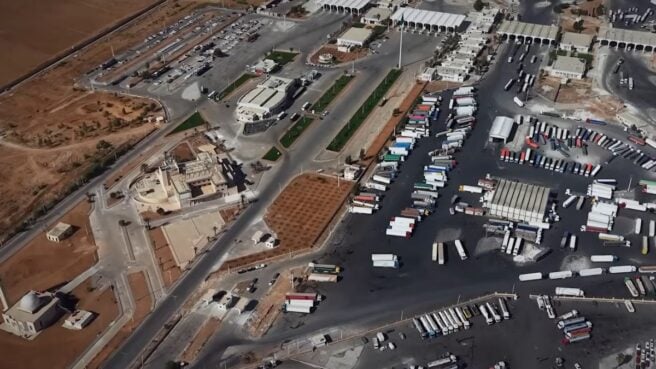
The decision coincides with a noticeable rise in the volume of trade between the two countries. Data from Jordan’s Department of Statistics, cited by the Petra News Agency, showed that Jordanian exports to Syria reached $217.5 million, compared with $45 million during the same period last year. Jordanian imports from Syria also rose to about $90 million, up from $52.5 million, a growth rate of 71.4%, bringing total trade to $330 million after it had been only $97.5 million in the corresponding period, according to Enab Baladi.
Jordanian exports to Syria included a wide range of goods, among them construction materials and construction-related products such as cement, iron, marble, tiles, paints, pipes, and electrical equipment, in addition to food and agricultural products and chemical products.
Transport challenges
Cross-border transport between the two countries became strained after the Syrian General Authority for Border Crossings and Customs decided on 7 February to ban the entry of non-Syrian trucks and impose a “transshipment” system inside customs yards, prompting Jordanian objections because of the increased costs, which ranged between $500 and $800 per truck, in addition to losses caused by delays. The Damascus Chamber of Commerce also warned of the risks of goods being damaged and of increased insurance and operating burdens as a result of repeated loading and unloading operations.
Later, the two sides reached an understanding allowing the reciprocal entry of trucks, on condition that each carry only goods originating from its own country, without resorting to the “transshipment” system, in what was considered a step aimed at facilitating the flow of goods and speeding delivery to markets in both countries.
- How the Houthis Are Choking Yemen’s Peace Efforts with a Broad Escalation on the Ground
- Economy in the Wind: How Yemenis Are Paying the Price of Disrupted Shipping Routes
- Houthi Summer Centers: Factories for Indoctrination and Raising a “Scream” Generation
- The “Coalition of Necessity”: What Costa Rica’s Terrorism Designation of the Houthis Signifies
- Mojtaba Khamenei Runs Iran from His Bed as Photos Vanish and the Supreme Leader Makes a “Voice-Only” Appearance