It is through Syria, not Saudi Arabia, that Iran has pinned its hopes on breaking the blockade imposed on it for many years, politically and economically. Its military intervention in the Syrian issue has produced several forms of expanded Iranian influence across a number of countries in the region. At present, Iran seems to believe it has entered a phase of reaping the rewards of its patience and of withstanding the confrontations it faced at various levels over recent years in the countries where it spread chaos, starting with Syria, whose crisis has its own particular characteristics compared with other Arab crisis states.
Although the meeting between the Iranian foreign minister and Saudi Crown Prince Mohammed bin Salman in the middle of this month was followed by positive Iranian statements meant to signal that the Iranian-Saudi rapprochement, brokered by China last March, is proceeding well, the two sides’ priorities differ, even if they overlap on some issues that matter more to Iran. What matters most to Saudi Arabia at present is protecting its southern border and putting an end to the encroachments of the Iran-backed Houthi group.
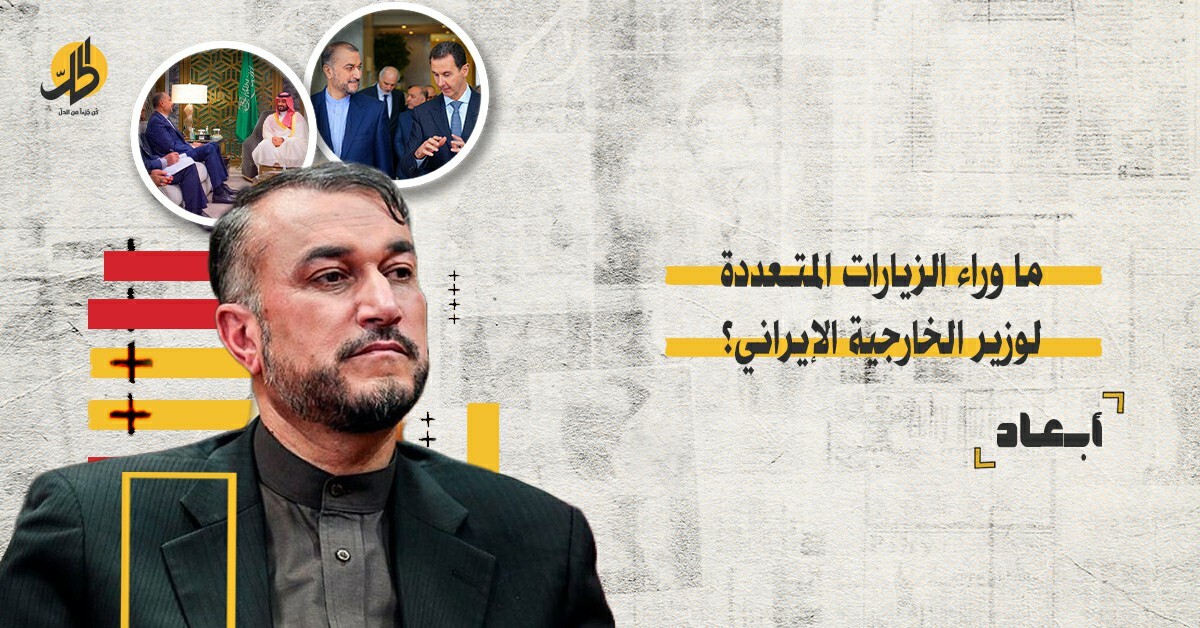
The Iranian foreign minister’s visits to countries in the region, beginning with Saudi Arabia and extending to Syria and then Lebanon, carry several dimensions.
Syria’s importance to Iran is not limited to its strategic location for Iranian influence in neighboring countries, as it forms a link between Lebanon and Iraq. It is also an influential base for Iran’s project of destabilizing the region, given Syria’s proximity to the Israeli border, and an additional base for Iranian presence near Saudi Arabia and the Gulf states.
The visit by Iranian President Ebrahim Raisi last May revealed Iran’s desire to exploit Syria as a future financial resource through the potential Arab rapprochement, which Iran appears to have been cultivating and then reinforcing by claiming good intentions in reaching an understanding with Saudi Arabia. This was followed by Syrian Foreign Minister Faisal Mekdad’s trip to Tehran and the signing of executive agreements. Iranian media then reported that Abdollahian would arrive in Damascus again at the end of the current week to discuss implementation of the latest agreements, especially the establishment of an Iranian bank in Syria, in addition to accelerating the actual launch of Syria’s third mobile telecom operator, which is under Iranian influence, according to sources speaking exclusively to Al-Hal Net.
The timing of the Iranian foreign minister’s dual visit to Syria and Lebanon reveals Iran’s ambitions to leverage its public rapprochement with Saudi Arabia by benefiting from the positive mood surrounding the Arab initiative on Syria, in the hope of attracting reconstruction funds, even if this is not simply a Saudi favor granted at Iran’s request.
Iran wants to treat Syria as a financial resource for itself, and it also wants to extend this project to Lebanon, which has been mired in economic crisis since 2019 and has, naturally, both affected and been affected by successive political crises. Thus, Abdollahian will base his visit on the sole meeting with Prince Mohammed bin Salman, relying on Riyadh’s blessing—at least so far—for continued work on the Jordanian-Arab initiative toward Syria, while also taking advantage of Saudi Arabia’s positive disposition toward supporting political stability, opening the door to economic support, and rescuing Iran’s suffocated lifeline in Lebanon, represented by Hezbollah.
In practical terms, Saudi Arabia views relations with Iran with caution and suspicion. The seven-year rupture was preceded by negative circumstances and factors between the two countries that led to the break. Therefore, Saudi Arabia’s opening of an initial window of engagement with Iran does not mean it is taking a deep step toward establishing positive mutual relations. What Riyadh hopes for—and on this it may align with its ally Washington—is the permanent end of Houthi threats and the consolidation of stability in Yemen. That will be the real test for Iran, and Tehran does not appear capable of meeting it, especially since the mullahs’ regime came to power in Iran and has long been accustomed to spreading tension and unrest throughout the region.
Finally, the ultimate arbiter of how developments involving Iran in the region will unfold is the American factor, the close ally of the Gulf states. Even if some believe these states are seeking to create economic stability through a political approach different from that of previous decades, the American presence will remain the key determinant of what happens.
- “Dimensions” is a weekly/periodic political analysis column written by Malek al-Hafez, editor-in-chief of Al-Hal Net.